

Fish identification archive / Cherubfish
Cherubfish
Centropyge argi
Fun facts for your next surface interval
Florida and local context
REEF's cumulative citizen-science diver survey report lists Centropyge argi at Juno Ledge. This is a historical reported occurrence, not an independently reidentified voucher or an encounter guarantee. Other supplied named-site reports are preserved in the observations list. Reports cover 1/1/93–11/10/26; historical occurrence does not establish present abundance or guarantee a sighting.
A documented past record does not establish present abundance or guarantee an encounter.
How to recognize this animal
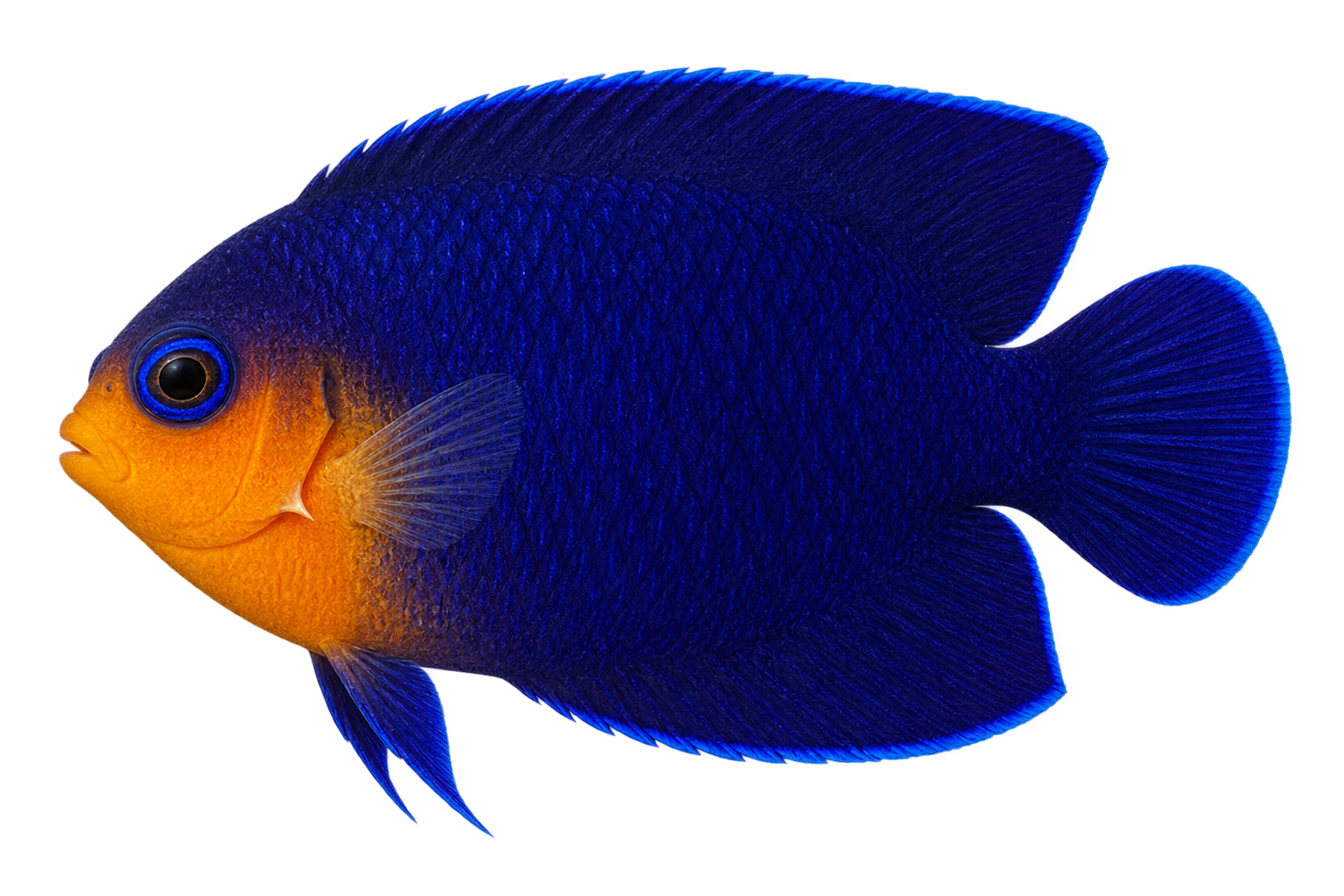
A tiny, deep-blue angelfish with a yellow-orange lower face and chest and a blue ring around the eye. The body is oval and flattened, with a short blunt snout.
Sources: Smithsonian Tropical Research Institute: Cherubfish
Size and life stages
The regional account gives about 5 cm (2 inches) as the maximum. Its small size is normal for this angelfish, not proof that it is a juvenile of a larger species.
Sources: Smithsonian Tropical Research Institute: Cherubfish
Habitat and where to look
Found on coral and rubble bottoms. The source says records are usually below 30 m, but this is not a reason to exceed your dive plan or training.
Sources: Smithsonian Tropical Research Institute: Cherubfish
Range and local context
The account extends from North Carolina to the southern Caribbean. Local presence is documented only by the supplied named-site reports, not by assumed continuous occupation of that range.
Sources: Smithsonian Tropical Research Institute: Cherubfish
What is on the menu?
The ecological report classifies it as herbivorous and lists benthic microalgae. Watch for picking at surfaces rather than assuming it is cleaning another fish or eating coral. Do not supply food to obtain a photograph.
Daily habits and behavior
A bottom-associated reef fish according to the compiled account. Search slowly without moving rubble. Local daily activity, territory size and group structure were not established by the sources reviewed for this draft.
Mating and the next generation
The source lists pelagic eggs and larvae. No local spawning season, clutch size or sex assignment is inferred from those categories. Color and a single size estimate do not establish the reproductive role of an observed fish.
Look-alikes and identification traps
Compare other small angelfishes, especially Centropyge aurantonotus and young rock beauties. Confirm the blue body, orange lower head and chest, and blue eye ring together rather than using small size alone.
Sources: Smithsonian Tropical Research Institute: Cherubfish
Observe without disturbing
Photograph from outside shelter and never lift rubble to expose a fish. If the animal repeatedly disappears after your approach, back away and let it resume normal activity. Leave all surrounding habitat in place.
Sources: Smithsonian Tropical Research Institute: Cherubfish
Harvest, protection and eating safety
Live-only ornamental collection; closed sites apply
Yellow denotes conditional live ornamental collection, never food harvest. Closed collection sites override statewide bag allowances. No year-round open season is inferred from the absence of dates.
This color is a qualified summary, not permission to collect or a guarantee that a particular animal is safe to eat.
Can it be hunted or harvested?
Centropyge argi falls within angelfishes, family Pomacanthidae. Florida recreational marine-life rules require live landing and continued live maintenance with suitable circulation, aeration or oxygenation. Where collection is lawful, the normal limit is five of a species within 20 total marine-life organisms per person daily; two-day possession is ten of a species within 40 total. A recreational saltwater license is required unless exempt; recreational sale is prohibited. The angelfish limit is five angelfish combined per person daily, within that aggregate. Do not assign Pomacanthus or Holacanthus size slots to Centropyge argi; no Centropyge size slot is stated in the reviewed table.
Florida seasons and areas
Florida marine-life requirements also apply in adjacent federal waters. Listed marine-life collection is prohibited in the mapped Blue Heron Bridge Special Marine Life Area, not throughout Palm Beach County. Pennekamp prohibits tropical-fish collection. Biscayne National Park prohibits ornamental collection except under a valid superintendent-issued collecting permit. This is not permission to seek or use such a permit. Check the exact site, not just the county. Florida Keys Sanctuary Preservation Areas prohibit fishing and collection, subject to specifically stated exceptions; the Key Largo Management Area separately prohibits tropical-fish take and spearfishing. Biscayne National Park has additional rules, including a mapped March 1–May 31 fishing closure effective in 2026. These are not whole-county bans.
Can it be speared?
Do not spear this live-only marine-life species. Use only authorized nonlethal collection methods where collection is permitted. Location restrictions still apply: spearfishing is prohibited in Monroe state waters from Long Key, including Long Key, north to the Miami-Dade line. This state-water restriction is separate from the Key Largo Management Area prohibition. Florida also restricts spearfishing around swimming beaches, fishing piers/bridges, jetties and state parks; federal water alone is not permission to spear in a closed sanctuary zone.
Is it safe to eat?
Not a recreational food-harvest fish under these live-only rules. No recipe, preparation method or food-safety clearance is provided. A harvest allowance is not a food-safety clearance. Check current Florida Department of Health advice for the capture location, species and person eating the fish. This review establishes no meal frequency and no local restaurant menu match.
This review covers the Vero Beach–Key Largo Atlantic corridor: Indian River, St. Lucie, Martin, Palm Beach, Broward, Miami-Dade and Monroe counties. Florida Atlantic state waters and South Atlantic federal waters are distinct jurisdictions. Do not extend a state-water season tag to federal waters or transfer Atlantic rules to Gulf-side Keys waters. Park and sanctuary boundaries can override a species allowance.
Before you act: Confirm the species, date, exact management area, state or federal waters, gear, licenses and current local closures. A local occurrence record never grants permission to take an animal.
Official rules and health guidance
- FWC: recreational marine-life species, live handling and limits
- Florida rule 68B-42.001: marine-life species; current rule landing page
- Florida rule 68B-42.0036: closed marine-life areas
- Florida State Parks: Pennekamp tropical-fish collection and spearing prohibition
- NPS: Biscayne ornamental marine-life collection prohibition and permit exception
- FWC: species and location spearing restrictions
- NOAA: Monroe state-water spearing boundaries
- NOAA: current Florida Keys sanctuary zone guide
- NOAA: Key Largo Management Area tropical-fish and spearing restrictions
- NOAA: Sanctuary Preservation Area fishing and collecting restrictions
- FWC: Biscayne National Park aggregate limits and mapped seasonal closure
- Florida Department of Health: seafood toxins
- Florida Department of Health: local consumption advisories
Reviewed 2026-11-11. Rules and advisories can change; check the linked authorities before acting.
Identification and source cautions
- Survey records are citizen-science reports, not independently reidentified vouchers; report frequency is not a current encounter probability.
- Detailed local reproductive timing and site-specific diet have not been established.
Sources and review
Biology and taxonomy reviewed 2026-11-11. Photographs on cited sites are reference material and are not reproduced here.
- Smithsonian Tropical Research Institute: Cherubfish
- Smithsonian: species ecological data report
- WoRMS: accepted taxonomy
- REEF cumulative diver-survey report: Juno Ledge
- REEF cumulative diver-survey report: Spiegel Grove Wreck
- REEF cumulative diver-survey report: Breakers Reef
- REEF cumulative diver-survey report: French Reef
- REEF cumulative diver-survey report: Carysfort Reef Ball 1
- REEF cumulative diver-survey report: Boynton Ledge
- REEF cumulative diver-survey report: Blue Heron Bridge (WPB), Phil Foster Park
Make your next dive happen
Dive With Us
Explore local charters and plan a dive suited to your experience.
View dive calendarTrain With Us
Build your fish identification, buoyancy and diving skills.
Explore trainingTravel With Us
Discover upcoming dive adventures and trip details.
Explore dive travelShop With Us
Browse equipment for your diving and ask our team for help choosing.
Explore dive gearReview current dates, availability, prices, inclusions and requirements on each listing before booking or buying.
Call us now
Ask about marine life identification
Marine Life Identification
Ask about dates, prerequisites or your next step. An inquiry does not reserve a place. Please provide your own contact details; do not include medical, payment or a child's personal information.
We use these details to respond to your inquiry. This form does not sign you up for marketing.
Explore more with Stuart Scuba
Open Water course options · Advanced Adventure training · Technical training · Professional training · All courses · Local dives · Dive trips · Facebook · Instagram · YouTube
Your surface-interval essentials
Questions for Stuart Scuba? info@stuartscuba.com
Check the Stuart Scuba Weather Center · Play scuba trivia
Weather and wildlife vary. Confirm current conditions, trip requirements and departure details with the operator.
Plan Your Next Dive with Stuart Scuba
Dive With Us
Explore upcoming local charters and choose a dive that fits your experience.
Before you book
Check the individual listing for departure time, requirements and availability.
Travel With Us
Find upcoming dive adventures and start planning your next trip.
Plan your trip
Review dates, inclusions and trip details on the travel calendar.
Stay Connected with Stuart Scuba
 Follow pageShare
YouTube
SubscribeWatch & shareFollow on InstagramView & share post
Follow company news, training updates, and dive stories.
Follow on LinkedInGoogle Reviews
See Stuart Scuba’s current Google rating and review count below. Open the listing in Google Maps to browse customer reviews.



