

Fish identification archive / Checkered Puffer
Checkered Puffer
Sphoeroides testudineus · Tetraodontidae
I saw this
Spotted this fish? Share the guide with your dive buddies. Review your caption before posting.
For Instagram, copy the caption and link into your own post or message. Nothing is posted automatically and this does not record a verified sighting.
Recognizing the fish
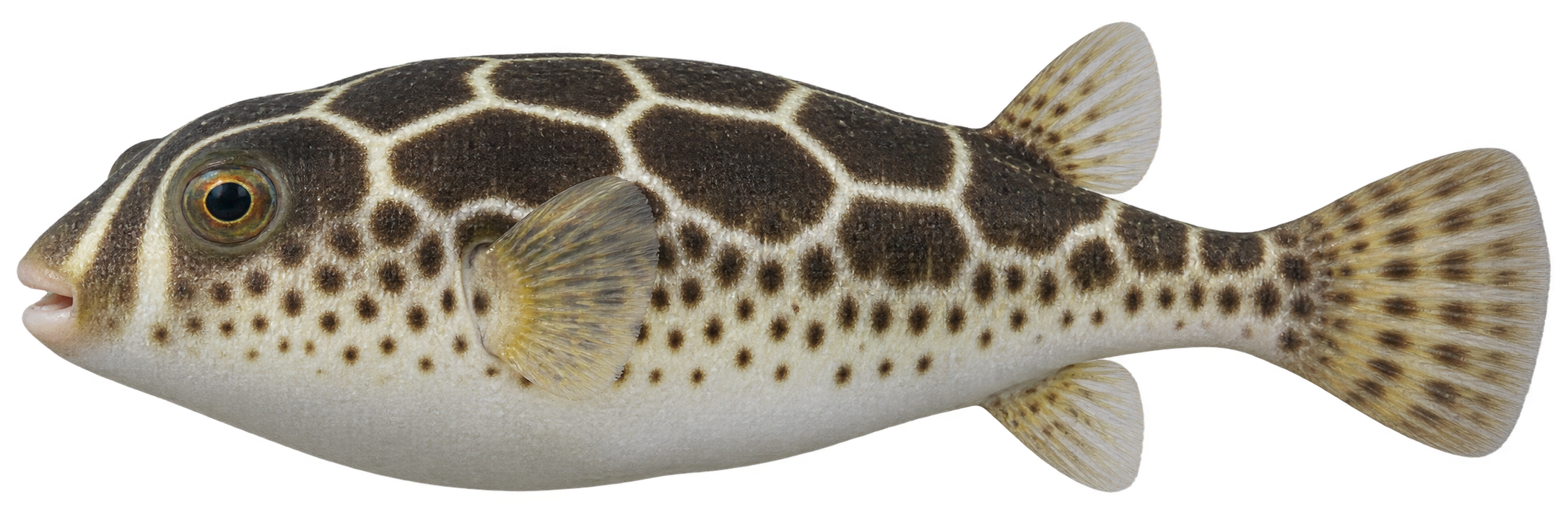
The checkered puffer wears its best identification clues across its back. Pale lines and curves divide darker areas into a bold geometric pattern, often accompanied by pale crossbars between the eyes. Its lower sides are spotted, and the belly is lighter. Look for this combination rather than expecting every individual to show identical colors. FAO western Atlantic puffer guide, page 2004.
The body is thick, with a blunt head and a small but powerful beak. The dorsal and anal fins sit well toward the rear, and there are no pelvic fins. Its tiny embedded prickles are very different from the long, obvious spines of a porcupinefish. A normal, uninflated fish gives the most useful view of its proportions.
Compare it carefully with southern and bandtail puffers. Spotted sides alone are insufficient; the arrangement of pale markings over the head and back matters. The bandtail puffer also has characteristic tail bands and small skin flaps that a checkered puffer lacks. Smithsonian checkered-puffer account.
Southeast Florida habitat
Biscayne National Park reports this species in its fish checklist. That confirms regional occurrence, not a promise of sightings at any particular beach, bridge or reef. Biscayne fish checklist.
Shallow estuarine and mangrove-associated water, especially over sand or mud, suits this coastal puffer. Its strong jaws are useful for eating shell-bearing prey. The combination of shallow habitat and cryptic pattern makes slow observation more productive than pursuing a fish after it swims away. The Smithsonian data also distinguish bottom-associated eggs from larvae that enter the water column. Smithsonian biology summary.
Important Florida restrictions
FWC prohibits taking puffers of the genus Sphoeroides in the waters of Volusia, Brevard, Indian River, St. Lucie and Martin counties. This includes the checkered puffer and directly affects the northern part of this guide’s corridor. The restriction is geographic, not a claim that the species is prohibited everywhere in Florida. FWC also lists pufferfish collection as prohibited in John Pennekamp Coral Reef State Park. FWC puffer prohibition; FWC marine-life rules.
Do not interpret a location outside those counties as permission to collect or eat one. FWC warns that puffer poisoning can be fatal and that cooking does not destroy the toxin.
Responsible observation
Never squeeze, handle or chase a puffer to make it inflate. Keep the fish underwater and let it choose its distance. Photograph the back and sides without blocking its escape route, and leave any uncertain identification unresolved rather than handling the animal to examine it.
Current Florida collection cautions
Reviewed November 12, 2026. Taking Sphoeroides puffers is prohibited in Volusia, Brevard, Indian River, St. Lucie and Martin county waters. Pufferfish collection is also prohibited in John Pennekamp Coral Reef State Park. Elsewhere is not automatically open: marine-life requirements and local closures still apply, including the defined Blue Heron Bridge dive-site closure. Do not eat pufferfish; FWC warns that saxitoxin poisoning can be fatal and neither cooking nor cleaning destroys the toxin. Official FWC puffer prohibition and poisoning warning Official FWC marine-life requirements
Blue Heron Bridge report
REEF’s Blue Heron Bridge / Phil Foster Park survey report includes Checkered puffer among species reported at this site. The cumulative volunteer survey record is not a guarantee of a sighting or evidence of current abundance. Blue Heron Bridge (BHB) is a Riviera Beach dive site at Phil Foster Park. Site-specific observation source.
Make your next dive happen
Dive With Us
Explore local charters and plan a dive suited to your experience.
View dive calendarTrain With Us
Build your fish identification, buoyancy and diving skills.
Explore trainingTravel With Us
Discover upcoming dive adventures and trip details.
Explore dive travelShop With Us
Browse equipment for your diving and ask our team for help choosing.
Explore dive gearReview current dates, availability, prices, inclusions and requirements on each listing before booking or buying.
Call us now
Ask about fish identification training
Reef Fish Identification
Ask about dates, prerequisites or your next step. An inquiry does not reserve a place. Please provide your own contact details; do not include medical, payment or a child's personal information.
We use these details to respond to your inquiry. This form does not sign you up for marketing.
Explore more with Stuart Scuba
Open Water course options · Advanced Adventure training · Technical training · Professional training · All courses · Local dives · Dive trips · Facebook · Instagram · YouTube
Your surface-interval essentials
Questions for Stuart Scuba? info@stuartscuba.com
Check the Stuart Scuba Weather Center · Play scuba trivia
Weather and wildlife vary. Confirm current conditions, trip requirements and departure details with the operator.
Plan Your Next Dive with Stuart Scuba
Dive With Us
Explore upcoming local charters and choose a dive that fits your experience.
Before you book
Check the individual listing for departure time, requirements and availability.
Travel With Us
Find upcoming dive adventures and start planning your next trip.
Plan your trip
Review dates, inclusions and trip details on the travel calendar.
Stay Connected with Stuart Scuba
 Follow pageShare
YouTube
SubscribeWatch & shareFollow on InstagramView & share post
Follow company news, training updates, and dive stories.
Follow on LinkedInGoogle Reviews
See Stuart Scuba’s current Google rating and review count below. Open the listing in Google Maps to browse customer reviews.



