

Fish identification archive / Chain Pipefish
Chain Pipefish
Syngnathus louisianae · Syngnathidae
I saw this
Spotted this fish? Share the guide with your dive buddies. Review your caption before posting.
For Instagram, copy the caption and link into your own post or message. Nothing is posted automatically and this does not record a verified sighting.
Recognizing the fish
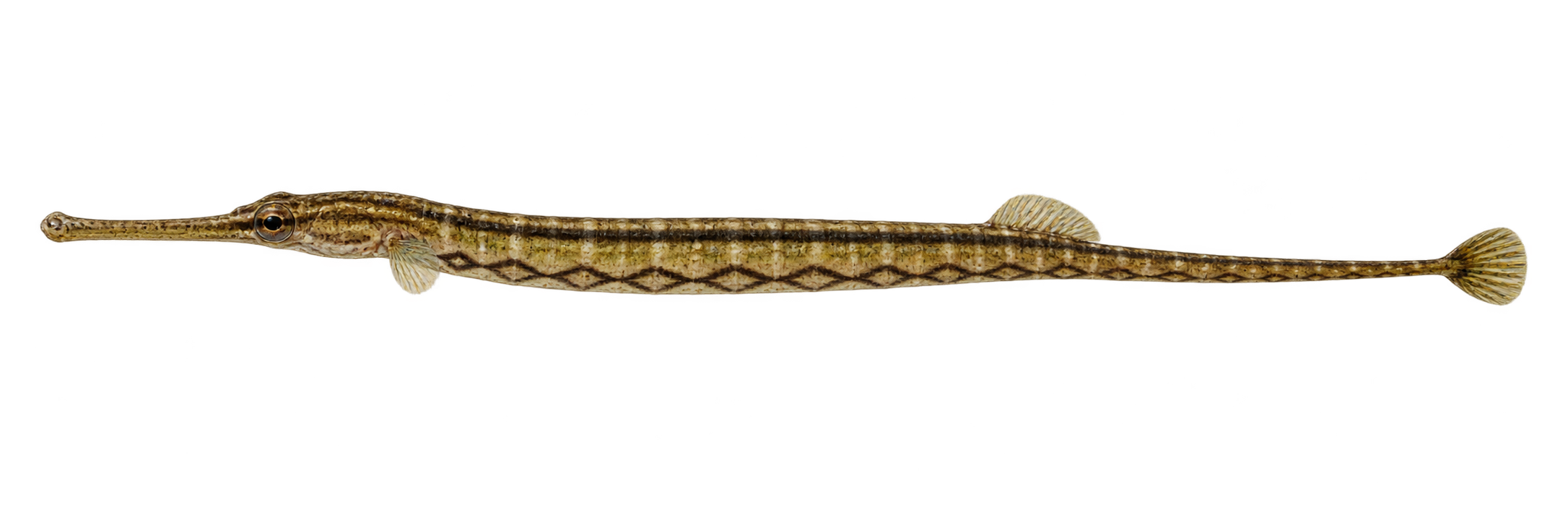
The chain pipefish has an exceptionally long, slender snout and a narrow body supported by rings of bony plates. Its outline can resemble a stem more than a typical fish. A small dorsal fin rises from the trunk, and the tail ends in a fin rather than the gripping curl associated with a seahorse. There are no pelvic fins or decorative skin flaps. Smithsonian chain-pipefish account.
A dark stripe above body bars and darker diamond-like markings below can create a chain-like impression, but the pattern is variable. Compare the proportions as well as the markings. Dusky pipefish can look similar, yet tend to have a deeper trunk and a broader triangular bony area in front of the eye. The chain pipefish has a narrower bony bar there. Ring and fin-ray counts may be needed when photographs leave the identification uncertain. Smithsonian pipefish comparison guide.
A close view is not a reason to capture or manipulate the animal. If the snout and body details are hidden, recording an unidentified pipefish is a sound result.
Southeast Florida occurrence
The National Park Service lists chain pipefish among fishes reported in Biscayne National Park. Farther north, Florida Museum’s Lake Worth Lagoon checklist marks the species as documented and provides multiple observer references. Together these support its inclusion in a Vero Beach–Key Largo field guide. They do not demonstrate current abundance or guarantee an encounter at a named dive site. Biscayne fish checklist; Florida Museum’s lagoon fish records.
These coastal records are a useful reminder to look beyond large reef fishes. Careful observation of the habitat around a small fish can also make a later identification more reliable, provided the habitat is recorded as context rather than used as proof of species.
Food and reproduction
Small crustaceans, particularly amphipods, are important prey. The narrow snout ends in a small mouth suited to feeding at this scale. As in related pipefishes, the male carries eggs in a brood pouch beneath the tail until the young are ready to emerge. FishBase biology account and references.
Protecting the encounter
Keep hands, fins and dangling equipment away from vegetation and the bottom. Avoid chasing the fish, lifting it out of the water or placing it against a plain background. Photograph its full length where it is.
Florida regulates pipefishes as marine-life fish. Check the current FWC marine-life rules and any local closures before collection. The species name and a published locality record are not harvest permission.
Current observation and collection guidance
Checked November 12, 2026: Florida includes pipefishes in its regulated marine-life fish list. Collection is subject to licensing, permitted gear, live-condition and life-support requirements, and applicable limits. The Blue Heron Bridge dive site is closed to marine-life harvest within its designated boundaries. Check park, sanctuary and other local restrictions before any collection; an occurrence record is not permission to remove an animal. Biscayne National Park fish checklist FWC marine-life collection regulations Florida Museum Lake Worth Lagoon fish checklist
Blue Heron Bridge report
A November 2010 REEF report by Mike Phelan records chain pipefish at Blue Heron Bridge (BHB). This historical report does not establish current abundance or guarantee a sighting. Site-specific observation source.
Make your next dive happen
Dive With Us
Explore local charters and plan a dive suited to your experience.
View dive calendarTrain With Us
Build your fish identification, buoyancy and diving skills.
Explore trainingTravel With Us
Discover upcoming dive adventures and trip details.
Explore dive travelShop With Us
Browse equipment for your diving and ask our team for help choosing.
Explore dive gearReview current dates, availability, prices, inclusions and requirements on each listing before booking or buying.
Call us now
Ask about fish identification training
Reef Fish Identification
Ask about dates, prerequisites or your next step. An inquiry does not reserve a place. Please provide your own contact details; do not include medical, payment or a child's personal information.
We use these details to respond to your inquiry. This form does not sign you up for marketing.
Explore more with Stuart Scuba
Open Water course options · Advanced Adventure training · Technical training · Professional training · All courses · Local dives · Dive trips · Facebook · Instagram · YouTube
Your surface-interval essentials
Questions for Stuart Scuba? info@stuartscuba.com
Check the Stuart Scuba Weather Center · Play scuba trivia
Weather and wildlife vary. Confirm current conditions, trip requirements and departure details with the operator.
Plan Your Next Dive with Stuart Scuba
Dive With Us
Explore upcoming local charters and choose a dive that fits your experience.
Before you book
Check the individual listing for departure time, requirements and availability.
Travel With Us
Find upcoming dive adventures and start planning your next trip.
Plan your trip
Review dates, inclusions and trip details on the travel calendar.
Stay Connected with Stuart Scuba
 Follow pageShare
YouTube
SubscribeWatch & shareFollow on InstagramView & share post
Follow company news, training updates, and dive stories.
Follow on LinkedInGoogle Reviews
See Stuart Scuba’s current Google rating and review count below. Open the listing in Google Maps to browse customer reviews.



