

Fish identification archive / Cero mackerel
Cero mackerel
Scomberomorus regalis
Fun facts for your next surface interval
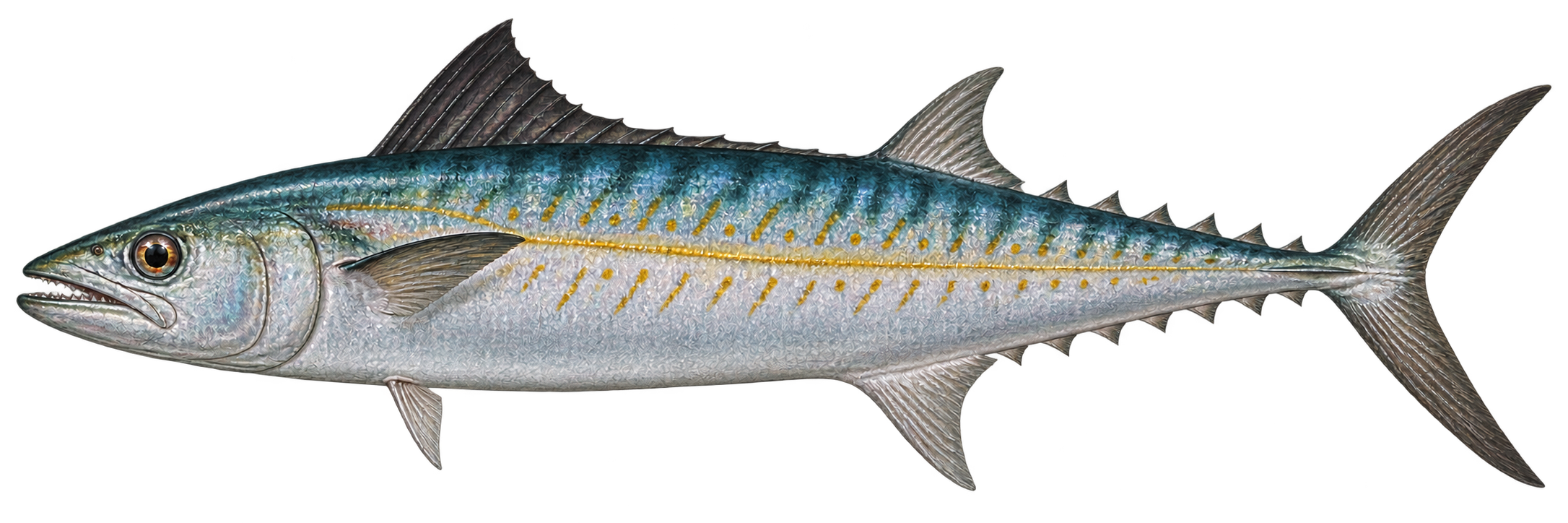
- The gold-line clue: A gold side stripe helps distinguish cero from spotted Spanish mackerel.
- A row of little fins: Small finlets run toward the tail on both the upper and lower sides.
- Look up from the reef: Cero can pass over reefs in open water instead of occupying reef crevices.
Florida and local context
Reported in REEF diver surveys at Blue Heron Bridge (WPB), Phil Foster Park. Cumulative survey records document occurrence, not a guaranteed encounter or present-day abundance.
Documented regional presence is not a guarantee of an encounter or a measure of how common this animal is at your dive site.
How to recognize this animal
Cero is a streamlined silver mackerel with a blue-green back, small yellow to orange spots and a bronze-gold line along the middle of the flank. That stripe may be broken rather than perfectly continuous. Finlets follow both the second dorsal and anal fins, leading toward a narrow tail base and deeply forked tail. The front portion of the first dorsal is dark. A complete side view is much more useful than a silver flash.
Size and life stages
FWC lists cero up to 36 inches, about 91 cm, and Smithsonian reports 89 cm. Published maximum-size figures differ: the ICCAT manual also cites a report of 183 cm total length, about six feet, and separately reports 83.5 cm fork length. Fork length and total length are different measurements and should not be substituted for one another. The three-foot figures provide source-specific size context, not a confirmed maximum for every population or an expected encounter size.
Habitat and where to look
Cero move through open water near reefs, wrecks and ledges, often above the bottom rather than inside reef shelter. FWC describes nearshore and offshore habitat. A diver looking only into coral crevices may miss this fish passing beyond the reef edge. Stay with the planned route instead of following a fast-moving mackerel away from the group.
Range and local context
Cero occur in the western Atlantic from Massachusetts to Brazil. FWC explicitly describes the species as common in South Florida, a stronger regional statement than a range map alone. It still does not guarantee a sighting on a specific Palm Beach or Stuart outing, nor establish equal abundance at every reef and wreck. Reported in REEF diver surveys at Blue Heron Bridge (WPB), Phil Foster Park. Cumulative survey records document occurrence, not a guaranteed encounter or present-day abundance.
What is on the menu?
Small fishes are important prey, including schooling herrings and silversides; squid and shrimp are also reported. This is an active water-column predator. Its form is suited to moving through open water, but a simple sighting does not demonstrate a chase or reveal which prey are being taken. Record visible feeding only when the action itself can be followed.
Daily habits and behavior
Cero can travel alone or in small groups. An individual may pass through a diver's view briefly, making a whole-body photograph valuable even if it is less close than a portrait. Watch for the gold stripe as the fish turns broadside. Because a dark first dorsal also occurs in Spanish mackerel, that fin alone is not a reliable identification shortcut.
Mating and the next generation
The species releases buoyant eggs and has pelagic larvae. Florida Museum reports a broad spawning period around Florida, rather than one short reproductive window. This does not locate a breeding site at a particular reef or show that a passing group is spawning. Early life in open water is a different stage from the larger fish that divers can identify visually.
Look-alikes and identification traps
Spanish mackerel have spots but lack cero's characteristic longitudinal gold line and streaked pattern. King mackerel have a sharper downward bend in the lateral line below the second dorsal, whereas cero's line slopes more gradually. Compare the stripe, body spots and lateral-line course together. Avoid naming an underexposed silhouette from tail shape alone: several fast-swimming fishes share a forked tail.
Observe without disturbing
Let the fish cross your field of view without chasing or feeding it. Maintain awareness of the surface, boat traffic, current and dive group while watching open water. Photographs should document the natural encounter, not draw fish toward food. Any eventual harvest label must be checked specifically for cero rather than copied from Spanish or king mackerel.
Harvest, protection and eating safety
Conditional harvest; rules and location must be checked
Yellow means collection or harvest is conditional on current rules and location. It is not permission to harvest or an assurance that the fish is safe to eat.
This color is a qualified summary, not permission to collect or a guarantee that a particular catch is safe to eat. Read the current rules and health guidance below.
Can it be hunted or harvested?
FWC expressly calls cero an unregulated species, which means no species-specific statewide size/bag/season rule, not no rules. Default recreational bag is two fish or 100 pounds per person per day, whichever is more; license and lawful gear still apply. Biscayne includes cero in its ten-fish aggregate and prohibits transiting excess listed-species aggregate. Do not import Spanish- or king-mackerel limits.
Florida seasons and areas
No species-specific Florida seasonal closure established by FWC’s default-rule guidance. Area closures still govern. Federal and local applicability must be rechecked for the capture location. Check the precise capture position, jurisdiction and transit route. Keys sanctuary preservation, conservation, research and restoration zones can override general allowances. Within the designated Western Dry Rocks boundary, fishing is closed April 1–July 31; continuous transit requires fish and gear properly stowed. Biscayne’s designated bonefish pre-spawning area prohibits fishing and fish possession March 1–May 31, with a properly stowed continuous-transit exception. These are mapped area rules, not statewide closures.
Can it be speared?
Conditionally possible only when harvest is otherwise legal and the fish can be positively identified before shooting. Species limits, closed seasons and area restrictions still apply. FWC prohibits spearfishing in Monroe County from Long Key north to the Miami-Dade line, near designated public beaches/piers/bridges and jetties, and in applicable park waters. No powerheads, bangsticks or rebreathers. This is not permission for a particular dive site.
Is it safe to eat?
Cero is not interchangeable with king mackerel in mercury advice. FDA identifies Scomberomorus regalis with potential ciguatera and scombrotoxin/histamine hazards. Chill promptly and maintain the cold chain; once histamine forms, cooking is not a fix. Cooking/freezing does not remove ciguatera. No blanket safe-to-eat assurance. Consult current Florida DOH advice for the exact fish, capture water and consumer, particularly pregnancy, nursing and children; this guide does not establish a species-specific meal allowance. Legal harvest and normal appearance do not establish food safety.
Blue Heron Bridge is an observation site: marine-life harvest is prohibited within the designated dive-site boundary. A local occurrence record is not permission to collect or spear.
Before you act: This recreational overview is not permission to collect or spear at your dive site. Confirm the species, date, management area, state or federal waters, gear, licenses and current local closures. Identification artwork cannot establish an identification or guarantee seafood safety.
Official rules and health guidance
- FWC default recreational limits; cero expressly named
- FWC Biscayne National Park regulations
- NOAA Keys sanctuary zones
- FWC Western Dry Rocks closure
- FWC spearing restrictions
- Florida DOH fish consumption guidance
- Florida DOH seafood poisoning
- FDA Chapter 3 species-related hazards; PDF page 21 visually checked for cero
- FDA Chapter 7 scombrotoxin formation
Reviewed 2026-11-11. Rules and advisories can change; check the linked authorities before harvesting or eating.
Sources and review
Reviewed 2026-11-11.
- Smithsonian Shorefishes of the Greater Caribbean
- FWC species profile
- Manual updated June 30, 2021, identification section page 2: 83.5 cm FL (Beardsley and Richards 1970), 183 cm TL (Claro 1994); page 4 says no conversion factors available.
- Florida Museum species profile
- FWC species profile
- FWC comparator species identification profile, verified 2026-11-11
- FWC comparator species identification profile, verified 2026-11-11
- REEF diver surveys: Blue Heron Bridge (WPB), Phil Foster Park
Make your next dive happen
Dive With Us
Explore local charters and plan a dive suited to your experience.
View dive calendarTrain With Us
Build your fish identification, buoyancy and diving skills.
Explore trainingTravel With Us
Discover upcoming dive adventures and trip details.
Explore dive travelShop With Us
Browse equipment for your diving and ask our team for help choosing.
Explore dive gearReview current dates, availability, prices, inclusions and requirements on each listing before booking or buying.
Call us now
Ask about marine life identification
Marine Life Identification
Ask about dates, prerequisites or your next step. An inquiry does not reserve a place. Please provide your own contact details; do not include medical, payment or a child's personal information.
We use these details to respond to your inquiry. This form does not sign you up for marketing.
Explore more with Stuart Scuba
Open Water course options · Advanced Adventure training · Technical training · Professional training · All courses · Local dives · Dive trips · Facebook · Instagram · YouTube
Your surface-interval essentials
Questions for Stuart Scuba? info@stuartscuba.com
Check the Stuart Scuba Weather Center · Play scuba trivia
Weather and wildlife vary. Confirm current conditions, trip requirements and departure details with the operator.
Plan Your Next Dive with Stuart Scuba
Dive With Us
Explore upcoming local charters and choose a dive that fits your experience.
Before you book
Check the individual listing for departure time, requirements and availability.
Travel With Us
Find upcoming dive adventures and start planning your next trip.
Plan your trip
Review dates, inclusions and trip details on the travel calendar.
Stay Connected with Stuart Scuba
 Follow pageShare
YouTube
SubscribeWatch & shareFollow on InstagramView & share post
Follow company news, training updates, and dive stories.
Follow on LinkedInGoogle Reviews
See Stuart Scuba’s current Google rating and review count below. Open the listing in Google Maps to browse customer reviews.



