

Fish identification archive / Caribbean Reef Octopus
Caribbean Reef Octopus
Octopus briareus
I saw this
Spotted this marine animal? Share the guide with your dive buddies. Review your caption before posting.
For Instagram, copy the caption and link into your own post or message. Nothing is posted automatically and this does not record a verified sighting.
Fun facts for your next surface interval
- The outfit can change faster than the photographer can adjust the camera.
- Its arms are not tentacles in the squid sense: all eight are sucker-bearing arms.
- Its babies skip a long drifting childhood and hatch looking like tiny octopuses.
Florida and local context
South Florida and Florida Keys: Published biological accounts document southern Florida; no species-confirmed Palm Beach record is asserted.
Documented regional presence is not a guarantee of an encounter or a measure of how common this animal is at your dive site.
How to recognize this animal
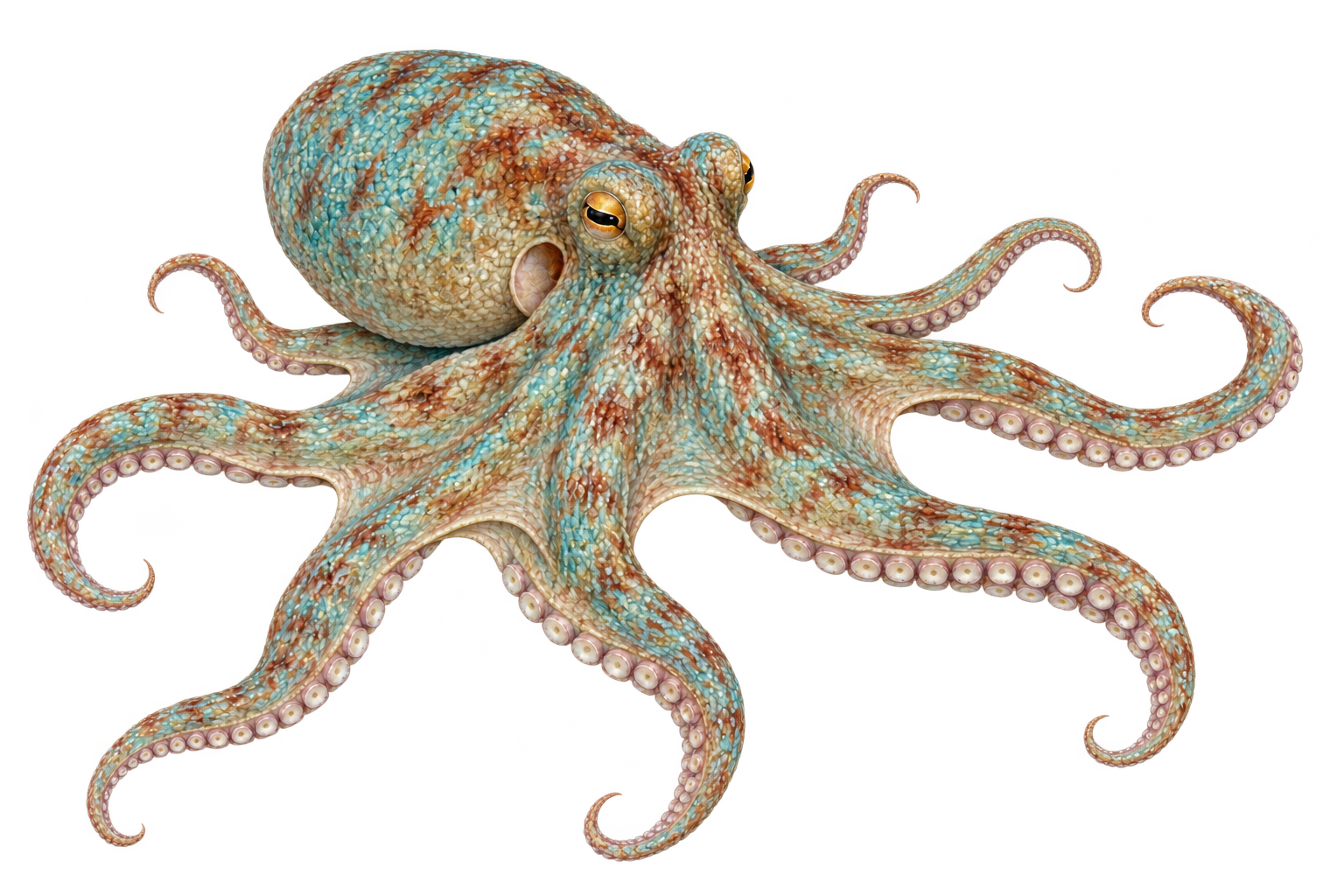
Look for eight long arms, a soft rounded mantle and skin that can shift through blue-green, brown and mottled patterns. Two rows of suckers run along the arms. Color is changeable, so a blue animal and a brown one may belong to the same species. The skin’s changing pigments are controlled through specialized cells called chromatophores. Arm proportions also matter: the second and third arm pairs are particularly long, and webbing links the arm bases. The rounded mantle holds the internal organs, while the eyes sit between that body region and the flexible arm crown. None of these structures resembles a fish’s fin or scale.
Size and life stages
The mantle, the main body behind the eyes, reaches about 12 centimeters. Arms can extend far beyond that compact body, making a single total-length estimate misleading.
Habitat and where to look
Shallow tropical reef habitats provide crevices and dens for shelter. The animal can flatten and stretch through openings that seem much too small for its expanded outline. A pile of shells may suggest feeding activity nearby, but does not by itself prove which octopus lives there.
Range and local context
The Caribbean reef octopus occurs from southern Florida through the Caribbean and neighboring tropical western Atlantic waters. Florida Keys observations support this profile. An octopus seen at a local bridge still requires identification; multiple octopus species inhabit Florida waters.
What is on the menu?
This is a predator of crabs, other crustaceans and mollusks. Flexible arms explore and control prey, while the hard beak is tucked at the center of the arm crown.
Daily habits and behavior
Changes in skin pattern and texture help the animal blend into its surroundings. It commonly shelters during daylight and forages after dark. A color change is not a reliable translation of a particular emotion; record the change without inventing a human conversation for it.
Mating and the next generation
Females tend their eggs in protected dens. The large eggs produce well-developed hatchlings that resemble small adults rather than entering a long planktonic stage. A brooding female should be left undisturbed, with no attempt to inspect or illuminate the den interior repeatedly.
Look-alikes and identification traps
Florida has several octopuses, and color alone cannot separate them. Caribbean reef octopus has notably long arms relative to its mantle, but an obscured or rapidly changing animal may remain unidentified.
Observe without disturbing
Record mantle size separately from arm spread when describing a sighting rather than assigning fish-style length. Do not put a finger near the mouth or offer food to demonstrate its hunting behavior. Keep the scientific name tentative when the photograph does not show diagnostic features. Never pull an octopus from its den, handle its arms or block its escape route. Give a naturally moving animal time and space to pass. A calm, stationary observer often learns more from ordinary searching and camouflage than from a forced close encounter. Dive with Stuart Scuba to explore Florida marine life with an emphasis on careful observation. Ask about current conditions and an appropriate dive plan; wildlife sightings remain unpredictable.
Harvest, protection and eating safety
Restricted marine life: live collection only; Blue Heron Bridge closed
Can it be hunted or harvested?
Caribbean reef octopus falls within regulated tropical ornamental marine life (octopods other than the common octopus). Where collection is legal, take no more than five of this species per person per day within the combined twenty-organism marine-life daily limit. The two-day possession limit is forty total organisms, no more than ten of one species. Animals must be landed and kept alive with adequately sized circulation, aeration or oxygenation. Hand collection and specified nets are allowed; no sale of recreational catch. A recreational saltwater fishing license is required unless exempt; a shoreline-only license does not cover collecting while diving.
Florida seasons and areas
No statewide recreational closed months are listed for this marine-life category. Collection is prohibited inside the designated Blue Heron Bridge Special Marine Life Area, which includes Phil Foster County Park and the waters bounded in FAC 68B-42.0036. This is not a blanket closure of all Palm Beach County waters. Possession there is also restricted, with narrowly defined motor-vessel transit and landing exceptions for animals lawfully collected elsewhere. The marine-life recreational bag rules also apply in adjacent federal waters in the absence of federal regulations for the species. Park, refuge and Florida Keys sanctuary zones can prohibit collection even where general state rules allow it. Check the exact site and current boundaries before any take. FWC additionally lists Lee County harvest prohibition and a two-per-species daily Manatee County limit under its octopod entry. Under FAC 68B-26, “live shellfish” includes living mollusks, including this species even without a visible external shell. Lee County prohibits harvest and possession in county waters seaward of mean high water. Manatee County limits harvest to two of a species per day and possession to two of that species in those waters. Do not use a general statewide limit to bypass these county rules.
Can it be speared?
No. This is a live-collection category: use the lawful nonlethal marine-life methods, not a spear. Do not break reef substrate or remove protected live rock to reach an animal.
Is it safe to eat?
Not recommended as a food target. These rules require live landing and continued live holding, not a food fishery. No species-specific safe-to-eat finding is made here. For any seafood, correct identity, legal sourcing, current health advisories and safe handling matter; cooking cannot remove all toxins.
Before you act: This recreational overview is not permission to collect or spear at your dive site. Confirm the species, date, management area, state or federal waters, gear, licenses and current local closures. Identification artwork cannot establish an identification or guarantee seafood safety.
Official rules and health guidance
- FWC: Recreational Marine Life
- Florida Administrative Code: Marine Life, Chapter 68B-42
- FAC 68B-42.001: restricted-species definitions (LII reproduction; current effective date checked against official FAC index)
- FWC: Saltwater Recreational Licenses and Permits
- NOAA: Florida Keys Sanctuary Marine Zones
- FDA: Selecting and Serving Seafood Safely
- Florida Department of Health: Seafood Poisoning
- FAC 68B-42.0036: Blue Heron Bridge boundaries and exceptions (LII reproduction)
- FAC 68B-42.005: marine-life recreational limits (LII reproduction)
- Florida Administrative Code: Southwest Florida Shells, Chapter 68B-26
- FAC 68B-26.002: live shellfish definition (LII reproduction)
- FAC 68B-26.004: Lee and Manatee restrictions (LII reproduction)
Reviewed 2026-11-10. Rules and advisories can change; check the linked authorities before harvesting or eating.
Sources and review
Reviewed 2026-11-10.
Make your next dive happen
Dive With Us
Explore local charters and plan a dive suited to your experience.
View dive calendarTrain With Us
Build your fish identification, buoyancy and diving skills.
Explore trainingTravel With Us
Discover upcoming dive adventures and trip details.
Explore dive travelShop With Us
Browse equipment for your diving and ask our team for help choosing.
Explore dive gearReview current dates, availability, prices, inclusions and requirements on each listing before booking or buying.
Call us now
Ask about marine life identification
Marine Life Identification
Ask about dates, prerequisites or your next step. An inquiry does not reserve a place. Please provide your own contact details; do not include medical, payment or a child's personal information.
We use these details to respond to your inquiry. This form does not sign you up for marketing.
Explore more with Stuart Scuba
Open Water course options · Advanced Adventure training · Technical training · Professional training · All courses · Local dives · Dive trips · Facebook · Instagram · YouTube
Your surface-interval essentials
Questions for Stuart Scuba? info@stuartscuba.com
Check the Stuart Scuba Weather Center · Play scuba trivia
Weather and wildlife vary. Confirm current conditions, trip requirements and departure details with the operator.
Plan Your Next Dive with Stuart Scuba
Dive With Us
Explore upcoming local charters and choose a dive that fits your experience.
Before you book
Check the individual listing for departure time, requirements and availability.
Travel With Us
Find upcoming dive adventures and start planning your next trip.
Plan your trip
Review dates, inclusions and trip details on the travel calendar.
Stay Connected with Stuart Scuba
 Follow pageShare
YouTube
SubscribeWatch & shareFollow on InstagramView & share post
Follow company news, training updates, and dive stories.
Follow on LinkedInGoogle Reviews
See Stuart Scuba’s current Google rating and review count below. Open the listing in Google Maps to browse customer reviews.



