

Fish identification archive / Caribbean Helmet
Caribbean Helmet
Cassis tuberosa · Cassidae
I saw this
Spotted this marine life? Share the guide with your dive buddies. Review your caption before posting.
For Instagram, copy the caption and link into your own post or message. Nothing is posted automatically and this does not record a verified sighting.
Identification overview
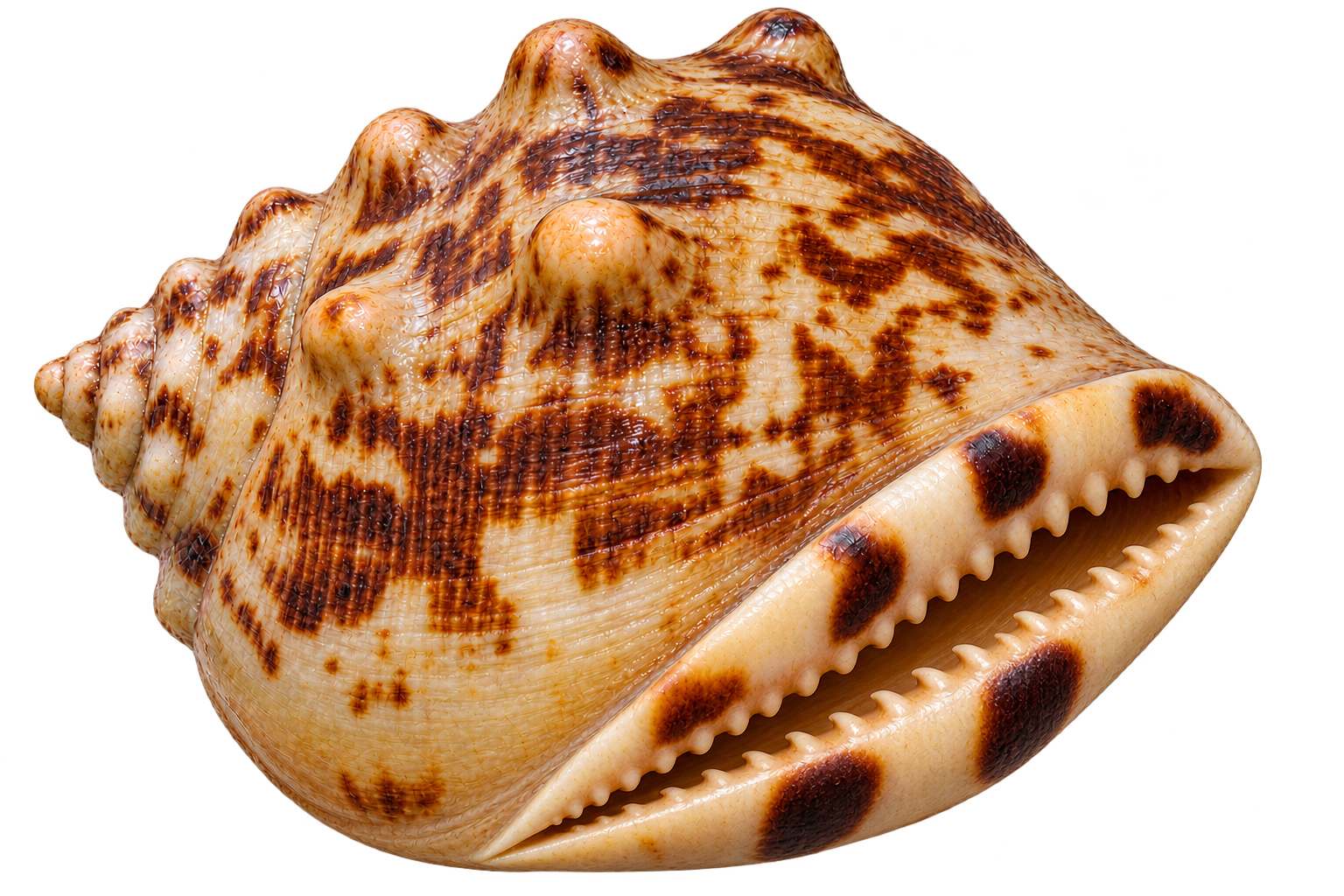
The Caribbean helmet, also called the king helmet, is a large marine snail rather than a true conch. Cassis tuberosa has a substantial shell with brown markings against a paler background. A University of Miami Sea Grant identification guide describes its triangular apertural face, dark blotches and fine crossing shell sculpture. The thickened outer lip carries toothlike projections.
Those features help separate it from other helmet snails. Do not identify one from size or a rounded silhouette alone: a clear view of the shell pattern and, when naturally visible, the opening is more useful. A numeric maximum size is intentionally omitted because the reviewed sources give differing figures. Never turn over a living helmet just to expose its aperture for a photograph.
Where it fits in South Florida
Biscayne National Park lists Cassis tuberosa in its official mollusk inventory. That supports occurrence within the southern Vero–Key Largo corridor, without establishing a present-day population at a named dive site. Look at the relationship between sand, seagrass and nearby reef habitat rather than imagining it as an animal restricted to the top of a coral head.
Research elsewhere in the Caribbean gives useful ecological context. In South Caicos, many studied helmets occupied seagrass habitat. Those observations describe that study population and should not be converted into a percentage for Florida habitats.
A predator with specialized feeding behavior
Helmets prey on echinoids, the group containing sea urchins and sea biscuits. A St John study documented Cassis tuberosa attacking long-spined urchins and rasping a hole through the rigid test. Successful attacks in that experiment occurred on sand, illustrating how the surrounding habitat can change a predator’s opportunities. In South Caicos, inflated sea biscuits were the principal observed prey. Together these studies caution against describing the species as eating only one kind of urchin.
Egg capsules and observation
A published observation from northeastern Brazil recorded a female laying orange, vase-shaped egg capsules on an algal frond. This demonstrates a reproductive behavior, not a Florida breeding date or a fixed number of capsules for every female.
The heavy patterned shell, echinoid diet and shaped egg capsules are three memorable features of this snail. Watch natural movements without offering prey or interfering with an attack. Leave living animals and their habitat intact. This guide does not authorize shell collecting or harvest; current FWC rules and the restrictions of the exact park or sanctuary require separate checking.
References
Current Florida collection cautions
Reviewed November 12, 2026. A living animal in a shell is not an empty-shell souvenir: applicable licensing, species rules and protected-area restrictions must be checked before removal. Leave attached animals and surrounding habitat undisturbed. This guide offers no collection permission or food-safety assurance. Official FWC live-shell collection guidance
Make your next dive happen
Dive With Us
Explore local charters and plan a dive suited to your experience.
View dive calendarTrain With Us
Build your fish identification, buoyancy and diving skills.
Explore trainingTravel With Us
Discover upcoming dive adventures and trip details.
Explore dive travelShop With Us
Browse equipment for your diving and ask our team for help choosing.
Explore dive gearReview current dates, availability, prices, inclusions and requirements on each listing before booking or buying.
Call us now
Ask about fish identification training
Reef Fish Identification
Ask about dates, prerequisites or your next step. An inquiry does not reserve a place. Please provide your own contact details; do not include medical, payment or a child's personal information.
We use these details to respond to your inquiry. This form does not sign you up for marketing.
Explore more with Stuart Scuba
Open Water course options · Advanced Adventure training · Technical training · Professional training · All courses · Local dives · Dive trips · Facebook · Instagram · YouTube
Your surface-interval essentials
Questions for Stuart Scuba? info@stuartscuba.com
Check the Stuart Scuba Weather Center · Play scuba trivia
Weather and wildlife vary. Confirm current conditions, trip requirements and departure details with the operator.
Plan Your Next Dive with Stuart Scuba
Dive With Us
Explore upcoming local charters and choose a dive that fits your experience.
Before you book
Check the individual listing for departure time, requirements and availability.
Travel With Us
Find upcoming dive adventures and start planning your next trip.
Plan your trip
Review dates, inclusions and trip details on the travel calendar.
Stay Connected with Stuart Scuba
 Follow pageShare
YouTube
SubscribeWatch & shareFollow on InstagramView & share post
Follow company news, training updates, and dive stories.
Follow on LinkedInGoogle Reviews
See Stuart Scuba’s current Google rating and review count below. Open the listing in Google Maps to browse customer reviews.



