

Fish identification archive / Bull Shark
Bull Shark
Carcharhinus leucas
I saw this
Spotted this fish? Share the guide with your dive buddies. Review your caption before posting.
For Instagram, copy the caption and link into your own post or message. Nothing is posted automatically and this does not record a verified sighting.
Fun facts for your next surface interval
- Fresh water is not automatically a no-shark zone: this species can travel into rivers.
- The second dorsal fin is the little sibling: it is much smaller than the first.
- Baby bull sharks arrive as live pups, not in little egg cases.
Palm Beach connection
Lake Worth Lagoon / Blue Heron Bridge, Palm Beach County: Verified local record.
Documented regional presence is not a guarantee of an encounter or a measure of how common this fish is at your dive site.
How to recognize this fish
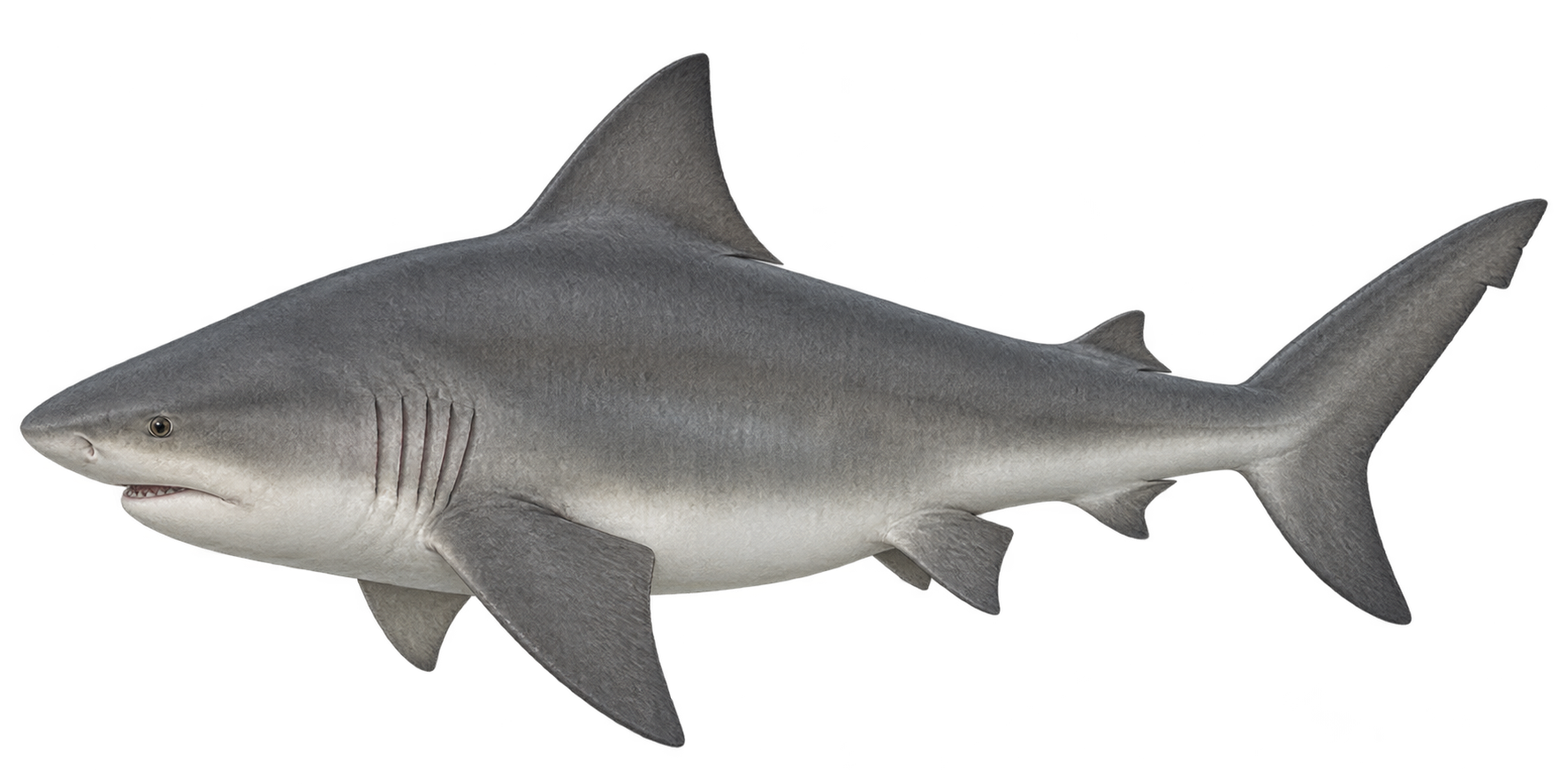
Start with the outline: this is a heavy, broad-shouldered shark with a short, rounded nose and small eyes. The first dorsal fin is much larger than the second. Its back is gray and its belly pale. Fin tips alone are unreliable because young bull sharks can have darker tips than adults. Look at several features together rather than naming a shark from a distant gray silhouette.
Size and life stages
Large adults can reach about 11 feet, with exceptional published reports near 13 feet. These are upper-size references, not a typical local encounter size. A young individual may be much smaller and less obviously bulky. Estimate length only from a safe viewing position; underwater perspective can exaggerate it. In a dive log, an approximate size and clear description are more useful than a confident but unsupported measurement.
Habitat and where to look
Bull sharks use shallow coastal water, estuaries and river mouths, and tolerate freshwater unusually well for sharks. Young animals use protected coastal nursery habitat. This is not exclusively an offshore reef species. A lagoon record therefore fits its ecology, but it does not mean a particular swimming area or dive site regularly contains bull sharks.
Range and local context
The species occurs in warm coastal regions around the world. In our area, verified Lake Worth Lagoon documentation supplies the local connection. Treat that record as evidence of presence, not a schedule for meeting one. Ask your operator about current conditions and site suitability rather than planning a shark encounter from an archive listing alone.
What is on the menu?
Bull sharks are opportunistic predators. Fish form an important part of the menu, which can also include rays and other sharks. Their broad food choices help explain why they use varied coastal environments. Do not offer food, carry fish scraps to attract attention, or interpret an approaching animal as requesting an interaction.
Daily habits and behavior
A bull shark can move between different salinities instead of remaining in seawater throughout its life. Its short snout and powerful body are useful identification clues, but posture and distance affect how those proportions appear. Watch calmly with your group; an identification task should never take priority over the dive briefing or awareness of the surroundings.
Mating and the next generation
Females give birth to live pups after internal development. Shallow estuarine habitats can provide nursery areas, linking healthy coastal water and shoreline habitat to the next generation. A diver cannot reliably judge pregnancy or reproductive condition from a brief encounter, so avoid adding those claims to a photograph unless a qualified specialist confirms them.
Look-alikes and identification traps
Blacktip sharks are generally more slender and have more pointed snouts. Lemon sharks have two dorsal fins closer in size. These comparisons narrow the possibilities but are not a complete shark-identification key. If your image omits the second dorsal fin or distorts the head, keeping the identification tentative is the most accurate choice.
Observe without disturbing
Never feed, touch, chase or corner a shark. Follow your qualified operator's briefing, remain with your buddy, and keep a clear route away from the animal. Do not seek a closer view to check teeth or small anatomical details. Record the sighting afterward, including location, conditions and features actually seen, without presenting a routine observation as proof of danger or guaranteed safety.
Harvest, protection and eating safety
Regulated harvest; not a prohibited shark species
Can it be hunted or harvested?
Bull sharks may be retained under Florida recreational rules: a 54-inch fork-length minimum; one shark per person daily and two per vessel, combined across harvestable sharks. Shore-based shark fishing requires the FWC course and applicable permit.
Florida seasons and areas
FWC lists no annual seasonal closure for this species. Federal HMS rules differ: NOAA lists a 54-inch fork-length minimum and one shark total per vessel per trip for this group, with an HMS permit and shark endorsement. Verify current federal status and local restrictions before fishing.
Can it be speared?
Spearfishing prohibited. Florida shark harvest is hook-and-line only; a legal size does not authorize spearing.
Is it safe to eat?
High-mercury caution. FDA/EPA advises people who are or might become pregnant, breastfeeding people, and children ages 1–11 to avoid shark. Other consumers should check Florida DOH guidance for their catch location; legal harvest is not proof that a meal is safe.
Before you act: This recreational overview is not permission to collect or spear at your dive site. Confirm the species, date, management area, state or federal waters, gear, licenses and current local closures. A fish illustration cannot establish an identification or guarantee seafood safety.
Official rules and health guidance
- FWC shark recreational regulations
- NOAA recreational Atlantic shark requirements
- FWC spearing restrictions
- FDA/EPA fish-consumption advice
- Florida DOH seafood and local advisories
Reviewed 2026-11-10. Rules and advisories can change; check the linked authorities before harvesting or eating.
Sources and review
Reviewed 2026-11-10.
Make your next dive happen
Dive With Us
Explore local charters and plan a dive suited to your experience.
View dive calendarTrain With Us
Build your fish identification, buoyancy and diving skills.
Explore trainingTravel With Us
Discover upcoming dive adventures and trip details.
Explore dive travelShop With Us
Browse equipment for your diving and ask our team for help choosing.
Explore dive gearReview current dates, availability, prices, inclusions and requirements on each listing before booking or buying.
Call us now
Ask about fish identification training
Reef Fish Identification
Ask about dates, prerequisites or your next step. An inquiry does not reserve a place. Please provide your own contact details; do not include medical, payment or a child's personal information.
We use these details to respond to your inquiry. This form does not sign you up for marketing.
Explore more with Stuart Scuba
Open Water course options · Advanced Adventure training · Technical training · Professional training · All courses · Local dives · Dive trips · Facebook · Instagram · YouTube
Your surface-interval essentials
Questions for Stuart Scuba? info@stuartscuba.com
Check the Stuart Scuba Weather Center · Play scuba trivia
Weather and wildlife vary. Confirm current conditions, trip requirements and departure details with the operator.
Plan Your Next Dive with Stuart Scuba
Dive With Us
Explore upcoming local charters and choose a dive that fits your experience.
Before you book
Check the individual listing for departure time, requirements and availability.
Travel With Us
Find upcoming dive adventures and start planning your next trip.
Plan your trip
Review dates, inclusions and trip details on the travel calendar.
Stay Connected with Stuart Scuba
 Follow pageShare
YouTube
SubscribeWatch & shareFollow on InstagramView & share post
Follow company news, training updates, and dive stories.
Follow on LinkedInGoogle Reviews
See Stuart Scuba’s current Google rating and review count below. Open the listing in Google Maps to browse customer reviews.



