

Fish identification archive / Bucktooth parrotfish
Bucktooth parrotfish
Sparisoma radians
Fun facts for your next surface interval
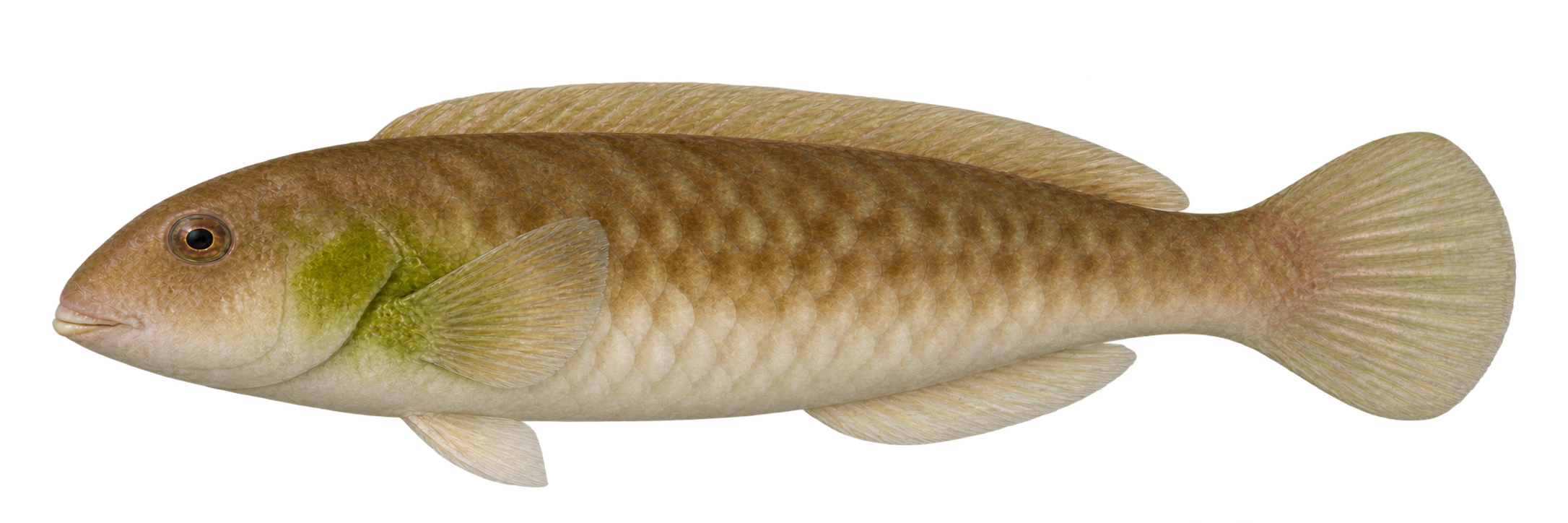
- An underbite with a name: the lower jaw projects farther forward than the upper jaw.
- New outfit, same tail: the tail remains rounded in both principal color phases.
- Social life gets complicated: species-specific field experiments have explored how social conditions affect sex change.
Florida and local context
Reported in REEF diver surveys at Blue Heron Bridge (WPB), Phil Foster Park. Cumulative survey records document occurrence, not a guaranteed encounter or present-day abundance.
Documented regional presence is not a guarantee of an encounter or a measure of how common this animal is at your dive site.
How to recognize this animal
The bucktooth parrotfish is a small, elongated parrotfish whose lower tooth plate projects ahead of the upper one when the mouth closes. Its rounded tail is useful across color phases. Initial-phase fish are greenish brown above and pale underneath, with a green patch around the pectoral base. Terminal-phase fish add an opalescent mark behind the eye, blue facial detail and dark edging on the rear dorsal, anal and tail fins.
Size and life stages
The maximum reported length is 20 cm, around eight inches. Its modest size contrasts with many familiar reef parrotfishes. Juveniles resemble the initial phase, so a plain green-brown appearance is not enough to assign age or sex. The mouth profile, tail outline and location of fin markings are stronger identification clues than size alone.
Habitat and where to look
Algal beds and seagrass are the principal habitats named in the species description. Most observations are shallower than 10 m, although the compilation includes a much wider overall depth range of 0–130 m. Shallow vegetated habitat is therefore the more useful ecological context. Do not treat the maximum recorded depth as representative of an ordinary encounter.
Range and local context
Its recorded western Atlantic distribution extends from Bermuda to Brazil, with South Florida coordinates in the Smithsonian data. That supports regional inclusion, not a guaranteed local encounter. This profile uses Scaridae to match the source's family treatment; some scientific literature places parrotfishes within Labridae as the subfamily Scarinae. Reported in REEF diver surveys at Blue Heron Bridge (WPB), Phil Foster Park. Cumulative survey records document occurrence, not a guaranteed encounter or present-day abundance.
What is on the menu?
The species grazes plant-associated bottom food; the compiled diet includes macroalgae, seagrasses and microalgae. Its tooth plates retain a rough surface with individual teeth visible, and the lips cover part of them. A crushing apparatus in the throat processes material after the bite. Observation alone does not establish whether a particular bite removed a blade, attached growth or both.
Daily habits and behavior
Its green-brown body can be inconspicuous among vegetation. Watch from above the bottom without disturbing the blades, and note whether several fish are feeding nearby or interacting. Different color phases may occur within one species. A dark-edged terminal-phase fish should not be cataloged as a separate species from the plainer fish around it.
Mating and the next generation
Species-specific research has examined female-to-male sex change and the effects of social setting in Sparisoma radians. A Caribbean field study tested how sperm competition and size differences affect sex-change predictions. These findings establish a more complex life history than a fixed one-color, one-sex rule, but they do not provide a Florida timetable for an individual. Smithsonian also records pelagic eggs and larvae.
Look-alikes and identification traps
Other small parrotfishes, including greenblotch and emerald parrotfishes, can occupy similar visual territory. Check the projecting lower jaw, persistently rounded tail and phase-specific head and fin marks together. A clear side photograph is often essential for a cautious identification.
Observe without disturbing
Keep fins, knees and camera equipment above seagrass. Avoid pulling blades aside or following a fish until it leaves cover. Photograph its natural lateral profile without handling the mouth. If phase is uncertain, report the observed pattern rather than assigning sex, and keep all life stages under the same species record.
Harvest, protection and eating safety
No food harvest or spearing; restricted live aquarium collection only
Yellow means collection or harvest is conditional on current rules and location. It is not permission to harvest or an assurance that the fish is safe to eat.
This color is a qualified summary, not permission to collect or a guarantee that a particular catch is safe to eat. Read the current rules and health guidance below.
Can it be hunted or harvested?
Bucktooth parrotfish is covered by Florida’s marine-life rules: parrotfish family Scaridae. Recreational collection requires a saltwater license unless exempt, live landing and continued live support using a suitably sized circulating, aerated or oxygenated system. Five of this species within 20 marine-life organisms per person daily; two-day possession ten of this species within 40 total. No recreational sale. Maximum 12 inches total length.
Florida seasons and areas
No species-specific annual closed months are listed for this live-collection category. Florida marine-life rules also apply in federal waters. Collection is prohibited inside the designated Blue Heron Bridge dive-site boundary, throughout Biscayne National Park and for this listed group at John Pennekamp Coral Reef State Park. Check the precise capture position, jurisdiction and transit route. Keys sanctuary preservation, conservation, research and restoration zones can override general allowances. Within the designated Western Dry Rocks boundary, fishing is closed April 1–July 31; continuous transit requires fish and gear properly stowed. Biscayne’s designated bonefish pre-spawning area prohibits fishing and fish possession March 1–May 31, with a properly stowed continuous-transit exception. These are mapped area rules, not statewide closures.
Can it be speared?
No. Live-only requirements and the authorized hand/net/slurp-gun methods exclude recreational spearing. Parrotfish additionally appear expressly in FWC’s prohibited ornamental spearing families. No quinaldine.
Is it safe to eat?
Not a food-harvest species under these live-only rules. Do not convert aquarium collection permission into an edible/safe badge. No blanket safe-to-eat assurance. Consult current Florida DOH advice for the exact fish, capture water and consumer, particularly pregnancy, nursing and children; this guide does not establish a species-specific meal allowance. Legal harvest and normal appearance do not establish food safety.
Blue Heron Bridge is an observation site: marine-life harvest is prohibited within the designated dive-site boundary. A local occurrence record is not permission to collect or spear.
Before you act: This recreational overview is not permission to collect or spear at your dive site. Confirm the species, date, management area, state or federal waters, gear, licenses and current local closures. Identification artwork cannot establish an identification or guarantee seafood safety.
Official rules and health guidance
- FWC recreational marine life
- FWC marine-life taxon and Pennekamp applicability; commercial quotas NOT adopted
- FAC marine-life designation rule index
- NOAA Keys sanctuary zones
- FWC Western Dry Rocks closure
- FWC Biscayne National Park regulations
- FWC spearing restrictions
- Florida DOH fish consumption guidance
- Florida DOH seafood poisoning
Reviewed 2026-11-11. Rules and advisories can change; check the linked authorities before harvesting or eating.
Sources and review
Reviewed 2026-11-11.
- Smithsonian Tropical Research Institute: Shorefishes of the Greater Caribbean, species account and data
- Muñoz and Warner (2004), Testing a new version of the size-advantage hypothesis for sex change
- Smithsonian comparator species account
- Smithsonian comparator species account
- REEF diver surveys: Blue Heron Bridge (WPB), Phil Foster Park
Make your next dive happen
Dive With Us
Explore local charters and plan a dive suited to your experience.
View dive calendarTrain With Us
Build your fish identification, buoyancy and diving skills.
Explore trainingTravel With Us
Discover upcoming dive adventures and trip details.
Explore dive travelShop With Us
Browse equipment for your diving and ask our team for help choosing.
Explore dive gearReview current dates, availability, prices, inclusions and requirements on each listing before booking or buying.
Call us now
Ask about marine life identification
Marine Life Identification
Ask about dates, prerequisites or your next step. An inquiry does not reserve a place. Please provide your own contact details; do not include medical, payment or a child's personal information.
We use these details to respond to your inquiry. This form does not sign you up for marketing.
Explore more with Stuart Scuba
Open Water course options · Advanced Adventure training · Technical training · Professional training · All courses · Local dives · Dive trips · Facebook · Instagram · YouTube
Your surface-interval essentials
Questions for Stuart Scuba? info@stuartscuba.com
Check the Stuart Scuba Weather Center · Play scuba trivia
Weather and wildlife vary. Confirm current conditions, trip requirements and departure details with the operator.
Plan Your Next Dive with Stuart Scuba
Dive With Us
Explore upcoming local charters and choose a dive that fits your experience.
Before you book
Check the individual listing for departure time, requirements and availability.
Travel With Us
Find upcoming dive adventures and start planning your next trip.
Plan your trip
Review dates, inclusions and trip details on the travel calendar.
Stay Connected with Stuart Scuba
 Follow pageShare
YouTube
SubscribeWatch & shareFollow on InstagramView & share post
Follow company news, training updates, and dive stories.
Follow on LinkedInGoogle Reviews
See Stuart Scuba’s current Google rating and review count below. Open the listing in Google Maps to browse customer reviews.



