

Fish identification archive / Bonnethead
Bonnethead
Sphyrna tiburo
Fun facts for your next surface interval
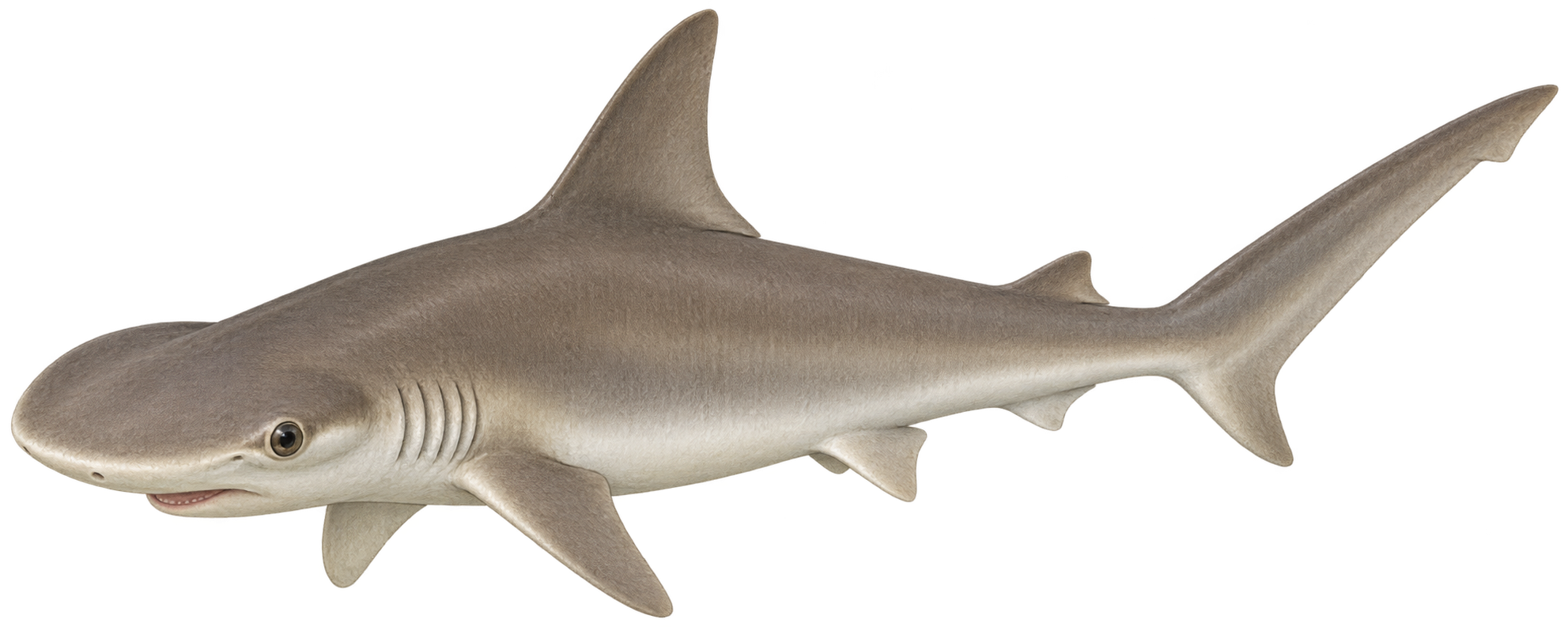
- A bonnet with fins: its rounded shovel-shaped head makes this hammerhead look as though it is wearing a bonnet.
- Bring on the crunch: rear teeth help crush crabs, one of its favorite food groups.
- A short wait by shark standards: bonnetheads have a short shark pregnancy, roughly four to five months in the reviewed accounts.
Florida and local context
Florida regional occurrence; no site-level or abundance claim: FWC documents Florida occurrence. Current Catalog and the 2024 revision distinguish northern Sphyrna tiburo from Sphyrna alleni; older broad southern ranges are not copied.
Documented regional presence is not a guarantee of an encounter or a measure of how common this animal is at your dive site.
How to recognize this animal
A bonnethead’s head is a smooth, rounded shovel rather than a broad, notched hammer. Its gray-brown body and relatively modest size make that head outline the strongest clue. Small dark spots may be present. The front edge has no scalloped indentations. Adult males can develop a slight front bulge, while female head outlines remain more rounded.
Size and life stages
Adults commonly fall around 3–4 feet (0.9–1.2 meters), with NOAA’s identification guide allowing a maximum near 5 feet (1.5 meters). Newborns are about 12 inches (30 centimeters) long. Small size alone is not decisive because larger hammerheads begin life small too. Look at the complete head shape rather than treating every little hammerhead as a bonnethead.
Habitat and where to look
Bonnetheads favor shallow coastal habitats, including bays, grass beds and sandy or muddy bottom. These are good places to find the crustaceans they eat. They can move toward deeper water during colder conditions. A seagrass edge or open bay can therefore be more relevant than a coral wall, though no habitat description guarantees a sighting.
Range and local context
Florida lies within the current northern western Atlantic range of Sphyrna tiburo, including Gulf and northern Caribbean waters. A 2024 taxonomic revision separated Sphyrna alleni from populations formerly included under a broad bonnethead name. Older accounts extending the same species far into Brazil should not be copied uncritically into this Florida profile. Regional occurrence is supported; Palm Beach abundance is not asserted.
What is on the menu?
Crabs are a major food, with shrimp, mollusks and small fishes also taken. The rear teeth are adapted for crushing rather than looking like the cutting teeth of a large tiger shark. Bonnetheads search over productive coastal bottom where hard-shelled prey can be abundant. There is no need to lift rocks or disturb grass to show a shark potential food.
Daily habits and behavior
Bonnetheads are active swimmers and may gather in schools. Their movements respond to seasonal conditions, so a shallow-water group can disappear as water cools without indicating a permanent loss from the region. A school’s rounded heads are an attractive sight, but observers should stay outside its route rather than surrounding it in a shallow bay.
Mating and the next generation
Bonnetheads give birth to live young after a comparatively short gestation of roughly 4–5 months. FWC reports litters around 4–14 pups. Birth timing varies geographically and is not a fishing-season rule. In addition to male claspers, adult head shape can show sex differences, but a slightly different viewing angle can exaggerate a bulge, so use that clue cautiously.
Look-alikes and identification traps
Young scalloped and great hammerheads have broader heads with different front edges, not the bonnethead’s evenly rounded shovel. The newly recognized shovelbill shark, Sphyrna alleni, complicates older range and name records outside this northern region. Do not use a generic ‘bonnethead’ photograph from another country as proof of Sphyrna tiburo without checking its location and current taxonomy.
Observe without disturbing
Let a school cross a grass flat without driving it toward shallower water. A naturally elevated photograph can show the shovel outline, while a side image records fin proportions. Keep fins clear of seagrass, avoid handling crabs to attract attention and retain the sighting location. For an unfamiliar overseas photograph, preserve the identification uncertainty rather than importing Florida assumptions.
Harvest, protection and eating safety
Harvest limited; mercury warning
Florida state waters: harvest is conditional on the shark size, bag, hook-and-line and permit rules below; no species-specific annual state closure is listed. Federal HMS rules can be stricter. The June 2021 guide currently linked by DOH says do not eat coastal sharks 43 inches or longer; below 43 inches, women of childbearing age and young children should not eat them, and others are limited to one meal/month. Recheck current advice.
This color is a qualified summary, not permission to collect or a guarantee that a particular catch is safe to eat. Read the current rules and health guidance below.
Harvestable shark with state and federal restrictions
Can it be hunted or harvested?
Florida state rules list no minimum size for this species. The state daily limit is one shark per person and two per vessel, all shark species combined. Hook-and-line is the only legal shark-harvest gear; required non-offset, non-stainless-steel circle hooks apply when using natural bait. Do not use multiple hooks with natural bait, and carry a cutting device. Land sharks with head, tail and fins attached; gutting is allowed. A saltwater license is required unless exempt. Shore-based shark fishing requires FWC’s course and permit for anglers age 16 and older, including otherwise license-exempt anglers; younger anglers have course/supervision requirements. Under federal HMS recreational rules, there is no minimum size, and the allowance is one bonnethead per person per trip, separate from the all-other-sharks vessel aggregate.
Florida seasons and areas
FWC lists no species-specific state closed season for this shark. Federal HMS permits and a shark endorsement are required for covered recreational shark activity, and HMS-permitted vessels must comply with applicable federal permit conditions even in state waters. Do not substitute the state limit for the federal one. Local closures and additional federal requirements must be checked for the actual trip.
Can it be speared?
No. Florida prohibits spearing all sharks, even species that can legally be retained by hook-and-line. No powerheads or bangsticks may be used to take this shark.
Is it safe to eat?
Legal retention is not a food-safety guarantee. FDA lists shark in the highest-mercury Choices to Avoid category for people who are pregnant, might become pregnant or are breastfeeding, and children ages 1–11. Other consumers should consult current Florida DOH advice for the species, size and catch area before eating it. The June 2021 guide currently linked by Florida DOH says not to eat coastal-water sharks 43 inches or longer, for any listed population. Below 43 inches, it advises women of childbearing age and young children not to eat them, and other consumers to limit them to one meal per month. This is an older currently linked guide, not a new 2026 table; recheck the current advisory before eating. The guide defines a meal as six ounces of cooked fish; consult current advice for age-appropriate portions and count other fish eaten as well.
Before you act: This recreational overview is not permission to collect or spear at your dive site. Confirm the species, date, management area, state or federal waters, gear, licenses and current local closures. Identification artwork cannot establish an identification or guarantee seafood safety.
Official rules and health guidance
- FWC current recreational shark rules
- NOAA current HMS recreational guide landing page and permit guidance
- NOAA linked 2025 HMS recreational guide, pages 15–16
- FWC saltwater recreational licensing
- FWC prohibited species, gear and spearing locations
- FDA advice about eating fish
- Florida DOH current fish-consumption advisory portal
- Florida DOH June 2021 guide, currently linked from its advisory portal
Reviewed 2026-11-10. Rules and advisories can change; check the linked authorities before harvesting or eating.
Sources and review
Reviewed 2026-11-10.
- FWC species account: Florida occurrence and biology
- NOAA shark identification guide: diagnostic anatomy, size, habitat and range
- Florida Museum species account: anatomy and life history
- NOAA repository: 2024 Sphyrna alleni taxonomic description
- Eschmeyer’s Catalog of Fishes: current taxonomy and synonymy
- UF/IFAS Florida Sea Grant: claspers and shark/ray reproductive anatomy
Make your next dive happen
Dive With Us
Explore local charters and plan a dive suited to your experience.
View dive calendarTrain With Us
Build your fish identification, buoyancy and diving skills.
Explore trainingTravel With Us
Discover upcoming dive adventures and trip details.
Explore dive travelShop With Us
Browse equipment for your diving and ask our team for help choosing.
Explore dive gearReview current dates, availability, prices, inclusions and requirements on each listing before booking or buying.
Call us now
Ask about marine life identification
Marine Life Identification
Ask about dates, prerequisites or your next step. An inquiry does not reserve a place. Please provide your own contact details; do not include medical, payment or a child's personal information.
We use these details to respond to your inquiry. This form does not sign you up for marketing.
Explore more with Stuart Scuba
Open Water course options · Advanced Adventure training · Technical training · Professional training · All courses · Local dives · Dive trips · Facebook · Instagram · YouTube
Your surface-interval essentials
Questions for Stuart Scuba? info@stuartscuba.com
Check the Stuart Scuba Weather Center · Play scuba trivia
Weather and wildlife vary. Confirm current conditions, trip requirements and departure details with the operator.
Plan Your Next Dive with Stuart Scuba
Dive With Us
Explore upcoming local charters and choose a dive that fits your experience.
Before you book
Check the individual listing for departure time, requirements and availability.
Travel With Us
Find upcoming dive adventures and start planning your next trip.
Plan your trip
Review dates, inclusions and trip details on the travel calendar.
Stay Connected with Stuart Scuba
 Follow pageShare
YouTube
SubscribeWatch & shareFollow on InstagramView & share post
Follow company news, training updates, and dive stories.
Follow on LinkedInGoogle Reviews
See Stuart Scuba’s current Google rating and review count below. Open the listing in Google Maps to browse customer reviews.



