

Fish identification archive / Bluntnose Stingray
Bluntnose Stingray
Hypanus say
Fun facts for your next surface interval
- Almost invisible: a buried ray can leave just its eyes and breathing openings visible above the sand.
- A tail with useful details: both upper and lower tail folds help distinguish this species from some familiar stingray neighbors.
- An old name still in circulation: its former scientific name, Dasyatis say, still appears in older Florida records.
Florida and local context
Florida regional occurrence; no site-level or abundance claim: FWC documents Florida coastal bays and estuaries. No specific Palm Beach site is asserted; older records may use Dasyatis say.
Documented regional presence is not a guarantee of an encounter or a measure of how common this animal is at your dive site.
How to recognize this animal
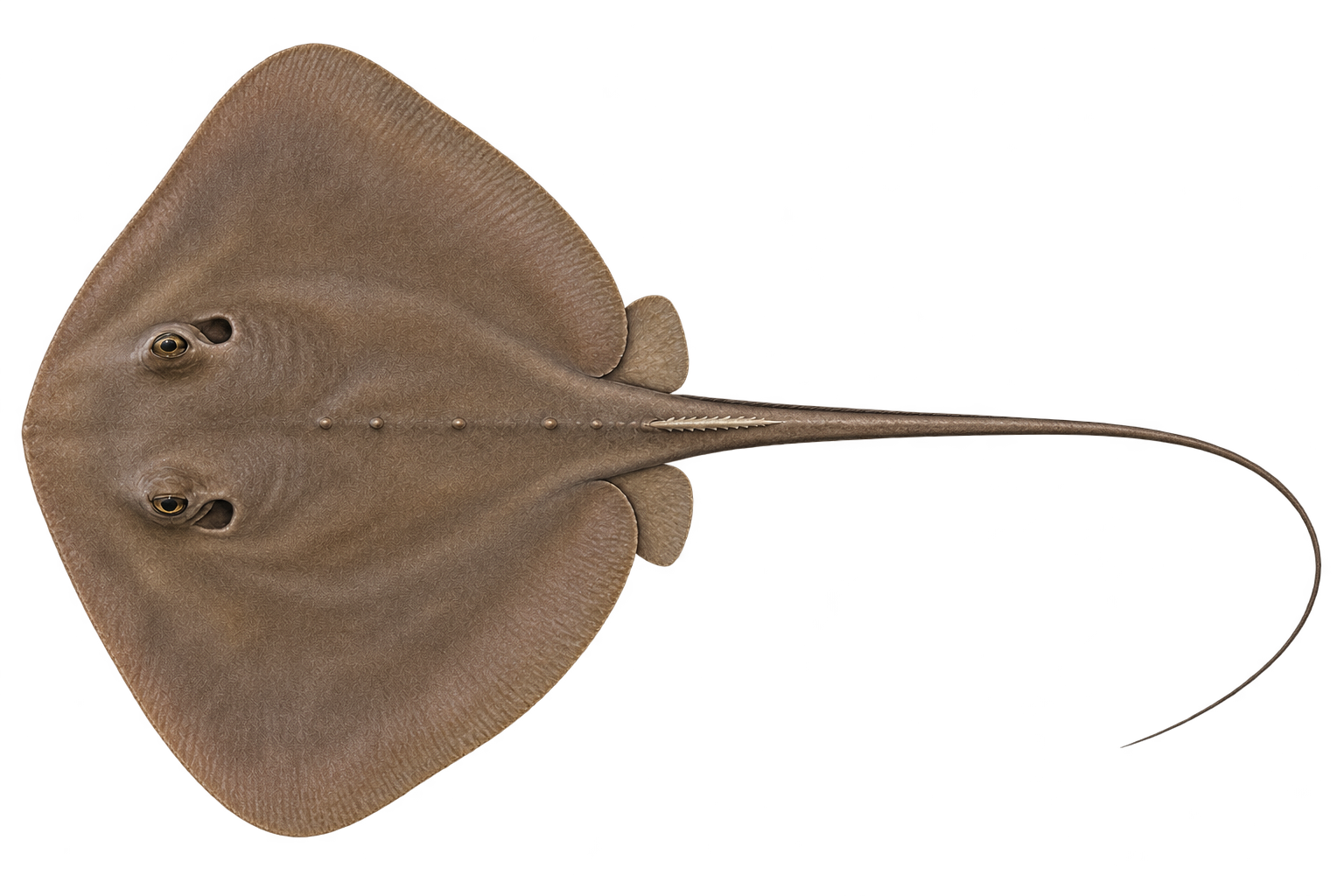
The bluntnose stingray has a broad, rounded diamond-shaped disc and a short, blunt snout. Its brown or gray upper surface contrasts with a pale underside. A row of small tubercles can run along the midline, and larger animals may be rougher. The tail has both upper and lower folds, with a defensive spine near its base.
Size and life stages
Large animals approach roughly 3 feet to a little over 3 feet (0.9–1 meter) in disc width. Females can grow larger than males. Newborn disc widths are around 6–7 inches (15–17 centimeters). Width excludes the long tail, so a nose-to-tail estimate cannot be substituted directly. A broad mature ray may look especially large when viewed from above.
Habitat and where to look
Bluntnose stingrays use coastal bays, estuaries, beaches and grass beds over sand or mud. They can bury much of the disc, leaving the eyes and spiracles exposed. The outline may therefore be hard to see even in clear water. Never sweep sand away to reveal the animal; a partial observation can be recorded honestly without disturbing it.
Range and local context
FWC documents the species in Florida. Current taxonomy places it in Hypanus, with a western Atlantic distribution extending along the American coast; older accounts use Dasyatis say. This profile does not convert that regional range into a confirmed Palm Beach site record. Habitat suitability and a broad range are supporting context, not proof of a particular dive encounter.
What is on the menu?
Small fishes, clams, worms, shrimp and crabs are among its bottom-associated prey. The underside mouth is suited to feeding close to the seabed. A resting ray may resume foraging after dark, so daytime stillness does not mean it is inactive throughout the day. Observe without bait or attempts to uncover prey beneath the disc.
Daily habits and behavior
Bluntnose stingrays often rest partly buried and are described as nocturnal feeders. Their venomous tail spine is used defensively rather than as a hunting spear. Give the tail room and avoid standing or kneeling on apparently empty sand. Calm behavior is not permission to touch; a startled ray can defend itself when trapped or stepped on.
Mating and the next generation
These rays give birth to live young, with FWC describing small litters of about 2–4 pups. Embryos first use yolk and later receive additional uterine nourishment. Males have pelvic claspers, and mature male teeth can differ during breeding from the blunter teeth of females and juveniles. Those mouth differences are not something a diver should try to inspect by handling.
Look-alikes and identification traps
Atlantic stingrays have a more pointed, projecting snout. Southern stingrays generally have a more angular disc, and tail-fold details help separate them from bluntnose rays. The bluntnose’s upper and lower tail folds are useful only when actually visible. A buried disc or an old damaged tail can hide the clues, so retain uncertainty rather than forcing the nearest familiar name.
Observe without disturbing
Maintain buoyancy above the bottom and leave buried rays undisturbed. A naturally obtained oblique image can show the snout, disc outline and tail base better than a close face-only shot. Never pull the tail or manipulate the spine to confirm an identification. Record disc width as an estimate, and keep yourself and your buddy clear of the animal’s escape path.
Harvest, protection and eating safety
Harvest conditional; eating advice applies
Florida state waters: default harvest and lawful-location/gear limits apply, with no species-specific annual state closed months identified. DOH’s currently linked June 2021 bluntnose row limits women of childbearing age and young children to one meal/week and others to two/week. Use current age-appropriate portions, count all fish eaten and recheck catch-area advice. A mercury table is not catch-specific safety certification.
This color is a qualified summary, not permission to collect or a guarantee that a particular catch is safe to eat. Read the current rules and health guidance below.
Harvest may be allowed; default limits and site rules apply
Can it be hunted or harvested?
In Florida state waters, the reviewed default recreational limit is two fish or 100 pounds per person per day, whichever is greater, unless a special rule applies. No species-specific statewide minimum size was identified. Use lawful gear and the required saltwater fishing license unless exempt. This does not authorize collection at a dive site.
Florida seasons and areas
No species-specific annual Florida state-water closed months were identified in the reviewed rules. That is not an all-waters opening: park, sanctuary, refuge and local restrictions can apply. Verify the actual location, current notices and any federal rules for the trip before harvest.
Can it be speared?
Potentially allowed where otherwise lawful, because this species is not on FWC’s no-spearing list. Bag and site rules still apply. Spearing is prohibited within 100 yards of public swimming beaches, public or commercial fishing piers, and bridge portions open to public fishing, with additional area restrictions. No powerheads, bangsticks or rebreathers. This is not permission to spear at Blue Heron Bridge.
Is it safe to eat?
No blanket safe-to-eat claim is made. Check current Florida DOH species, catch-area and population-specific advice before eating a lawfully retained ray. Do not substitute FDA’s skate category for this species or assume that a lack of a prominent advisory establishes safety. The June 2021 guide currently linked by DOH lists bluntnose stingray at one meal per week for women of childbearing age and young children, and two per week for other consumers. This older table is not a safe-to-eat guarantee or a newly issued 2026 advisory. The guide defines a meal as six ounces of cooked fish; consult current advice for age-appropriate portions, count other fish eaten as well, and recheck current catch-area guidance.
Before you act: This recreational overview is not permission to collect or spear at your dive site. Confirm the species, date, management area, state or federal waters, gear, licenses and current local closures. Identification artwork cannot establish an identification or guarantee seafood safety.
Official rules and health guidance
- FWC default recreational limits and lawful gear
- FWC saltwater recreational licensing
- FWC prohibited species, gear and spearing locations
- Florida DOH current fish-consumption advisory portal
- FDA advice about eating fish
- Florida DOH June 2021 guide, currently linked from its advisory portal
Reviewed 2026-11-10. Rules and advisories can change; check the linked authorities before harvesting or eating.
Sources and review
Reviewed 2026-11-10.
Make your next dive happen
Dive With Us
Explore local charters and plan a dive suited to your experience.
View dive calendarTrain With Us
Build your fish identification, buoyancy and diving skills.
Explore trainingTravel With Us
Discover upcoming dive adventures and trip details.
Explore dive travelShop With Us
Browse equipment for your diving and ask our team for help choosing.
Explore dive gearReview current dates, availability, prices, inclusions and requirements on each listing before booking or buying.
Call us now
Ask about marine life identification
Marine Life Identification
Ask about dates, prerequisites or your next step. An inquiry does not reserve a place. Please provide your own contact details; do not include medical, payment or a child's personal information.
We use these details to respond to your inquiry. This form does not sign you up for marketing.
Explore more with Stuart Scuba
Open Water course options · Advanced Adventure training · Technical training · Professional training · All courses · Local dives · Dive trips · Facebook · Instagram · YouTube
Your surface-interval essentials
Questions for Stuart Scuba? info@stuartscuba.com
Check the Stuart Scuba Weather Center · Play scuba trivia
Weather and wildlife vary. Confirm current conditions, trip requirements and departure details with the operator.
Plan Your Next Dive with Stuart Scuba
Dive With Us
Explore upcoming local charters and choose a dive that fits your experience.
Before you book
Check the individual listing for departure time, requirements and availability.
Travel With Us
Find upcoming dive adventures and start planning your next trip.
Plan your trip
Review dates, inclusions and trip details on the travel calendar.
Stay Connected with Stuart Scuba
 Follow pageShare
YouTube
SubscribeWatch & shareFollow on InstagramView & share post
Follow company news, training updates, and dive stories.
Follow on LinkedInGoogle Reviews
See Stuart Scuba’s current Google rating and review count below. Open the listing in Google Maps to browse customer reviews.



