

Fish identification archive / Bluespotted Cornetfish
Bluespotted Cornetfish
Fistularia tabacaria
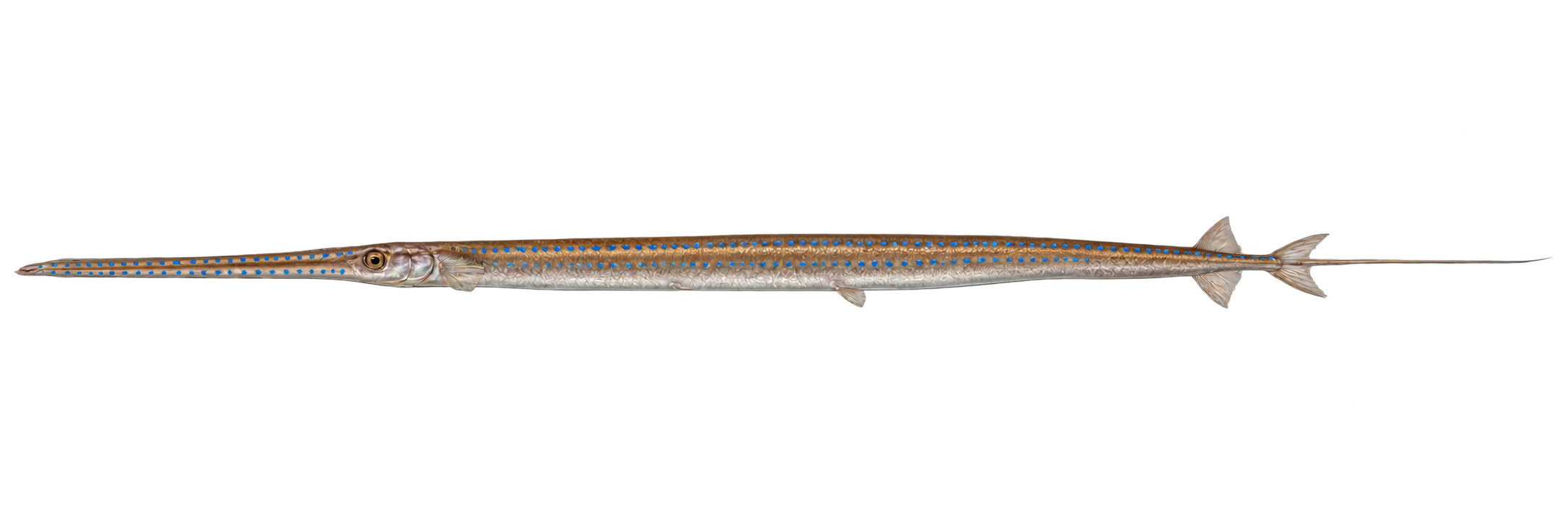
Fun facts for your next surface interval
- The line goes on: Its lateral line continues out onto the long tail filament.
- Long face, little mouth: The mouth is tiny despite the exceptionally long snout.
- A matching set: The dorsal and anal fins are similar in shape and placed near the tail.
Florida and local context
Broader Florida; no verified Lake Worth Lagoon checklist claim: Smithsonian species-distribution data include Florida Keys-area coordinates, for example [24.4933, -81.8033]. These are database distribution records, not newly observed fish or a verified Lake Worth Lagoon checklist row.
Documented regional presence is not a guarantee of an encounter or a measure of how common this animal is at your dive site.
How to recognize this animal
The bluespotted cornetfish is extremely slender, with a long tubular snout ending in a small mouth. Rows of blue spots mark the brownish upper body and snout. Small, similarly shaped dorsal and anal fins oppose one another near the tail. A long central tail filament is a major clue, especially when the rest of the fish nearly disappears against the background.
Size and life stages
Smithsonian reports a maximum length of 200 centimeters, about six and a half feet. Much of the impression of length comes from the elongated head, narrow body and trailing filament, rather than a heavy body. The tail lobes are small compared with the dorsal fin. A cropped photograph can hide the filament and make identification substantially harder.
Habitat and where to look
The species occurs around reefs and seagrass beds, with a broad recorded depth span of 1–250 meters. That interval describes distribution, not safe recreational diving depths. A diver should look for the complete shape in the water above or beside habitat rather than assume a thin line is a plant stem. Seagrass and reef edges both provide relevant sighting context.
Range and local context
The species occurs on both sides of the Atlantic, with a western range from Nova Scotia to Brazil. Florida Keys-area records in Smithsonian distribution data corroborate Florida occurrence. The Lake Worth Lagoon checklist does not mark this species as verified; this profile therefore claims broader Florida presence, not a confirmed local checklist sighting or local abundance.
What is on the menu?
Its recorded prey include small fishes and crustaceans. Minute teeth and a small oblique mouth sit at the end of the tube, far in front of the eye. The feeding apparatus is therefore very different from the exposed toothed beak of a needlefish. A head photograph can show that difference without needing to provoke feeding or offer bait.
Daily habits and behavior
The front half of its lateral line curves along the body, and the line continues onto the tail filament. Small pectoral fins lie near the head while the pelvic fins are farther back on the abdomen. These widely spaced structures explain its unfamiliar outline. Capture the whole animal in an undisturbed side view before taking close-ups of its blue markings.
Mating and the next generation
The species data describe pelagic eggs and pelagic larvae. The adult's association with reefs or seagrass does not mean that its entire life remains attached to those habitats. No Palm Beach spawning calendar was verified. A pair of nearby fish or a filament touching vegetation does not establish a mating event or a nest.
Look-alikes and identification traps
Trumpetfish have a deeper body, a chin barbel and no long central tail filament. Red cornetfish, Fistularia petimba, differ in coloration and in bony plates along the back; the bluespotted species lacks the elongate embedded dorsal plates described for that comparison. Blue spot rows, the tube mouth and the filament together are safer than any single color cue.
Observe without disturbing
Do not grab the filament or attempt to straighten the animal for a picture. Maintain enough distance to frame the whole fish without herding it into coral or seagrass. Note whether the filament was visible, hidden or outside the frame. A partially seen cornetfish can be recorded at genus level until the diagnostic head, spots and tail are documented.
Harvest, protection and eating safety
LIVE COLLECTION ONLY — NO FOOD HARVEST
Florida state and adjacent federal waters: limited licensed live collection may be lawful, with live landing/holding, life support, species size rules and bag/possession limits. No species-specific annual closed months are listed, but Blue Heron Bridge, Biscayne and other area closures override that allowance. This is not a blanket ban on lawful live collection or an eating recommendation. Listed-group collection is also prohibited in John Pennekamp.
This color is a qualified summary, not permission to collect or a guarantee that a particular catch is safe to eat. Read the current rules and health guidance below.
Restricted live collection only; no spearing; protected collection areas apply
Can it be hunted or harvested?
Bluespotted Cornetfish belongs to Florida's regulated marine-life category (cornetfish family Fistulariidae). Food harvest is not authorized by these live-only rules. Where collection is lawful, a saltwater license is required unless exempt; organisms must be landed and kept alive in an adequately sized continuously circulating, aerated or oxygenated system. No species-specific size limit is listed in the live-collection table. Daily limit: five of this species within 20 total marine-life organisms per person. Two-day possession: ten of this species within 40 total. Recreational sale is prohibited.
Florida seasons and areas
No species-specific annual closed months are listed for this live-collection category. Florida marine-life requirements apply in state and adjacent federal waters on both Atlantic and Gulf coasts. Collection is prohibited inside the designated Blue Heron Bridge dive-site boundary, throughout Biscayne National Park and for this listed group in John Pennekamp Coral Reef State Park. The designated Western Dry Rocks area closes to all fishing April 1–July 31. In Biscayne National Park, the designated bonefish pre-spawning area closes to fishing and fish possession March 1–May 31; continuous transit with fish and gear properly stowed is allowed. Sanctuary, park and refuge zones may impose additional no-take or gear restrictions. These are area rules, not a claim that every Florida site is closed.
Can it be speared?
No. This species must remain alive, and spears are not an authorized recreational marine-life method. Where otherwise lawful, authorized gear is hand collection, permitted hand-held, drop or barrier nets, or a slurp gun. Quinaldine is prohibited. Protected-area rules override any general collection allowance.
Is it safe to eat?
Not a food-harvest species under the applicable live-only rules. Aquarium collection does not establish edibility or food safety. This identification page cannot establish that a particular catch is safe to eat. Consult current Florida DOH advice for the exact species and capture water, especially for pregnancy, breastfeeding and children. Do not borrow an advisory for a similarly named fish. Prompt chilling and proper cooking reduce some hazards, but cooking does not remove mercury or all marine toxins; absence of a named advisory is not a safety clearance.
Before you act: This recreational overview is not permission to collect or spear at your dive site. Confirm the species, date, management area, state or federal waters, gear, licenses and current local closures. Identification artwork cannot establish an identification or guarantee seafood safety.
Official rules and health guidance
- FWC recreational marine-life requirements
- FWC marine-life species applicability (commercial quotas not used)
- Florida Administrative Code: current marine-life designation rule index
- FWC Biscayne National Park rules
- NOAA Florida Keys sanctuary zones
- FWC Western Dry Rocks seasonal closure
- FWC spearing prohibitions and locations
- Florida DOH fish-consumption advisories
- Florida DOH seafood poisoning guidance
- FDA Bad Bug Book: ciguatera and scombrotoxin
Reviewed 2026-11-10. Rules and advisories can change; check the linked authorities before harvesting or eating.
Sources and review
Reviewed 2026-11-10.
Make your next dive happen
Dive With Us
Explore local charters and plan a dive suited to your experience.
View dive calendarTrain With Us
Build your fish identification, buoyancy and diving skills.
Explore trainingTravel With Us
Discover upcoming dive adventures and trip details.
Explore dive travelShop With Us
Browse equipment for your diving and ask our team for help choosing.
Explore dive gearReview current dates, availability, prices, inclusions and requirements on each listing before booking or buying.
Call us now
Ask about marine life identification
Marine Life Identification
Ask about dates, prerequisites or your next step. An inquiry does not reserve a place. Please provide your own contact details; do not include medical, payment or a child's personal information.
We use these details to respond to your inquiry. This form does not sign you up for marketing.
Explore more with Stuart Scuba
Open Water course options · Advanced Adventure training · Technical training · Professional training · All courses · Local dives · Dive trips · Facebook · Instagram · YouTube
Your surface-interval essentials
Questions for Stuart Scuba? info@stuartscuba.com
Check the Stuart Scuba Weather Center · Play scuba trivia
Weather and wildlife vary. Confirm current conditions, trip requirements and departure details with the operator.
Plan Your Next Dive with Stuart Scuba
Dive With Us
Explore upcoming local charters and choose a dive that fits your experience.
Before you book
Check the individual listing for departure time, requirements and availability.
Travel With Us
Find upcoming dive adventures and start planning your next trip.
Plan your trip
Review dates, inclusions and trip details on the travel calendar.
Stay Connected with Stuart Scuba
 Follow pageShare
YouTube
SubscribeWatch & shareFollow on InstagramView & share post
Follow company news, training updates, and dive stories.
Follow on LinkedInGoogle Reviews
See Stuart Scuba’s current Google rating and review count below. Open the listing in Google Maps to browse customer reviews.



