

Fish identification archive / Bluelip Parrotfish
Bluelip Parrotfish
Cryptotomus roseus
Fun facts for your next surface interval
- Its jaw teeth remain separate instead of forming the conspicuous solid beak of many parrotfishes. [source]
- At a reported maximum of 13 cm, it is a small target even beside other reef fishes. [source] [source]
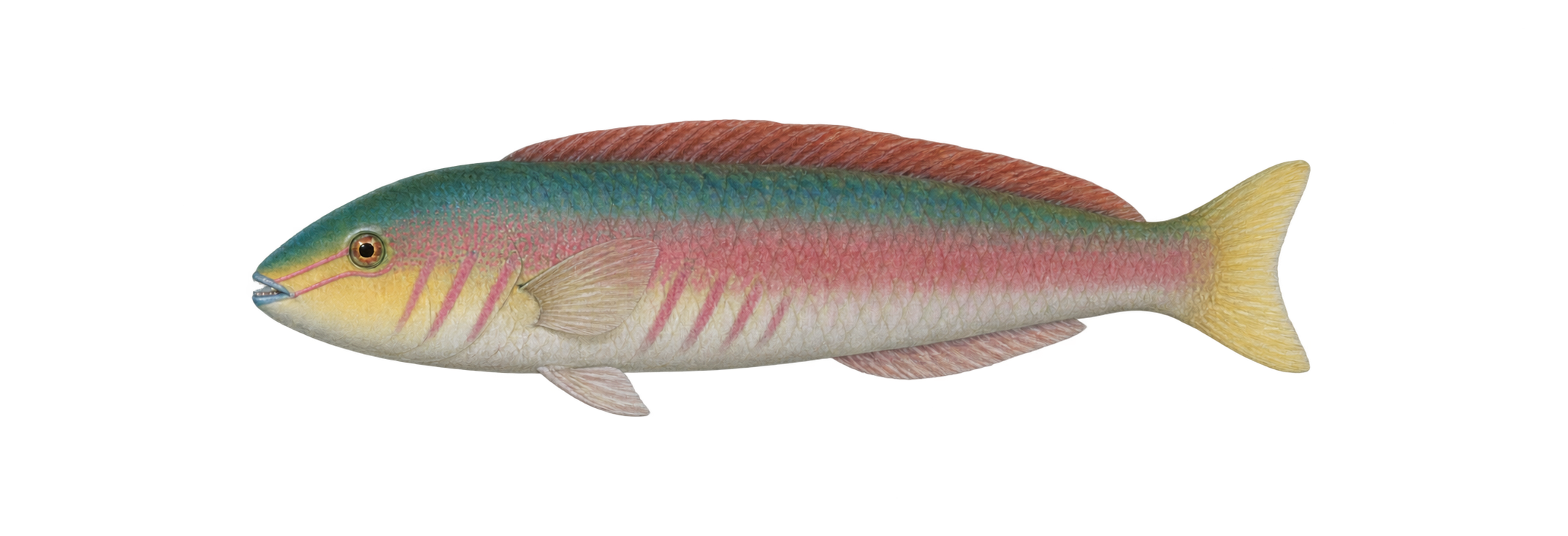
- The brownish initial-phase pattern and green-and-pink terminal-phase pattern belong to one species. [source]
Florida and local context
REEF's cumulative diver-survey report lists Cryptotomus roseus at Blue Heron Bridge (WPB), Phil Foster Park. This is a species-level citizen-science report, not an independently reidentified specimen or a prediction of present-day abundance.
A documented past record does not establish present abundance or guarantee an encounter.
Sources: REEF: Blue Heron Bridge cumulative diver-survey species report
How to recognize this animal
A very slender, cigar-shaped parrotfish with a pointed snout. Initial-phase fish and juveniles can be tan, brown or reddish above, pale underneath, and marked with two pale lengthwise stripes. Terminal-phase fish have green or blue upper areas and a pink side stripe with pink markings around the head. Its slim outline can look more wrasse-like than parrot-like.
Sources: Smithsonian Tropical Research Institute: bluelip parrotfish
Size and life stages
The reported maximum is 13 cm (5.1 inches); FishBase gives about 10 cm as a common length. Juveniles and initial-phase adults can both be relatively plain, so a muted pattern is not an exact age test. Use a full side view and keep the phase label separate from any unverified sex assignment.
Sources: Smithsonian Tropical Research Institute: bluelip parrotfish; FishBase: bluelip parrotfish size account
Habitat and where to look
Look around seagrass, algae, rubble and sponge-associated bottom. Smithsonian’s habitat summary and the UWI account both emphasize vegetated shallow coastal settings. Approach above the plants rather than pushing between them. Finding a small, slender fish here is a starting clue, not enough to distinguish it from similarly shaped wrasses.
Sources: Smithsonian Tropical Research Institute: bluelip parrotfish; University of the West Indies: slender or bluelip parrotfish ecology
Range and local context
The western Atlantic range extends from Bermuda and the southeastern United States through the Caribbean toward Brazil. Sources also discuss wider central Atlantic occurrence, but no wider record substitutes for the local evidence. The project uses the species-level Blue Heron Bridge REEF entry for its West Palm Beach diving connection.
Sources: Smithsonian Tropical Research Institute: bluelip parrotfish; University of the West Indies: slender or bluelip parrotfish ecology
What is on the menu?
It is a vegetation-feeding parrotfish, with seagrasses and algae listed in the sources. Unlike the familiar solid beak of many parrotfishes, Smithsonian describes separate, flattened, pointed jaw teeth, along with crushing structures in the throat. We do not infer that this little species produces large amounts of reef sand from family-wide descriptions.
Sources: Smithsonian Tropical Research Institute: bluelip parrotfish; University of the West Indies: slender or bluelip parrotfish ecology
Daily habits and behavior
The UWI account, citing Caribbean research, describes daytime feeding in pairs or small groups, sometimes including a terminal-phase fish. A quiet wait at the edge of a grassbed can document the real group rather than a group scattered by the photographer. Local group sizes and daily routes are not established by this profile.
Sources: University of the West Indies: slender or bluelip parrotfish ecology
Mating and the next generation
Caribbean research supports female-to-male sex change and documents spawning behavior. The Smithsonian species data list pelagic eggs and larvae. The published studies concern particular sampled populations, so no single size is presented as an inevitable transition point for every fish, and no Palm Beach spawning timetable is promised.
Sources: Smithsonian Tropical Research Institute: bluelip parrotfish; Robertson and Warner (1978): Caribbean parrotfish sexual patterns
Look-alikes and identification traps
Slippery dick and other small wrasses can share the slim shape and lengthwise markings. Compare the whole body pattern and mouth profile instead of assuming every green, narrow fish is a wrasse. The scientific account’s dental distinction is valuable, but a diver should not capture a fish to inspect its teeth.
Sources: Smithsonian Tropical Research Institute: bluelip parrotfish
Observe without disturbing
Keep fins, hoses and camera arms out of the seagrass. Let a grazing group continue its path without circling or cutting it off. Do not turn a resting fish or disturb the bottom to investigate nighttime behavior. Avoid repeating generic parrotfish cocoon or coral-grinding claims unless evidence specifically supports this species.
Sources: Smithsonian Tropical Research Institute: bluelip parrotfish; University of the West Indies: slender or bluelip parrotfish ecology
Harvest, protection and eating safety
Live-only ornamental collection; no collection at Blue Heron Bridge
Yellow means legal or safety conditions require attention. It is not an edible badge or permission to take an animal.
This color is a qualified summary, not permission to collect or a guarantee that a particular animal is safe to eat.
Can it be hunted or harvested?
Bluelip Parrotfish falls under Florida’s parrotfish category, called family Scaridae in the regulations. A recreational saltwater fishing license is required unless exempt. Where collection is lawful, the animal must be landed alive and maintained alive in a suitably sized circulating, aerated or oxygenated system. The recreational limit is five of this species within 20 marine-life organisms per person per day; the two-day possession limit is ten of this species within 40 total. Recreational sale is prohibited. Maximum 12 inches total length.
Florida seasons and areas
The designated Blue Heron Bridge Special Marine Life Area, including Phil Foster Park and its mapped surrounding waters, is closed to collection of listed tropical ornamental marine life. Narrow motorized-vessel transit and landing exceptions concern animals lawfully taken elsewhere, not collection here. The Florida marine-life requirements also apply in adjacent federal waters. No species-specific annual closed months are stated in the reviewed marine-life table. Biscayne National Park, state parks, wildlife refuges and Florida Keys sanctuary zones can impose additional closures; check the actual location before collecting.
Can it be speared?
No recreational spearing under these live-only marine-life requirements. Collection uses authorized nonlethal hand/net/slurp-gun methods, subject to species and site restrictions. Quinaldine is prohibited.
Is it safe to eat?
This is live-only ornamental collection, not food harvest. Do not kill a collected animal for a meal. No recipe or safe-to-eat claim is provided.
Modern WoRMS placement in Labridae does not remove the rule’s expressly named parrotfish category.
Palm Beach is Atlantic Florida. Do not transfer Atlantic guidance to the Gulf, Monroe County, or federal waters without checking the applicable rules.
Before you act: Confirm the species, date, exact management area, state or federal waters, gear, licenses and current local closures. A local occurrence record never grants permission to take an animal.
Official rules and health guidance
- FWC recreational marine-life requirements and species list
- Florida Rule 68B-42.001: listed marine-life species
- Florida Rule 68B-42.0036: mapped marine-life collection closures
- Palm Beach County: Phil Foster Park fishing and collection notice
- FWC spearing restrictions
- NOAA: Florida Keys sanctuary zones
- Florida Rule 68B-42.005: final-adopted recreational bag rule register
Reviewed 2026-11-11. Rules and advisories can change; check the linked authorities before acting.
Identification and source cautions
- UWI’s generic-looking fused-beak, sand-production and nighttime-cocoon statements are not adopted; Smithsonian’s species-specific dentition takes precedence.
- No universal sex-change size or Palm Beach spawning schedule is asserted.
Sources and review
Biology and taxonomy reviewed 2026-11-11. Photographs on cited sites are reference material and are not reproduced here.
- Smithsonian Tropical Research Institute: bluelip parrotfish
- FishBase: bluelip parrotfish size account
- University of the West Indies: slender or bluelip parrotfish ecology
- Robertson and Warner (1978): Caribbean parrotfish sexual patterns
- WoRMS: accepted taxonomy
- REEF: Blue Heron Bridge cumulative diver-survey species report
Make your next dive happen
Dive With Us
Explore local charters and plan a dive suited to your experience.
View dive calendarTrain With Us
Build your fish identification, buoyancy and diving skills.
Explore trainingTravel With Us
Discover upcoming dive adventures and trip details.
Explore dive travelShop With Us
Browse equipment for your diving and ask our team for help choosing.
Explore dive gearReview current dates, availability, prices, inclusions and requirements on each listing before booking or buying.
Call us now
Ask about marine life identification
Marine Life Identification
Ask about dates, prerequisites or your next step. An inquiry does not reserve a place. Please provide your own contact details; do not include medical, payment or a child's personal information.
We use these details to respond to your inquiry. This form does not sign you up for marketing.
Explore more with Stuart Scuba
Open Water course options · Advanced Adventure training · Technical training · Professional training · All courses · Local dives · Dive trips · Facebook · Instagram · YouTube
Your surface-interval essentials
Questions for Stuart Scuba? info@stuartscuba.com
Check the Stuart Scuba Weather Center · Play scuba trivia
Weather and wildlife vary. Confirm current conditions, trip requirements and departure details with the operator.
Plan Your Next Dive with Stuart Scuba
Dive With Us
Explore upcoming local charters and choose a dive that fits your experience.
Before you book
Check the individual listing for departure time, requirements and availability.
Travel With Us
Find upcoming dive adventures and start planning your next trip.
Plan your trip
Review dates, inclusions and trip details on the travel calendar.
Stay Connected with Stuart Scuba
 Follow pageShare
YouTube
SubscribeWatch & shareFollow on InstagramView & share post
Follow company news, training updates, and dive stories.
Follow on LinkedInGoogle Reviews
See Stuart Scuba’s current Google rating and review count below. Open the listing in Google Maps to browse customer reviews.



