

Fish identification archive / Blue Crab
Blue Crab
Callinectes sapidus · Portunidae
I saw this
Spotted this marine life? Share the guide with your dive buddies. Review your caption before posting.
For Instagram, copy the caption and link into your own post or message. Nothing is posted automatically and this does not record a verified sighting.
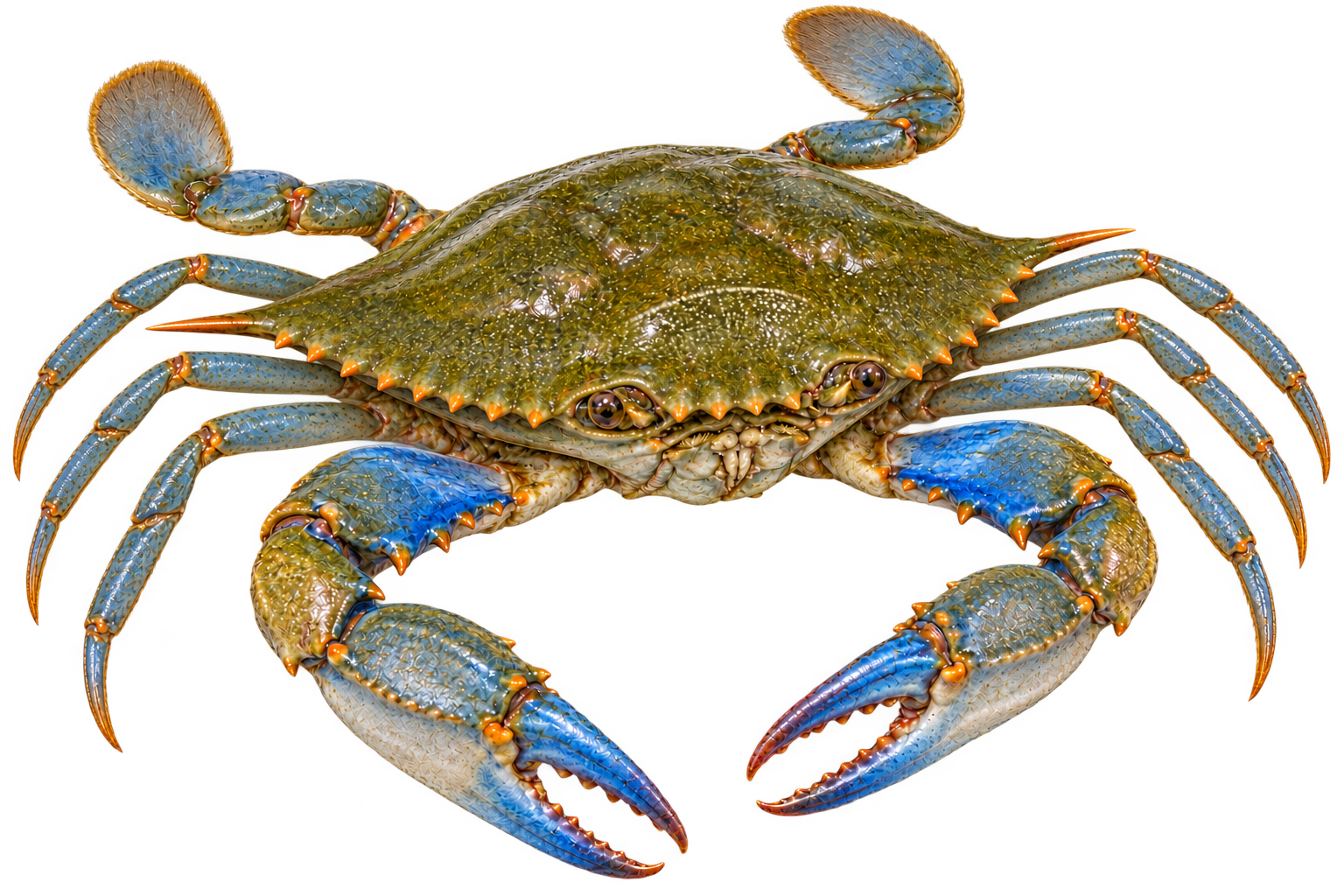
The blue crab, Callinectes sapidus, is recognizable by its broad shell, long side spines and paddle-shaped rear legs. The carapace is often olive or bluish green, while the claws can show conspicuous blue. Mature females commonly have red claw tips. Check the complete outline and swimming legs rather than labeling every blue-tinted crab as this species.
Atlantic Florida habitat
FWC documents blue-crab reproduction on Florida’s Atlantic coast and describes adults in fresh, brackish and marine settings. Seagrass and other submerged vegetation are important nursery habitat. This makes the species relevant to the estuaries and coastal waters of an Atlantic Florida guide, but not a guaranteed resident of every reef or dive site between Vero Beach and Key Largo.
The crab’s location can reflect its life stage. After mating in estuaries, females move toward saltier water near estuary mouths or the coast before spawning. A record from a lagoon and one from more open coastal water may therefore describe different parts of the same life cycle.
Food and growth
Blue crabs eat a varied diet that includes fish, mollusks, crustaceans, vegetation and organic debris. Soft-shelled crabs can also become prey. Growth requires shedding the hard outer skeleton, leaving a softer animal until the new shell firms up. An empty molt is not necessarily a dead crab.
Females mate after the molt into their mature form. FWC reports spawning throughout the year along Atlantic Florida. Do not use that biological statement as a substitute for current harvest restrictions, and do not disturb an egg-bearing animal to inspect the egg mass.
Useful identification details
FWC describes nine lateral spines behind each eye and four low, blunt points between the eye sockets. A clear front or overhead photograph may show these details. The broad outline alone can overlap with other swimming crabs, so retain an uncertain identification when the diagnostic features are hidden.
Watch without handling
Give the crab room to leave rather than blocking its path for a photograph. Do not grab its claws or flip it over to inspect the underside. Photograph visible features, note the habitat and keep a sensible distance from the sharp spines and pincers.
Current FWC rules govern recreational collection, including protections for egg-bearing females, gear requirements and area restrictions. Protected-site rules can add further limits. This page explains the animal; it is not permission to trap, collect or keep it. Leaving nursery vegetation and shallow-bottom habitat intact helps preserve the setting that supports young crabs.
Florida DEP’s 2014 St. Lucie Inlet Preserve plan also names this species in its estuarine habitat.
References
Collection and seafood safety
FWC prohibits harvesting egg-bearing blue crabs. Recreational trap use has registration and construction requirements, and crab snares are not legal blue-crab gear in Florida. Check current bag limits, trap closures and exact site restrictions. A reported sighting does not authorize trapping or collecting. Current FWC guidance. Guidance reviewed November 12, 2026. No location-specific harvest or sanitation clearance is given.
Blue Heron Bridge observation context
Snorkeling Report lists a blue-crab snorkeling photograph at Blue Heron Bridge–Phil Foster Park. This is an attributed, undated site report, not a current population survey or a guaranteed encounter. Observe without handling and follow the rules for the exact site.
Make your next dive happen
Dive With Us
Explore local charters and plan a dive suited to your experience.
View dive calendarTrain With Us
Build your fish identification, buoyancy and diving skills.
Explore trainingTravel With Us
Discover upcoming dive adventures and trip details.
Explore dive travelShop With Us
Browse equipment for your diving and ask our team for help choosing.
Explore dive gearReview current dates, availability, prices, inclusions and requirements on each listing before booking or buying.
Call us now
Ask about fish identification training
Reef Fish Identification
Ask about dates, prerequisites or your next step. An inquiry does not reserve a place. Please provide your own contact details; do not include medical, payment or a child's personal information.
We use these details to respond to your inquiry. This form does not sign you up for marketing.
Explore more with Stuart Scuba
Open Water course options · Advanced Adventure training · Technical training · Professional training · All courses · Local dives · Dive trips · Facebook · Instagram · YouTube
Your surface-interval essentials
Questions for Stuart Scuba? info@stuartscuba.com
Check the Stuart Scuba Weather Center · Play scuba trivia
Weather and wildlife vary. Confirm current conditions, trip requirements and departure details with the operator.
Plan Your Next Dive with Stuart Scuba
Dive With Us
Explore upcoming local charters and choose a dive that fits your experience.
Before you book
Check the individual listing for departure time, requirements and availability.
Travel With Us
Find upcoming dive adventures and start planning your next trip.
Plan your trip
Review dates, inclusions and trip details on the travel calendar.
Stay Connected with Stuart Scuba
 Follow pageShare
YouTube
SubscribeWatch & shareFollow on InstagramView & share post
Follow company news, training updates, and dive stories.
Follow on LinkedInGoogle Reviews
See Stuart Scuba’s current Google rating and review count below. Open the listing in Google Maps to browse customer reviews.



