

Fish identification archive / Blacknose Shark
Blacknose Shark
Carcharhinus acronotus
Fun facts for your next surface interval
- The nose knows: the black nose smudge is often easier to see on a young shark than on an adult.
- A change of depth: young blacknose sharks and adults can favor different water depths.
- The long-lived ladies: female blacknose sharks grow more slowly than males but can live longer and reach a larger size.
Florida and local context
Florida regional occurrence; no site-level or abundance claim: FWC species information and the NPS Biscayne fish list support Florida occurrence. The park-level record is not a verified Palm Beach or Blue Heron Bridge sighting.
Documented regional presence is not a guarantee of an encounter or a measure of how common this animal is at your dive site.
How to recognize this animal
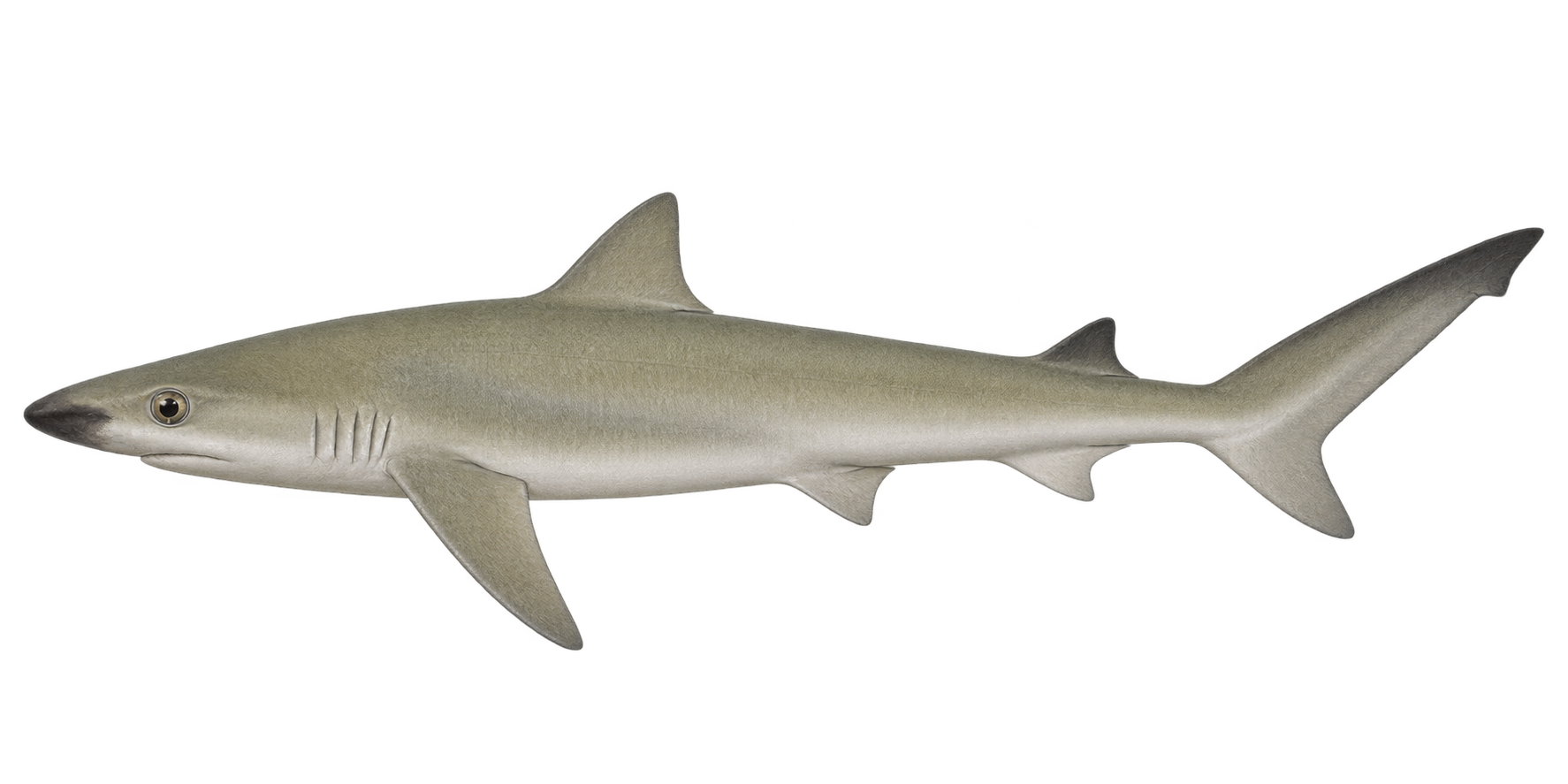
The dark smudge on the underside of the snout gives the blacknose shark its name. It is often strongest in young sharks and can fade in adults. The body is slender, olive-gray to brown above and pale below, with a small first dorsal and no interdorsal ridge. Do not confuse a shadow across the nose with a genuine mark.
Size and life stages
Florida and NOAA summaries place large blacknose sharks around 4.5–5 feet (1.4–1.5 meters) long. Pups are roughly 17–20 inches (43–51 centimeters) at birth. The snout mark is not a measure of age precise enough for a field estimate. A small shark may be a juvenile of a much larger species, so proportions still matter.
Habitat and where to look
Blacknose sharks occupy coastal bays, lagoons and shelf waters. Young animals are more associated with shallow habitat, while adults can occur deeper, including water beyond about 30 feet (9 meters). Sand and seagrass settings both provide feeding opportunities. A calm bay sighting and a deeper coastal observation can therefore belong to the same species at different life stages.
Range and local context
Florida occurrence is supported by FWC’s species account and the National Park Service’s Biscayne fish list. These are regional records, not confirmation of a specific Blue Heron Bridge or Palm Beach encounter. The broader distribution lies in the western Atlantic. A species on a park list still needs direct evidence before being claimed from a particular dive.
What is on the menu?
Small fishes such as pinfish, croakers and anchovies contribute to the diet; crustaceans and other marine prey are also recorded. The snout mark is pigmentation, not a feeding tool or lure. Watch a shark’s route over the bottom and its response to fish schools without supplying bait. A brief pass does not reveal everything it has been eating.
Daily habits and behavior
Blacknose sharks may form schools and move seasonally within coastal waters. Age-related habitat use can change the apparent size mix at a location. Being a relatively small shark does not make it appropriate to handle or corner. A useful behavior note describes group size, swimming depth and direction rather than guessing whether a passing animal was curious or friendly.
Mating and the next generation
Blacknose sharks give birth to live young. FWC reports litters of about 1–8 pups after roughly 10–11 months of gestation. Reproductive schedules differ among studied regions, so a single breeding calendar should not be applied to all Florida waters. Male claspers distinguish sex when naturally visible; a dark snout does not distinguish males from females.
Look-alikes and identification traps
Atlantic sharpnose sharks often have pale body spots and a more conspicuously pointed snout. Finetooth sharks have unusually long gill slits and lack the characteristic nose blotch. Because the blacknose mark can weaken with age, combine it with fin position and body shape. A photograph showing only the dark nose is weaker evidence than a clear complete side view.
Observe without disturbing
Stay above the bottom without stirring sand, and allow the shark to leave a bay or channel freely. Photograph the snout and both dorsal fins if the opportunity occurs naturally. Do not approach from below merely to inspect the mark. Report an uncertain identification when glare, poor visibility or a hidden head prevents the distinguishing features from being seen.
Harvest, protection and eating safety
Harvest limited; mercury warning
Florida state waters: harvest is conditional on the shark size, bag, hook-and-line and permit rules below; no species-specific annual state closure is listed. Federal HMS rules can be stricter. The June 2021 guide currently linked by DOH says do not eat coastal sharks 43 inches or longer; below 43 inches, women of childbearing age and young children should not eat them, and others are limited to one meal/month. Recheck current advice.
This color is a qualified summary, not permission to collect or a guarantee that a particular catch is safe to eat. Read the current rules and health guidance below.
Harvestable shark with state and federal restrictions
Can it be hunted or harvested?
Florida state rules list no minimum size for this species. The state daily limit is one shark per person and two per vessel, all shark species combined. Hook-and-line is the only legal shark-harvest gear; required non-offset, non-stainless-steel circle hooks apply when using natural bait. Do not use multiple hooks with natural bait, and carry a cutting device. Land sharks with head, tail and fins attached; gutting is allowed. A saltwater license is required unless exempt. Shore-based shark fishing requires FWC’s course and permit for anglers age 16 and older, including otherwise license-exempt anglers; younger anglers have course/supervision requirements. Under federal HMS recreational rules, the minimum is 54 inches fork length and the limit is one shark total from the all-other-sharks category per vessel per trip.
Florida seasons and areas
FWC lists no species-specific state closed season for this shark. Federal HMS permits and a shark endorsement are required for covered recreational shark activity, and HMS-permitted vessels must comply with applicable federal permit conditions even in state waters. Do not substitute the state limit for the federal one. Local closures and additional federal requirements must be checked for the actual trip.
Can it be speared?
No. Florida prohibits spearing all sharks, even species that can legally be retained by hook-and-line. No powerheads or bangsticks may be used to take this shark.
Is it safe to eat?
Legal retention is not a food-safety guarantee. FDA lists shark in the highest-mercury Choices to Avoid category for people who are pregnant, might become pregnant or are breastfeeding, and children ages 1–11. Other consumers should consult current Florida DOH advice for the species, size and catch area before eating it. The June 2021 guide currently linked by Florida DOH says not to eat coastal-water sharks 43 inches or longer, for any listed population. Below 43 inches, it advises women of childbearing age and young children not to eat them, and other consumers to limit them to one meal per month. This is an older currently linked guide, not a new 2026 table; recheck the current advisory before eating. The guide defines a meal as six ounces of cooked fish; consult current advice for age-appropriate portions and count other fish eaten as well.
Before you act: This recreational overview is not permission to collect or spear at your dive site. Confirm the species, date, management area, state or federal waters, gear, licenses and current local closures. Identification artwork cannot establish an identification or guarantee seafood safety.
Official rules and health guidance
- FWC current recreational shark rules
- NOAA current HMS recreational guide landing page and permit guidance
- NOAA linked 2025 HMS recreational guide, pages 15–16
- NOAA blacknose shark: recreational federal management
- FWC saltwater recreational licensing
- FWC prohibited species, gear and spearing locations
- FDA advice about eating fish
- Florida DOH current fish-consumption advisory portal
- Florida DOH June 2021 guide, currently linked from its advisory portal
Reviewed 2026-11-10. Rules and advisories can change; check the linked authorities before harvesting or eating.
Sources and review
Reviewed 2026-11-10.
- National Park Service: Biscayne fish list
- NOAA shark identification guide: diagnostic anatomy, size, habitat and range
- NOAA species account: biology, distribution and management
- FWC species account: Florida occurrence and biology
- Florida Museum species account: anatomy and life history
- UF/IFAS Florida Sea Grant: claspers and shark/ray reproductive anatomy
- Eschmeyer’s Catalog of Fishes: current taxonomy and synonymy
Make your next dive happen
Dive With Us
Explore local charters and plan a dive suited to your experience.
View dive calendarTrain With Us
Build your fish identification, buoyancy and diving skills.
Explore trainingTravel With Us
Discover upcoming dive adventures and trip details.
Explore dive travelShop With Us
Browse equipment for your diving and ask our team for help choosing.
Explore dive gearReview current dates, availability, prices, inclusions and requirements on each listing before booking or buying.
Call us now
Ask about marine life identification
Marine Life Identification
Ask about dates, prerequisites or your next step. An inquiry does not reserve a place. Please provide your own contact details; do not include medical, payment or a child's personal information.
We use these details to respond to your inquiry. This form does not sign you up for marketing.
Explore more with Stuart Scuba
Open Water course options · Advanced Adventure training · Technical training · Professional training · All courses · Local dives · Dive trips · Facebook · Instagram · YouTube
Your surface-interval essentials
Questions for Stuart Scuba? info@stuartscuba.com
Check the Stuart Scuba Weather Center · Play scuba trivia
Weather and wildlife vary. Confirm current conditions, trip requirements and departure details with the operator.
Plan Your Next Dive with Stuart Scuba
Dive With Us
Explore upcoming local charters and choose a dive that fits your experience.
Before you book
Check the individual listing for departure time, requirements and availability.
Travel With Us
Find upcoming dive adventures and start planning your next trip.
Plan your trip
Review dates, inclusions and trip details on the travel calendar.
Stay Connected with Stuart Scuba
 Follow pageShare
YouTube
SubscribeWatch & shareFollow on InstagramView & share post
Follow company news, training updates, and dive stories.
Follow on LinkedInGoogle Reviews
See Stuart Scuba’s current Google rating and review count below. Open the listing in Google Maps to browse customer reviews.



