

Fish identification archive / Bigeye Thresher
Bigeye Thresher
Alopias superciliosus · Alopiidae
I saw this
Spotted this fish? Share the guide with your dive buddies. Review your caption before posting.
For Instagram, copy the caption and link into your own post or message. Nothing is posted automatically and this does not record a verified sighting.
Identification and comparisons
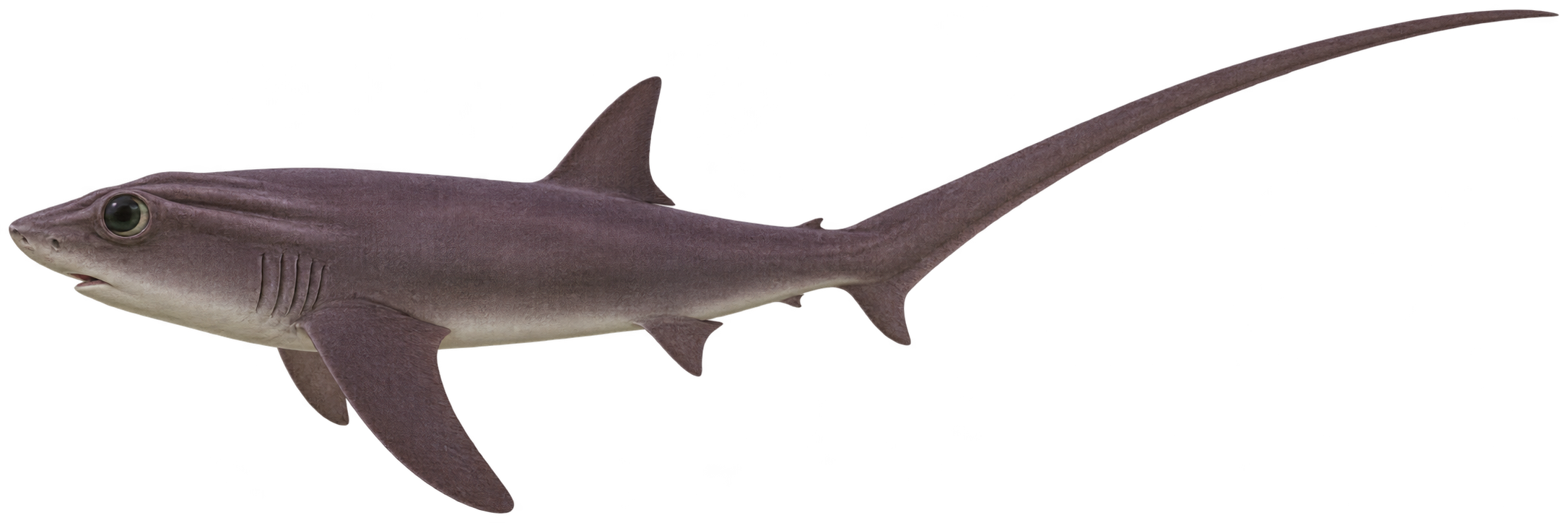
Huge eyes directed partly upward and deep grooves across the top of the head distinguish this thresher from the common thresher. Both have an extremely long upper tail lobe. On a bigeye, the pale underside does not extend above the pectoral fins as it does on the common thresher. Photographing these features from a safe distance is more informative than estimating size alone. Florida Museum identification profile.
Atlantic Florida context
The Florida Museum explicitly includes Florida, and NOAA describes a western Atlantic range from New York to Cuba. Its usual setting is offshore near the continental-shelf edge. This supports an offshore regional guide entry, not a routine shallow-reef encounter. The museum’s older depth summary is shallower than NOAA’s current identification guide; the profile therefore avoids declaring a hard depth limit. NOAA regional identification guides.
Feeding, breeding and size
Fishes and squid are important prey. The long tail contributes to prey capture. Females produce small litters of live young, with embryos nourished by yolk and additional eggs rather than a placenta. Published maximum lengths and weight conversions differ among references, so a precise record badge is withheld. Total length includes that enormous upper tail lobe; fork length does not measure to its tip. Species biology reference.
Three things worth noticing
- Its eyes and head grooves distinguish it better than the long tail alone.
- A long tail does not mean a long list of pups: litters are small.
- Two thresher species have different scientific names and different fishing rules.
Observation and harvest caution
This shark is prohibited from harvest in Florida state waters and is on the federal prohibited-species list. Consult Florida’s shark rules and NOAA’s current recreational shark guidance. Prohibited sharks must remain in the water with their gills submerged under Florida’s handling rules. Do not delay release for photographs or measurements. The Florida legal definitions correctly identify bigeye as Alopias superciliosus and common thresher as Alopias vulpinus.
For divers, the useful response is to stay with the group, follow the guide’s directions and give the animal room. Do not chase, touch, feed or block its path for a better image. Record the date, location, depth and identifying features after the encounter. An honest uncertain identification is better than attaching a confident species name to an indistinct silhouette.
Current recreational retention rules
Checked November 12, 2026: recreational harvest of bigeye threshers is prohibited in Florida state waters and retention is prohibited under Atlantic federal shark rules. Florida requires prohibited sharks to remain in the water with their gills submerged. NOAA requires release with minimal injury without removing the shark from the water. Do not delay release for photographs or measurements. Check current jurisdiction-specific requirements before fishing. Official FWC shark rules Official NOAA retention guidance Official Florida legal definitions
Make your next dive happen
Dive With Us
Explore local charters and plan a dive suited to your experience.
View dive calendarTrain With Us
Build your fish identification, buoyancy and diving skills.
Explore trainingTravel With Us
Discover upcoming dive adventures and trip details.
Explore dive travelShop With Us
Browse equipment for your diving and ask our team for help choosing.
Explore dive gearReview current dates, availability, prices, inclusions and requirements on each listing before booking or buying.
Call us now
Ask about fish identification training
Reef Fish Identification
Ask about dates, prerequisites or your next step. An inquiry does not reserve a place. Please provide your own contact details; do not include medical, payment or a child's personal information.
We use these details to respond to your inquiry. This form does not sign you up for marketing.
Explore more with Stuart Scuba
Open Water course options · Advanced Adventure training · Technical training · Professional training · All courses · Local dives · Dive trips · Facebook · Instagram · YouTube
Your surface-interval essentials
Questions for Stuart Scuba? info@stuartscuba.com
Check the Stuart Scuba Weather Center · Play scuba trivia
Weather and wildlife vary. Confirm current conditions, trip requirements and departure details with the operator.
Plan Your Next Dive with Stuart Scuba
Dive With Us
Explore upcoming local charters and choose a dive that fits your experience.
Before you book
Check the individual listing for departure time, requirements and availability.
Travel With Us
Find upcoming dive adventures and start planning your next trip.
Plan your trip
Review dates, inclusions and trip details on the travel calendar.
Stay Connected with Stuart Scuba
 Follow pageShare
YouTube
SubscribeWatch & shareFollow on InstagramView & share post
Follow company news, training updates, and dive stories.
Follow on LinkedInGoogle Reviews
See Stuart Scuba’s current Google rating and review count below. Open the listing in Google Maps to browse customer reviews.



