

Fish identification archive / Bicolor Damselfish
Bicolor Damselfish
Stegastes partitus
I saw this
Spotted this marine animal? Share the guide with your dive buddies. Review your caption before posting.
For Instagram, copy the caption and link into your own post or message. Nothing is posted automatically and this does not record a verified sighting.
Fun facts for your next surface interval
- A tuxedo with options: this species has several intergrading black-and-white color patterns.
- Courtship comes with sound effects: males can grunt during their mating display.
- Tiny fish, surprisingly long résumé: the Smithsonian account reports an age of 13 years.
Florida and local context
Lake Worth Lagoon, Palm Beach County, Florida: Florida Museum checklist has an observer and verification mark for Stegastes partitus. This establishes occurrence, not local abundance.
Documented regional presence is not a guarantee of an encounter or a measure of how common this animal is at your dive site.
How to recognize this animal
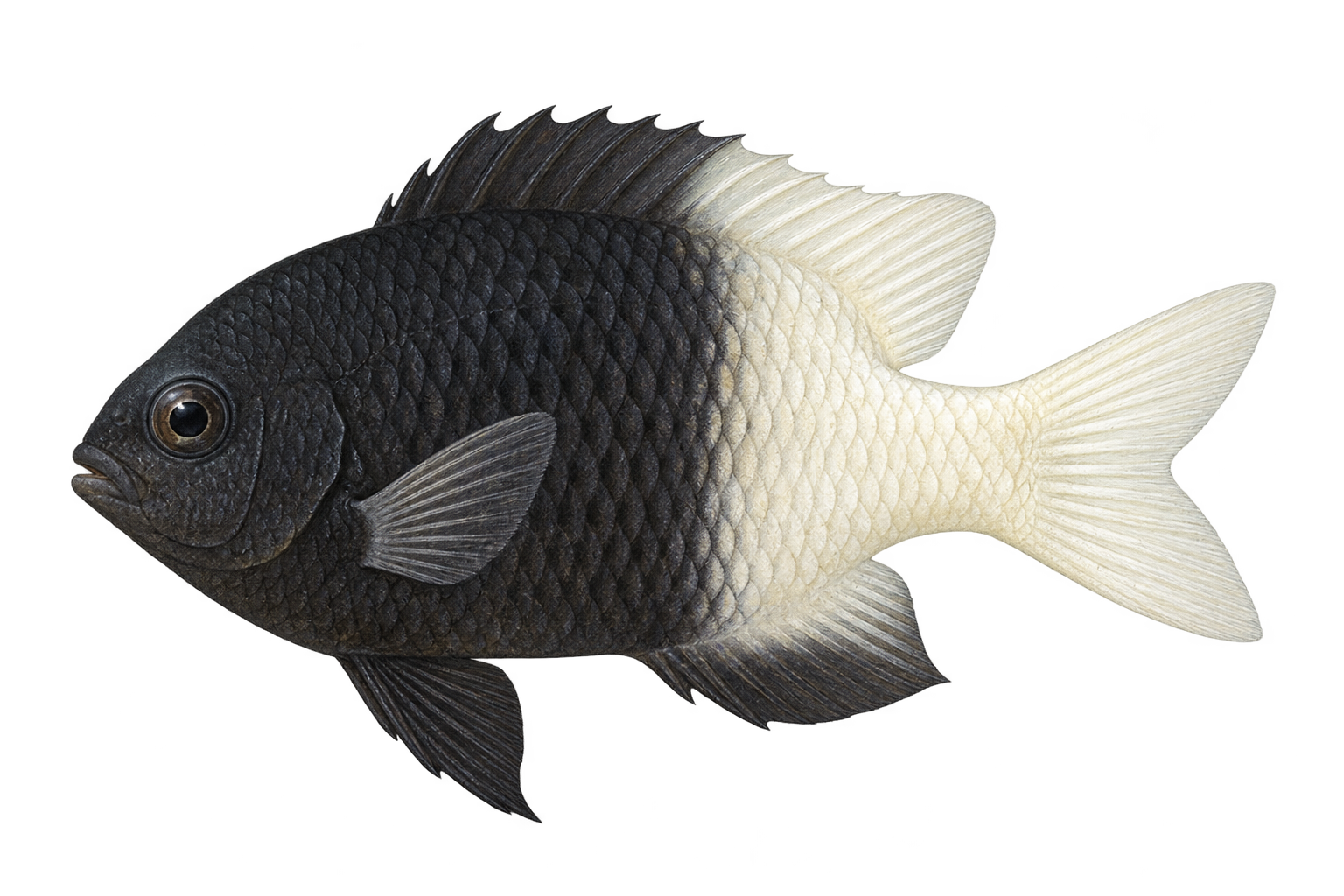
Bicolor Damselfish is a compact, laterally flattened reef fish with a small mouth and a shallowly forked tail. The familiar outfit is dark in front and pale behind, but other individuals have a yellow-orange lower front or a mostly pale body with a dark tail. The illustration shows the dark-front form. One color boundary alone is not a reliable test.
Size and life stages
This is a small species, reaching about 10 cm. A large adult can still disappear visually beside a coral head or a school of bigger fish. Photograph the whole outline before trying to estimate length from a close-up. The large eye, short soft fins and sturdy little body are useful clues even when exact size is difficult to judge.
Habitat and where to look
Look around sheltered coral and rocky reefs, including the spaces near rubble and other solid structure. A useful search starts slightly above the bottom, then follows an individual back toward cover. Although records span a broad depth range, that is a description of the species, not a recommendation to leave the agreed depth or route of your dive.
Range and local context
Bicolor Damselfish occurs in the western Atlantic, including Florida, the Bahamas and the Caribbean. Florida Museum's Lake Worth Lagoon checklist specifically verifies it, giving this guide a documented Palm Beach County connection. A checklist is a record of occurrence, not a promise of today's conditions. Visibility, habitat and the fish's own position all affect what you actually see.
What is on the menu?
Its diet includes zooplankton as well as other small food items. Unlike a simple picture of all damselfishes as reef gardeners, this species can feed above its home area. Watch for quick, directed mouth movements in the water rather than assuming every turn is territorial defense. A feeding observation is stronger when you can describe the action, not just name the nearby substrate.
Daily habits and behavior
Territorial behavior is a conspicuous part of its life. A fish may repeatedly leave a small area and return, or challenge another fish crossing its patch. Do not mistake a group of neighboring territories for a freely roaming school. Remaining still for a short interval often reveals these boundaries better than swimming from one individual to the next.
Mating and the next generation
A male prepares a spawning surface and courts females with conspicuous movements and sound. Eggs attach to the substrate, and the male guards them until hatching. This is quite different from releasing unattended eggs into open water. A quick display is not enough to diagnose spawning, however; observe from a distance without moving closer to inspect or expose a possible nest.
Look-alikes and identification traps
Juvenile and adult damselfishes can share broad dark-and-pale patterns. Compare the location of the boundary, tail shape and fin lengths instead of choosing a name from color alone. Beaugregory usually shows blue spotting and often a yellow lower body; chromis have a more deeply forked tail. Keep photographs of uncertain individuals for comparison after the dive.
Observe without disturbing
Give a territorial fish room to settle rather than repeatedly testing its response. Do not put fingers, a camera or a pointer into its refuge, and never rearrange rubble to locate eggs. Hover clear of the bottom and let the fish resume its routine. A patient photograph of normal behavior is more useful than a dramatic image created by disturbing it.
Harvest, protection and eating safety
Restricted marine life: live collection only; no spearing
Can it be hunted or harvested?
Bicolor Damselfish is regulated live ornamental marine life, not an ordinary food-fishing target. FWC lists no species-specific size limit for this damselfish. A saltwater fishing license is required unless exempt. Fish must be landed and kept alive with adequate aeration or circulating water. Daily limit: five of this species within 20 marine-life organisms; possession: ten within 40. Recreational sale is prohibited.
Florida seasons and areas
No recreational closed months are listed for this species in the reviewed marine-life rules. Collection is prohibited within the designated Blue Heron Bridge dive site. Florida marine-life rules also apply in adjacent federal waters. Sanctuary no-take zones and other park or refuge restrictions can close otherwise eligible areas; check the exact site before collecting.
Can it be speared?
Prohibited. FWC expressly includes damselfishes among ornamental reef-fish families that cannot be taken by spearing. Chromis and reeffishes are damselfishes too.
Is it safe to eat?
This live-collection classification is not an eating-safety approval. No species-specific Florida consumption clearance was verified. Do not assume a fish is safe because it is small, colorful or absent from an advisory chart. Marine toxins can cause illness despite cooking; consult current local health guidance rather than using this identification page as permission to eat it.
Before you act: This recreational overview is not permission to collect or spear at your dive site. Confirm the species, date, management area, state or federal waters, gear, licenses and current local closures. Identification artwork cannot establish an identification or guarantee seafood safety.
Official rules and health guidance
- FWC: Recreational Marine Life
- Florida Administrative Code: current Marine Life chapter 68B-42
- FWC: Saltwater Recreational Licenses
- NOAA: Florida Keys Sanctuary Regulations
- FWC: Spearing
- Florida Department of Health: Eating Healthy Seafood
- Florida Department of Health: Seafood Poisoning
- FDA/EPA: Advice about Eating Fish
Reviewed 2026-11-10. Rules and advisories can change; check the linked authorities before harvesting or eating.
Sources and review
Reviewed 2026-11-10.
Make your next dive happen
Dive With Us
Explore local charters and plan a dive suited to your experience.
View dive calendarTrain With Us
Build your fish identification, buoyancy and diving skills.
Explore trainingTravel With Us
Discover upcoming dive adventures and trip details.
Explore dive travelShop With Us
Browse equipment for your diving and ask our team for help choosing.
Explore dive gearReview current dates, availability, prices, inclusions and requirements on each listing before booking or buying.
Call us now
Ask about marine life identification
Marine Life Identification
Ask about dates, prerequisites or your next step. An inquiry does not reserve a place. Please provide your own contact details; do not include medical, payment or a child's personal information.
We use these details to respond to your inquiry. This form does not sign you up for marketing.
Explore more with Stuart Scuba
Open Water course options · Advanced Adventure training · Technical training · Professional training · All courses · Local dives · Dive trips · Facebook · Instagram · YouTube
Your surface-interval essentials
Questions for Stuart Scuba? info@stuartscuba.com
Check the Stuart Scuba Weather Center · Play scuba trivia
Weather and wildlife vary. Confirm current conditions, trip requirements and departure details with the operator.
Plan Your Next Dive with Stuart Scuba
Dive With Us
Explore upcoming local charters and choose a dive that fits your experience.
Before you book
Check the individual listing for departure time, requirements and availability.
Travel With Us
Find upcoming dive adventures and start planning your next trip.
Plan your trip
Review dates, inclusions and trip details on the travel calendar.
Stay Connected with Stuart Scuba
 Follow pageShare
YouTube
SubscribeWatch & shareFollow on InstagramView & share post
Follow company news, training updates, and dive stories.
Follow on LinkedInGoogle Reviews
See Stuart Scuba’s current Google rating and review count below. Open the listing in Google Maps to browse customer reviews.



