

Fish identification archive / Bandtail Puffer
Bandtail Puffer
Sphoeroides spengleri
Fun facts for your next surface interval
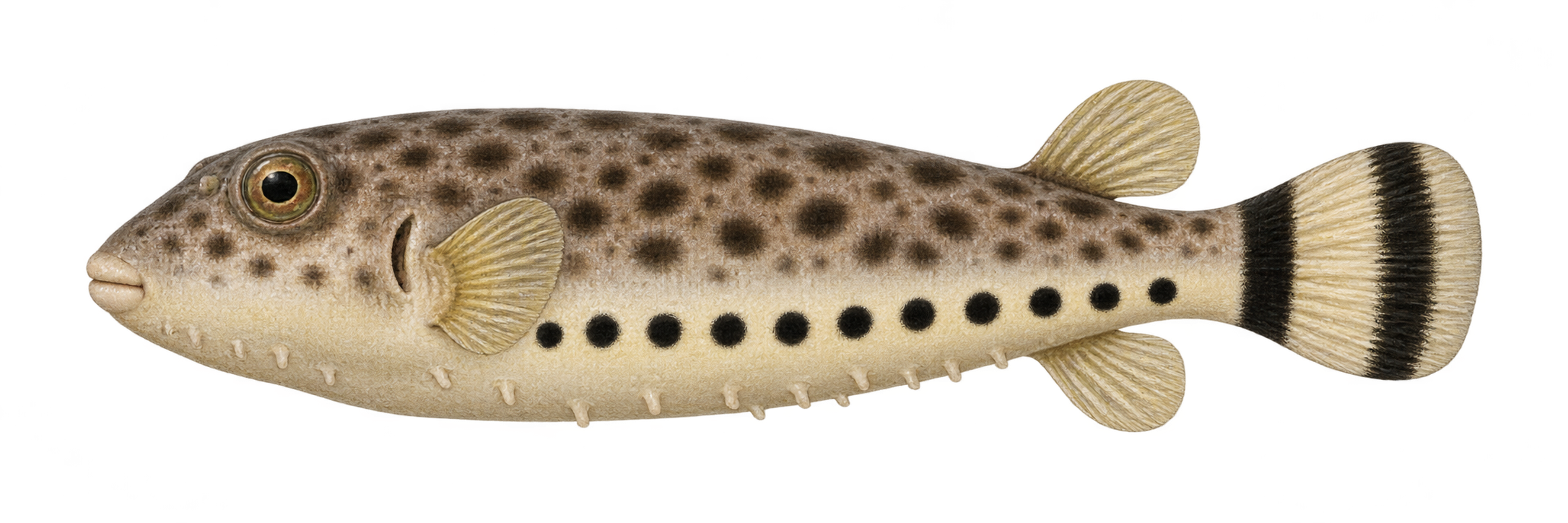
- The row of lower-side spots is more orderly than the mottled markings across its back. [source]
- Its beak is formed from four fused teeth, with a seam dividing each jaw. [source]
- Source disagreement matters: the Smithsonian regional account separates the Brazilian form while other summaries still include Brazil. [source] [source]
Florida and local context
REEF's cumulative diver-survey report lists Sphoeroides spengleri at Blue Heron Bridge (WPB), Phil Foster Park. This is a species-level citizen-science report, not an independently reidentified specimen or a prediction of present-day abundance.
A documented past record does not establish present abundance or guarantee an encounter.
Sources: REEF: Blue Heron Bridge cumulative diver-survey species report
How to recognize this animal
A blunt, short-faced puffer with large dark spots on a pale brown or gray body. Its most useful combination is a neat row of round black spots along the lower side, small uncolored skin flaps on the rear body, and two dark bands across the tail fin. Do not mistake scattered body mottling for the organized lower-side spot row.
Sources: Smithsonian Tropical Research Institute: bandtail puffer; FishBase: bandtail puffer species account
Size and life stages
Size accounts disagree. Smithsonian lists 16 cm (6.3 inches), Florent’s guide illustrates a 10–18 cm range, and FishBase reports a 30 cm maximum under a broader range treatment. This guide uses the conservative regional figure rather than presenting the larger maximum as typical. No reliable visual age scale was established in the reviewed material.
Sources: Smithsonian Tropical Research Institute: bandtail puffer; FishBase: bandtail puffer species account; Florent’s Guide: bandtail puffer, including Blue Heron Bridge photographs
Habitat and where to look
Seagrass, reef flats and reef edges provide the cover described in the species accounts. Search slowly over the interface between vegetation and open bottom without pushing grass aside. A fish visible on sand may still be using nearby cover; record its actual setting rather than assuming that every puffer prefers identical habitat.
Sources: Smithsonian Tropical Research Institute: bandtail puffer; FishBase: bandtail puffer species account
Range and local context
Smithsonian places the regional species from Massachusetts to the southern Caribbean and flags the Brazilian form as separate. FishBase and some diver guides retain a broader Brazil-inclusive range. We preserve that disagreement instead of combining it into a single confident range. Florent’s photographs independently name Blue Heron Bridge, supporting the local survey evidence.
Sources: Smithsonian Tropical Research Institute: bandtail puffer; FishBase: bandtail puffer species account; Florent’s Guide: bandtail puffer, including Blue Heron Bridge photographs
What is on the menu?
FishBase reports mollusks, crustaceans, echinoderms and worms among its prey. The mouth has fused teeth that form a strong beak. A feeding photograph may show the fish approaching bottom prey, but identifying the prey itself requires a clear view. Never offer shellfish or other food to obtain the shot.
Sources: Smithsonian Tropical Research Institute: bandtail puffer; FishBase: bandtail puffer species account
Daily habits and behavior
The species is bottom-associated and uses inshore cover. Watch the animal’s own route between vegetation, reef and sediment rather than moving it into an open patch. Detailed daily movement distances or a Palm Beach activity schedule were not established by the reviewed sources; a single resting fish cannot supply those missing data.
Sources: Smithsonian Tropical Research Institute: bandtail puffer; FishBase: bandtail puffer species account
Mating and the next generation
This is an egg-laying fish. Smithsonian lists bottom-associated eggs and pelagic larvae. That supports a life cycle with a benthic egg stage and an early drifting stage, but does not establish a local spawning season, clutch size or guarding pattern. Those details should not be borrowed from another puffer species.
Sources: Smithsonian Tropical Research Institute: bandtail puffer; FishBase: bandtail puffer species account
Look-alikes and identification traps
Checkered and southern puffers can also look blotchy. Prioritize the bandtail’s lower-side spot row and dark tail bands together. The sharpnose puffer has a much more pointed face and a yellow tail bordered along its upper and lower edges. If the tail is hidden, record a tentative identification rather than inventing the missing feature.
Sources: Smithsonian Tropical Research Institute: bandtail puffer; Smithsonian Tropical Research Institute: sharpnose puffer
Observe without disturbing
Give the fish room to move and do not prod, capture or lift it for inflation. Photograph body, lower flank and tail in one view if possible. Keep hands away from the beak, avoid handling entirely, and leave feeding surfaces intact. A recognizable photograph is not evidence that any puffer is safe to eat.
Sources: Smithsonian Tropical Research Institute: bandtail puffer
Harvest, protection and eating safety
Do not eat; Sphoeroides harvest banned in five counties
Red marks potentially severe puffer poisoning and a geographically specific harvest ban. It is not a statewide all-method prohibition claim.
This color is a qualified summary, not permission to collect or a guarantee that a particular animal is safe to eat.
Can it be hunted or harvested?
Bandtail puffer belongs to Sphoeroides. FWC prohibits taking that genus in the waters of Volusia, Brevard, Indian River, St. Lucie and Martin counties. Palm Beach County is not on that list. The reviewed regulatory species list names sharpnose puffer but does not separately list Sphoeroides spengleri, so the sharpnose live-only 5/20 limits are not assigned to bandtail by analogy. This guide does not issue a numerical take allowance for it.
Florida seasons and areas
The five-county prohibition is not a seasonal closure. Do not confuse the Martin County ban with neighboring Palm Beach County or treat its boundary as proof that harvest elsewhere is lawful or safe. Phil Foster Park, spearing restrictions, federal waters and protected-area rules need separate checks.
Can it be speared?
No. Florida Rule 68B-20.005 prohibits spearing puffers in family Tetraodontidae, which includes Sphoeroides spengleri. This method prohibition is separate from the five-county Sphoeroides all-method harvest ban.
Is it safe to eat?
Do not eat this puffer. Florida health authorities advise avoiding pufferfish. Saxitoxin and other puffer toxins can cause severe neurological poisoning; cooking or cleaning cannot establish safety. No recipe, testing shortcut or safe-preparation advice is provided.
The broad puffer headings on FWC’s summary pages and the narrower enumerated list in Rule 68B-42.001 should not be treated as identical categories. A numerical collection allowance is intentionally withheld.
Palm Beach is Atlantic Florida. Do not transfer Atlantic guidance to the Gulf, Monroe County, or federal waters without checking the applicable rules.
Before you act: Confirm the species, date, exact management area, state or federal waters, gear, licenses and current local closures. A local occurrence record never grants permission to take an animal.
Official rules and health guidance
- FWC: Sphoeroides puffer prohibition in five named counties
- FWC recreational marine-life requirements and species list
- Florida Rule 68B-42.001: listed marine-life species
- Palm Beach County: Phil Foster Park fishing and collection notice
- FWC spearing restrictions
- Florida Department of Health: seafood toxin warnings
- FWC: default recreational rules for species without specific limits
- Florida Rule 68B-20.005: puffers in family Tetraodontidae may not be speared (Cornell text)
Reviewed 2026-11-11. Rules and advisories can change; check the linked authorities before acting.
Identification and source cautions
- Regional size and Brazilian range treatment conflict between Smithsonian, FishBase and diver-guide summaries; not silently reconciled.
- No verified species-specific Palm Beach spawning schedule or guarding details.
Sources and review
Biology and taxonomy reviewed 2026-11-11. Photographs on cited sites are reference material and are not reproduced here.
- Smithsonian Tropical Research Institute: bandtail puffer
- FishBase: bandtail puffer species account
- Florent’s Guide: bandtail puffer, including Blue Heron Bridge photographs
- Smithsonian Tropical Research Institute: sharpnose puffer
- WoRMS: accepted taxonomy
- REEF: Blue Heron Bridge cumulative diver-survey species report
Make your next dive happen
Dive With Us
Explore local charters and plan a dive suited to your experience.
View dive calendarTrain With Us
Build your fish identification, buoyancy and diving skills.
Explore trainingTravel With Us
Discover upcoming dive adventures and trip details.
Explore dive travelShop With Us
Browse equipment for your diving and ask our team for help choosing.
Explore dive gearReview current dates, availability, prices, inclusions and requirements on each listing before booking or buying.
Call us now
Ask about marine life identification
Marine Life Identification
Ask about dates, prerequisites or your next step. An inquiry does not reserve a place. Please provide your own contact details; do not include medical, payment or a child's personal information.
We use these details to respond to your inquiry. This form does not sign you up for marketing.
Explore more with Stuart Scuba
Open Water course options · Advanced Adventure training · Technical training · Professional training · All courses · Local dives · Dive trips · Facebook · Instagram · YouTube
Your surface-interval essentials
Questions for Stuart Scuba? info@stuartscuba.com
Check the Stuart Scuba Weather Center · Play scuba trivia
Weather and wildlife vary. Confirm current conditions, trip requirements and departure details with the operator.
Plan Your Next Dive with Stuart Scuba
Dive With Us
Explore upcoming local charters and choose a dive that fits your experience.
Before you book
Check the individual listing for departure time, requirements and availability.
Travel With Us
Find upcoming dive adventures and start planning your next trip.
Plan your trip
Review dates, inclusions and trip details on the travel calendar.
Stay Connected with Stuart Scuba
 Follow pageShare
YouTube
SubscribeWatch & shareFollow on InstagramView & share post
Follow company news, training updates, and dive stories.
Follow on LinkedInGoogle Reviews
See Stuart Scuba’s current Google rating and review count below. Open the listing in Google Maps to browse customer reviews.



