

Fish identification archive / Banded Butterflyfish
Banded Butterflyfish
Chaetodon striatus
I saw this
Spotted this marine animal? Share the guide with your dive buddies. Review your caption before posting.
For Instagram, copy the caption and link into your own post or message. Nothing is posted automatically and this does not record a verified sighting.
Fun facts for your next surface interval
- A temporary fake eye: the juvenile dorsal eyespot fades with growth.
- Dinner can become a group event: plankton-feeding schools have been reported.
- An occasional side job in cleaning: some pick parasites from other reef fishes.
Florida and local context
Biscayne National Park, southeastern Florida: National Park Service species inventory lists Chaetodon striatus. The Lake Worth Lagoon row lacks a verified-observation mark and is not used as proof of a Palm Beach sighting.
Documented regional presence is not a guarantee of an encounter or a measure of how common this animal is at your dive site.
How to recognize this animal
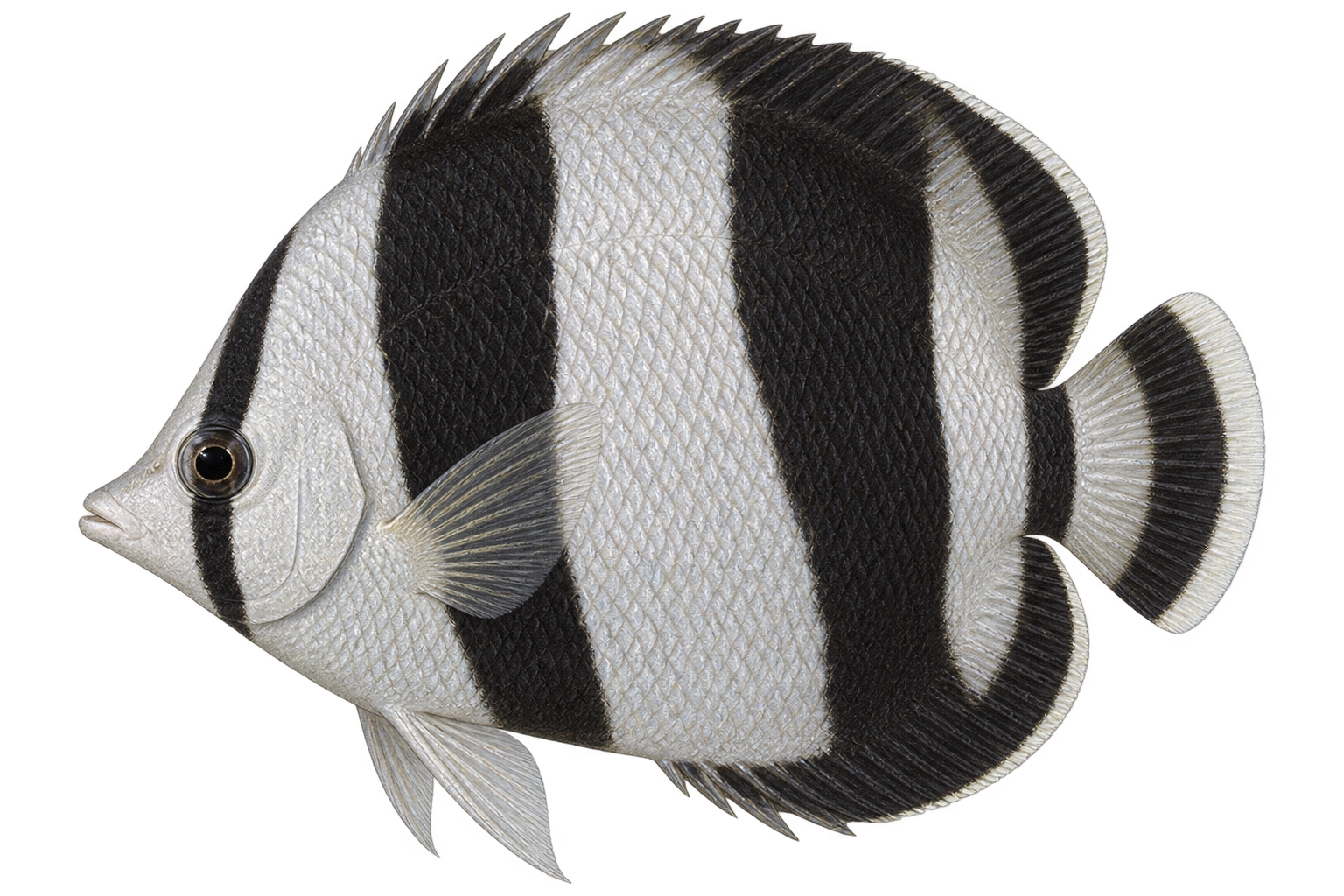
Banded Butterflyfish look like small silver disks crossed by bold black bars. One bar hides the eye, with others passing through the body and rear fin region. Fine dark chevrons lie between the larger markings. The short pointed snout, deep compressed body and rounded tail are useful structural clues. Adults lack the conspicuous dorsal eyespot carried by juveniles.
Size and life stages
Size summaries differ: Florida Museum gives about 15 cm, while Smithsonian reports 20 cm. Treat that as a published range of maxima rather than an exact local growth target. Juveniles have a browner or yellowish background and an eyespot that fades as they grow. A small, dark fish therefore need not resemble the adult illustration perfectly.
Habitat and where to look
Reefs are the principal adult setting, while young fish also use seagrass beds. Search around small feeding surfaces and shelter rather than expecting the fish to remain in midwater. Its flattened body makes it easy to lose sight of when it turns edge-on. Wait for a natural turn instead of swimming around the coral to keep it visible.
Range and local context
The National Park Service lists Banded Butterflyfish in Biscayne National Park, confirming southeastern Florida occurrence. Its wider western Atlantic range includes the Caribbean and extends south to Brazil. The Lake Worth Lagoon list contains an unverified row, so it is not used here as proof of a Palm Beach sighting. Regional presence does not establish abundance at a particular dive site.
What is on the menu?
Food includes attached invertebrates such as tube worms, anemones and corals, with small crustaceans also taken. Feeding is not restricted to the reef surface: Florida Museum describes groups taking plankton and occasional cleaning of other fishes. A butterflyfish approaching another fish might therefore be doing something other than defending space. Watch the interaction before giving it a label.
Daily habits and behavior
Individuals are often seen alone or in pairs, and daytime activity is followed by sheltering at night. Paired fish can be territorial. A quiet observer may see the alternating pauses, turns and short movements that make a small reef patch productive. Avoid assuming that every brief chase is courtship; feeding space and social interactions can also matter.
Mating and the next generation
The species produces pelagic eggs and larvae rather than guarding an attached nest. Butterflyfish development includes a specialized larval phase before the familiar juvenile body pattern appears. A pair seen on a dive is not enough evidence to identify a spawning season. This guide does not assign Florida reproductive dates from a general description of tropical butterflyfish biology.
Look-alikes and identification traps
Adult Foureyes have a large ringed rear-body eyespot and much less prominent broad barring. Adult Spotfins are mostly white with yellow fins and a small dorsal-tip spot. Young Banded Butterflyfish complicate comparisons because their dorsal ocellus temporarily resembles other juvenile patterns. Use the full arrangement of bars, the spot position and the dark pelvic fins together.
Observe without disturbing
Never separate a pair or press a fish against shelter to obtain an identification photograph. Keep fins and dangling equipment away from both coral and seagrass. If the fish withdraws, leave it room to return naturally. During a Stuart Scuba dive, a wider image that includes the fish's entire outline often tells more than a cropped close-up of a single black stripe.
Harvest, protection and eating safety
Restricted marine life: live collection only; spearing prohibited
Can it be hunted or harvested?
Banded Butterflyfish is regulated ornamental marine life, not an ordinary food-fishing target. Recreational collection requires the appropriate saltwater license unless exempt, lawful marine-life gear, and landing and keeping the fish alive in adequately aerated or circulating water. Only fish from 1 to 4 inches total length may be retained. The daily limit is five of this species within 20 marine-life organisms total; the two-day possession limit is ten of this species within 40 total. Recreational sale is prohibited.
Florida seasons and areas
No species-specific recreational closed months are listed in the reviewed marine-life rules. This is not permission to collect anywhere: the designated Blue Heron Bridge dive site is closed to marine-life harvest. Florida marine-life rules also apply in adjacent federal waters. Check sanctuary zones, parks, refuges and current local closures before any collection.
Can it be speared?
Prohibited. FWC expressly includes butterflyfish among ornamental reef fishes that may not be harvested by spearing. Live ornamental collection is a separate, restricted activity, not an exception allowing a spear.
Is it safe to eat?
No species-specific Florida consumption-safety clearance was verified. Do not treat live-collection status as permission or evidence that this fish is safe to eat. Ciguatoxin cannot be removed by cooking or freezing. FDA/EPA mercury-based meal advice is not a ciguatera clearance for an individual reef fish.
Before you act: This recreational overview is not permission to collect or spear at your dive site. Confirm the species, date, management area, state or federal waters, gear, licenses and current local closures. Identification artwork cannot establish an identification or guarantee seafood safety.
Official rules and health guidance
- FWC: Recreational Marine Life
- FWC: Spearing
- Florida Administrative Code: Marine Life Chapter 68B-42
- NOAA: Florida Keys Sanctuary Marine Zones
- Florida Department of Health: Seafood Poisoning
- FDA/EPA: Advice about Eating Fish
Reviewed 2026-11-10. Rules and advisories can change; check the linked authorities before harvesting or eating.
Sources and review
Reviewed 2026-11-10.
Make your next dive happen
Dive With Us
Explore local charters and plan a dive suited to your experience.
View dive calendarTrain With Us
Build your fish identification, buoyancy and diving skills.
Explore trainingTravel With Us
Discover upcoming dive adventures and trip details.
Explore dive travelShop With Us
Browse equipment for your diving and ask our team for help choosing.
Explore dive gearReview current dates, availability, prices, inclusions and requirements on each listing before booking or buying.
Call us now
Ask about marine life identification
Marine Life Identification
Ask about dates, prerequisites or your next step. An inquiry does not reserve a place. Please provide your own contact details; do not include medical, payment or a child's personal information.
We use these details to respond to your inquiry. This form does not sign you up for marketing.
Explore more with Stuart Scuba
Open Water course options · Advanced Adventure training · Technical training · Professional training · All courses · Local dives · Dive trips · Facebook · Instagram · YouTube
Your surface-interval essentials
Questions for Stuart Scuba? info@stuartscuba.com
Check the Stuart Scuba Weather Center · Play scuba trivia
Weather and wildlife vary. Confirm current conditions, trip requirements and departure details with the operator.
Plan Your Next Dive with Stuart Scuba
Dive With Us
Explore upcoming local charters and choose a dive that fits your experience.
Before you book
Check the individual listing for departure time, requirements and availability.
Travel With Us
Find upcoming dive adventures and start planning your next trip.
Plan your trip
Review dates, inclusions and trip details on the travel calendar.
Stay Connected with Stuart Scuba
 Follow pageShare
YouTube
SubscribeWatch & shareFollow on InstagramView & share post
Follow company news, training updates, and dive stories.
Follow on LinkedInGoogle Reviews
See Stuart Scuba’s current Google rating and review count below. Open the listing in Google Maps to browse customer reviews.



