

Fish identification archive / Ballyhoo
Ballyhoo
Hemiramphus brasiliensis
Fun facts for your next surface interval
Florida and local context
REEF's cumulative volunteer diver-survey report lists Hemiramphus brasiliensis at Blue Heron Bridge (WPB) Phil Foster Park. This is a citizen-science identification, not an independently reidentified voucher or a current sighting report.
A documented past record does not establish present abundance or guarantee an encounter.
Sources: REEF volunteer diver surveys: Blue Heron Bridge (WPB) Phil Foster Park
How to recognize this animal
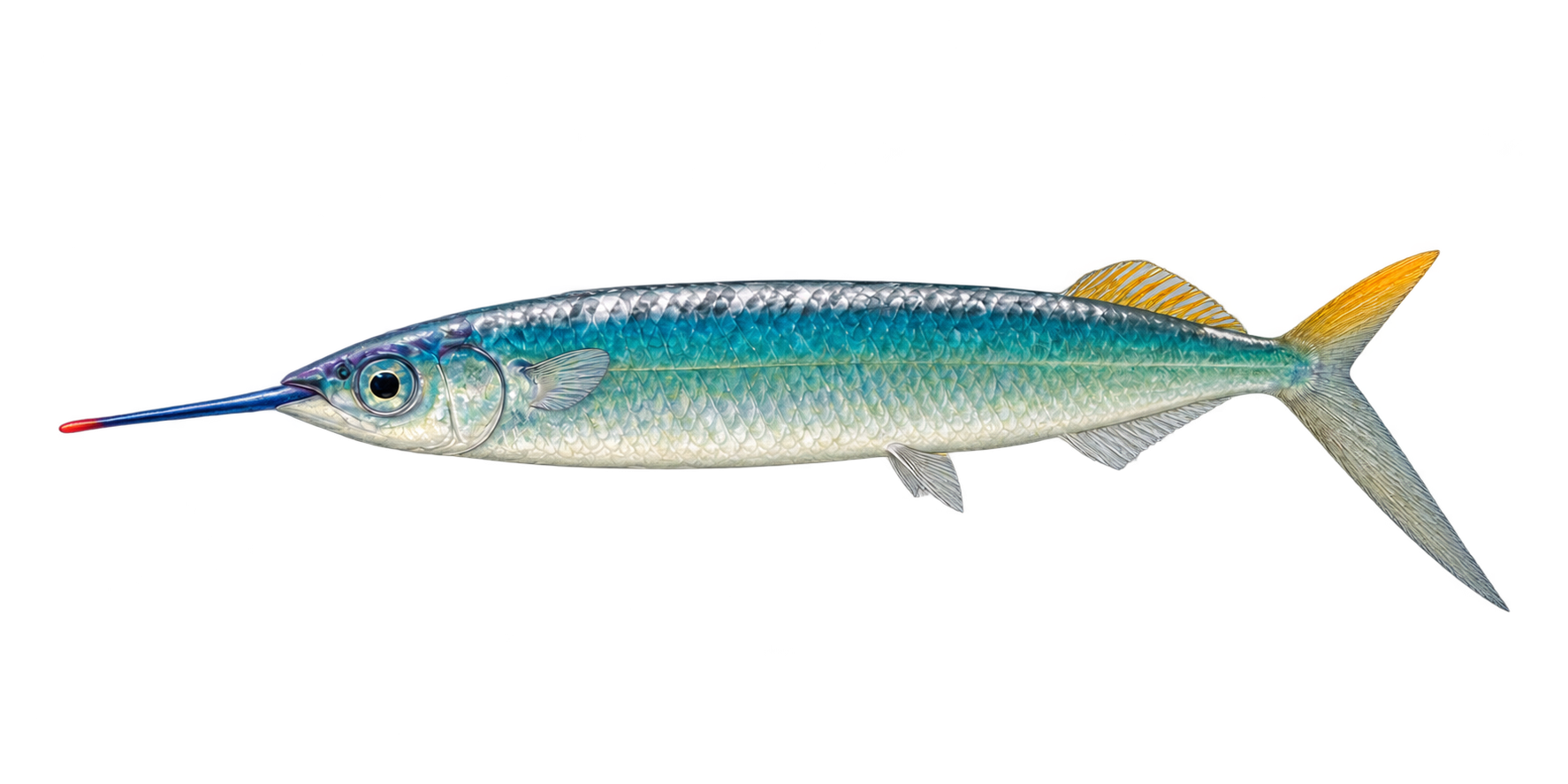
A slender surface fish with a greatly extended lower jaw and short upper jaw. The beak tip is red; the upper tail lobe is yellow-orange and the lower lobe larger.
Sources: Smithsonian STRI: species identification and natural history
Size and life stages
Smithsonian reports a maximum of 41 cm. The entry does not explicitly identify total, fork or standard length for this maximum. Juvenile size and beak development are not documented in the accessed entry.
Sources: Smithsonian STRI: species identification and natural history
Habitat and where to look
Nearshore surface waters. The source tentatively gives 0–5 m, marking the depth with a question mark.
Sources: Smithsonian STRI: species identification and natural history
Range and local context
The Smithsonian range account lists: Both Atlantic shores; Massachusetts to southern Brazil in the west. Local corridor evidence comes from Blue Heron Bridge (WPB) Phil Foster Park, as documented separately in the REEF report.
Sources: Smithsonian STRI: species identification and natural history; REEF volunteer diver surveys: Blue Heron Bridge (WPB) Phil Foster Park
What is on the menu?
The species report lists bony fishes, microscopic bottom algae, larger algae or seagrasses. These categories do not establish local prey proportions or a preference ranking.
Sources: Smithsonian STRI: species-level ecology and reproduction data
Daily habits and behavior
The NOAA Florida Bay monograph describes ballyhoo forming large schools in the coastal water column. Its Florida Bay sampling collected them in surface trawls rather than bottom trawls. This supports watching the upper water column, without promising a school at any particular time or site.
Sources: NOAA: Fishes of Florida Bay
Mating and the next generation
The report lists bottom-associated eggs and a free-swimming larval stage. Courtship details, maturity size and South Florida spawning dates were not established from this account.
Sources: Smithsonian STRI: species-level ecology and reproduction data
Look-alikes and identification traps
Compare halfbeaks using jaw proportions and tail coloration; this account describes a long lower beak but a short upper jaw.
Sources: Smithsonian STRI: species identification and natural history
Observe without disturbing
Keep fins and equipment clear of the bottom and give the animal an unobstructed retreat. Photograph without touching, chasing, feeding, uncovering or repositioning it. Never move shells, reef material or vegetation for a clearer view. An occurrence record is not collection permission.
Rules unverified
Hemiramphus brasiliensis is treated as a baitfish by FWC. Ballyhoo-specific commercial/net provisions exist; they do not establish this recreational trip allowance. Exact recreational quantity, gear and sanctuary permit treatment remains unverified.
This scoped status is not permission to collect or a guarantee of food safety.
Harvest, collection and food status
Checked 2026-11-11.
Harvest status
Rules unverified. Hemiramphus brasiliensis is treated as a baitfish by FWC. Ballyhoo-specific commercial/net provisions exist; they do not establish this recreational trip allowance. Exact recreational quantity, gear and sanctuary permit treatment remains unverified. FWC has default limits for genuinely unregulated species, but this review does not establish that classification for this species. Confirm the scientific name, jurisdiction, method and exact site with FWC/NOAA before take. Unknown does not mean prohibited.
Jurisdiction and closed areas
Vero Beach–Key Largo Atlantic corridor. Florida state waters extend 3 nautical miles offshore; adjacent South Atlantic federal waters have separate rules. Park, sanctuary, method and landing restrictions remain applicable. No trip clearance. Check the exact site before taking fish. The mapped Blue Heron Bridge dive site is closed to marine-life collection, not automatically to every form of fishing. Biscayne National Park prohibits ordinary ornamental collection; NPS describes a superintendent collecting-permit exception. Its mapped 1.74-square-mile area closes to fishing and fish possession March 1–May 31, with properly stowed continuous transit excepted. John Pennekamp allows fishing only in designated areas and has additional collection restrictions. Key Largo Management Area prohibits tropical-fish collection and spearfishing. Sanctuary Preservation Areas prohibit take; other conservation/restoration zones and marked access closures also require checking. These site rules override general species allowances.
Spearfishing
No corridor-wide spearfishing clearance. FWC prohibits spearfishing in state-park waters, within specified distances of swimming beaches, fishing piers and fishing bridges, and in Upper Keys state waters from Long Key north to the Miami-Dade line. Key Largo Management Area has an independent federal spearfishing and equipment-possession restriction.
Food and menu status
Species-matched food-safety advice and a dated, exact-species local restaurant menu were not verified. Menu status is unverified, not evidence that restaurants never serve it. No recipes or safe-to-eat claim.
Official sources
- https://myfwc.com/fishing/saltwater/recreational/marine-life/
- https://flrules.org/gateway/RuleNo.asp?id=68B-42.001
- https://myfwc.com/fishing/saltwater/recreational/unregulated/
- https://myfwc.com/fishing/saltwater/recreational/spearing/
- https://myfwc.com/fishing/saltwater/recreational/bnp/
- https://www.nps.gov/bisc/planyourvisit/fishing.htm
- https://floridakeys.noaa.gov/regs/welcome.html
- https://www.ecfr.gov/current/title-15/subtitle-B/chapter-IX/subchapter-B/part-922/subpart-P/section-922.164
- https://www.floridastateparks.org/parks-and-trails/john-pennekamp-coral-reef-state-park
- https://myfwc.com/fishing/basics/
Identification and source cautions
- Maximum length is not labelled TL, FL or SL in the accessed Smithsonian entry; do not silently assign a measurement convention.
- REEF cumulative sightings are citizen-science reports, not independently verified vouchers, current abundance estimates or encounter guarantees.
- Listed depth spans are species-wide source envelopes, not dive plans or promised local encounter depths.
- The cited account does not resolve every life stage, daily activity pattern or local breeding season. Unverified details remain unstated.
- Source images are reference material; no photo reuse rights are asserted.
- The source marks its 0–5 m depth entry as uncertain.
Sources and review
Reviewed 2026-11-11; biological claims and this representative illustration independently checked. Photographs on cited sites are reference material and are not reproduced here.
Make your next dive happen
Dive With Us
Explore local charters and plan a dive suited to your experience.
View dive calendarTrain With Us
Build your fish identification, buoyancy and diving skills.
Explore trainingTravel With Us
Discover upcoming dive adventures and trip details.
Explore dive travelShop With Us
Browse equipment for your diving and ask our team for help choosing.
Explore dive gearReview current dates, availability, prices, inclusions and requirements on each listing before booking or buying.
Call us now
Ask about marine life identification
Marine Life Identification
Ask about dates, prerequisites or your next step. An inquiry does not reserve a place. Please provide your own contact details; do not include medical, payment or a child's personal information.
We use these details to respond to your inquiry. This form does not sign you up for marketing.
Explore more with Stuart Scuba
Open Water course options · Advanced Adventure training · Technical training · Professional training · All courses · Local dives · Dive trips · Facebook · Instagram · YouTube
Your surface-interval essentials
Questions for Stuart Scuba? info@stuartscuba.com
Check the Stuart Scuba Weather Center · Play scuba trivia
Weather and wildlife vary. Confirm current conditions, trip requirements and departure details with the operator.
Plan Your Next Dive with Stuart Scuba
Dive With Us
Explore upcoming local charters and choose a dive that fits your experience.
Before you book
Check the individual listing for departure time, requirements and availability.
Travel With Us
Find upcoming dive adventures and start planning your next trip.
Plan your trip
Review dates, inclusions and trip details on the travel calendar.
Stay Connected with Stuart Scuba
 Follow pageShare
YouTube
SubscribeWatch & shareFollow on InstagramView & share post
Follow company news, training updates, and dive stories.
Follow on LinkedInGoogle Reviews
See Stuart Scuba’s current Google rating and review count below. Open the listing in Google Maps to browse customer reviews.



