

Fish identification archive / Balloonfish
Balloonfish
Diodon holocanthus
I saw this
Spotted this fish? Share the guide with your dive buddies. Review your caption before posting.
For Instagram, copy the caption and link into your own post or message. Nothing is posted automatically and this does not record a verified sighting.
Fun facts for your next surface interval
- The calm version has its spines folded: no need to request the balloon setting.
- Those unspotted fins help separate it from its porcupinefish look-alike.
- Its shell-crushing beak is a built-in seafood opener.
Palm Beach connection
Lake Worth Lagoon / Blue Heron Bridge, Palm Beach County: Verified local record.
Documented regional presence is not a guarantee of an encounter or a measure of how common this fish is at your dive site.
How to recognize this fish
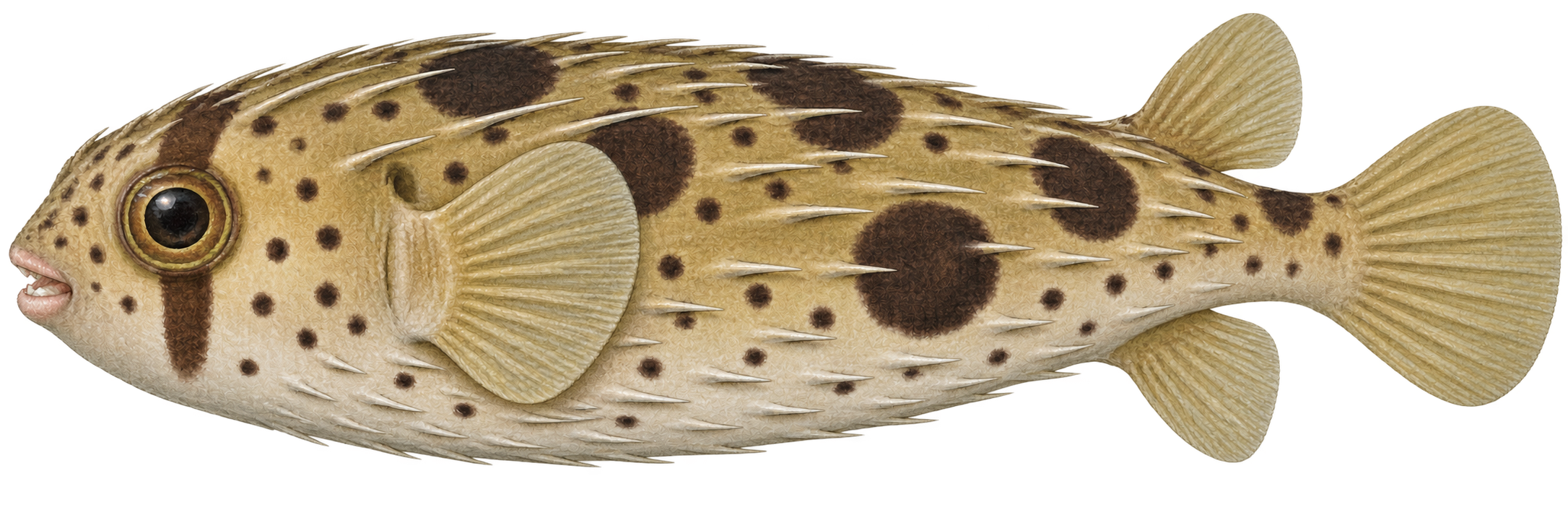
Identify a relaxed balloonfish by its large eyes, rounded body and long spines lying against the skin. Dark blotches dominate the back and sides, with smaller spots between them. A brown bar extends above and below each eye. The fins lack the small dark spots seen on a porcupinefish. Always make the comparison on an uninflated animal; defensive inflation is not needed for identification.
Size and life stages
Field references often describe individuals around 8–14 inches, and the reported maximum is about 20 inches. Different references use different typical lengths, reflecting samples and life stages. Treat these values as broad guidance rather than a size test. Small young fish can have different spotting, so a photograph should include the fins as well as the body.
Habitat and where to look
Balloonfish use shallow reefs, seagrass and other open or rocky bottom habitats. Sheltered crevices can conceal them during daylight. Scan from outside a shelter without inserting hands, lights or camera equipment into it. Finding an animal resting does not justify flushing it out. Its undisturbed position can be a more interesting observation than an exposed swimming shot.
Range and local context
The species has a broad tropical distribution, including Florida and the Caribbean. Lake Worth Lagoon documentation provides a verified local record. This is not an estimate of how many occur there or a guarantee that one will be visible on a daytime dive. Search patiently within the planned route rather than treating the archive as a checklist that must be completed.
What is on the menu?
A strong beaklike mouth crushes hard prey such as mollusks, hermit crabs and sea urchins. Feeding is mainly nocturnal. The seemingly gentle face therefore belongs to a capable predator of small bottom animals. Observe any natural feeding without offering food, picking up shells for it, or presenting your fingers near the mouth.
Daily habits and behavior
Its small fins allow controlled movement around structure. Inflation is a defensive response involving water intake and erection of the long spines, not a trick for divers. A calm fish with folded spines shows the normal shape you should learn first. If your approach changes its behavior, back away and let it resume whatever it was doing.
Mating and the next generation
Eggs and early life stages occur in open water. Young balloonfish can associate with floating vegetation before taking up adult habitats. That journey is a useful reminder that a reef resident's life is not confined to one reef. Do not assume a small fish at the surface is stranded or move it to a different habitat.
Look-alikes and identification traps
Porcupinefish have small spots extending onto the fins, whereas balloonfish fins are unspotted and the body has conspicuous larger blotches. Burrfishes have short spines that stay erect rather than the long folding spines characteristic here. Compare several details in good light. A round outline alone cannot distinguish these related fishes, especially in a hurried or partially hidden view.
Observe without disturbing
Never touch, chase, lift or deliberately inflate a balloonfish. Do not block the entrance to its shelter or use a pointer to make it move. Maintain buoyancy above the substrate and give it a clear escape route. When sharing a sighting, choose an image of the undisturbed fish and describe its natural appearance rather than promoting a defensive response as entertainment.
Harvest, protection and eating safety
Restricted marine life: live collection only; no spearing
Can it be hunted or harvested?
Balloonfish (Diodon holocanthus) is regulated live marine life, not an ordinary food-fishing target. The five-county puffer harvest ban specifically names genus Sphoeroides; do not apply it to Diodon. A recreational saltwater license is required unless exempt; collected fish must be kept alive with suitable aeration or circulation. No species-specific size limit is listed. Limit: five balloonfish within 20 marine-life organisms daily; two-day possession limits apply.
Florida seasons and areas
No recreational closed months are listed. Collection is prohibited at the designated Blue Heron Bridge dive site and in John Pennekamp Coral Reef State Park. Florida marine-life rules extend to adjacent federal waters on both coasts; other protected-area closures also apply.
Can it be speared?
Prohibited. FWC expressly includes this ornamental-fish family in its no-spearing list.
Is it safe to eat?
Do not treat balloonfish as food based on this guide. No species-specific Florida consumption-safety clearance was verified. Being outside the Sphoeroides harvest ban is not evidence of edibility, and cooking is not a general safeguard against marine toxins.
Before you act: This recreational overview is not permission to collect or spear at your dive site. Confirm the species, date, management area, state or federal waters, gear, licenses and current local closures. A fish illustration cannot establish an identification or guarantee seafood safety.
Official rules and health guidance
- FWC: Recreational Marine Life
- Florida Administrative Code: Marine Life, Chapter 68B-42
- FWC: Puffer Fish Prohibition
- FWC: Saltwater Recreational Licenses and Permits
- NOAA: Florida Keys National Marine Sanctuary Zones
- FWC: Spearing
- Florida Department of Health: Eating Healthy Seafood and Local Advisories
- Florida Department of Health: Seafood Poisoning
Reviewed 2026-11-10. Rules and advisories can change; check the linked authorities before harvesting or eating.
Sources and review
Reviewed 2026-11-10.
Make your next dive happen
Dive With Us
Explore local charters and plan a dive suited to your experience.
View dive calendarTrain With Us
Build your fish identification, buoyancy and diving skills.
Explore trainingTravel With Us
Discover upcoming dive adventures and trip details.
Explore dive travelShop With Us
Browse equipment for your diving and ask our team for help choosing.
Explore dive gearReview current dates, availability, prices, inclusions and requirements on each listing before booking or buying.
Call us now
Ask about fish identification training
Reef Fish Identification
Ask about dates, prerequisites or your next step. An inquiry does not reserve a place. Please provide your own contact details; do not include medical, payment or a child's personal information.
We use these details to respond to your inquiry. This form does not sign you up for marketing.
Explore more with Stuart Scuba
Open Water course options · Advanced Adventure training · Technical training · Professional training · All courses · Local dives · Dive trips · Facebook · Instagram · YouTube
Your surface-interval essentials
Questions for Stuart Scuba? info@stuartscuba.com
Check the Stuart Scuba Weather Center · Play scuba trivia
Weather and wildlife vary. Confirm current conditions, trip requirements and departure details with the operator.
Plan Your Next Dive with Stuart Scuba
Dive With Us
Explore upcoming local charters and choose a dive that fits your experience.
Before you book
Check the individual listing for departure time, requirements and availability.
Travel With Us
Find upcoming dive adventures and start planning your next trip.
Plan your trip
Review dates, inclusions and trip details on the travel calendar.
Stay Connected with Stuart Scuba
 Follow pageShare
YouTube
SubscribeWatch & shareFollow on InstagramView & share post
Follow company news, training updates, and dive stories.
Follow on LinkedInGoogle Reviews
See Stuart Scuba’s current Google rating and review count below. Open the listing in Google Maps to browse customer reviews.



