

Fish identification archive / Atlantic Triton’s Trumpet
Atlantic Triton’s Trumpet
Charonia variegata
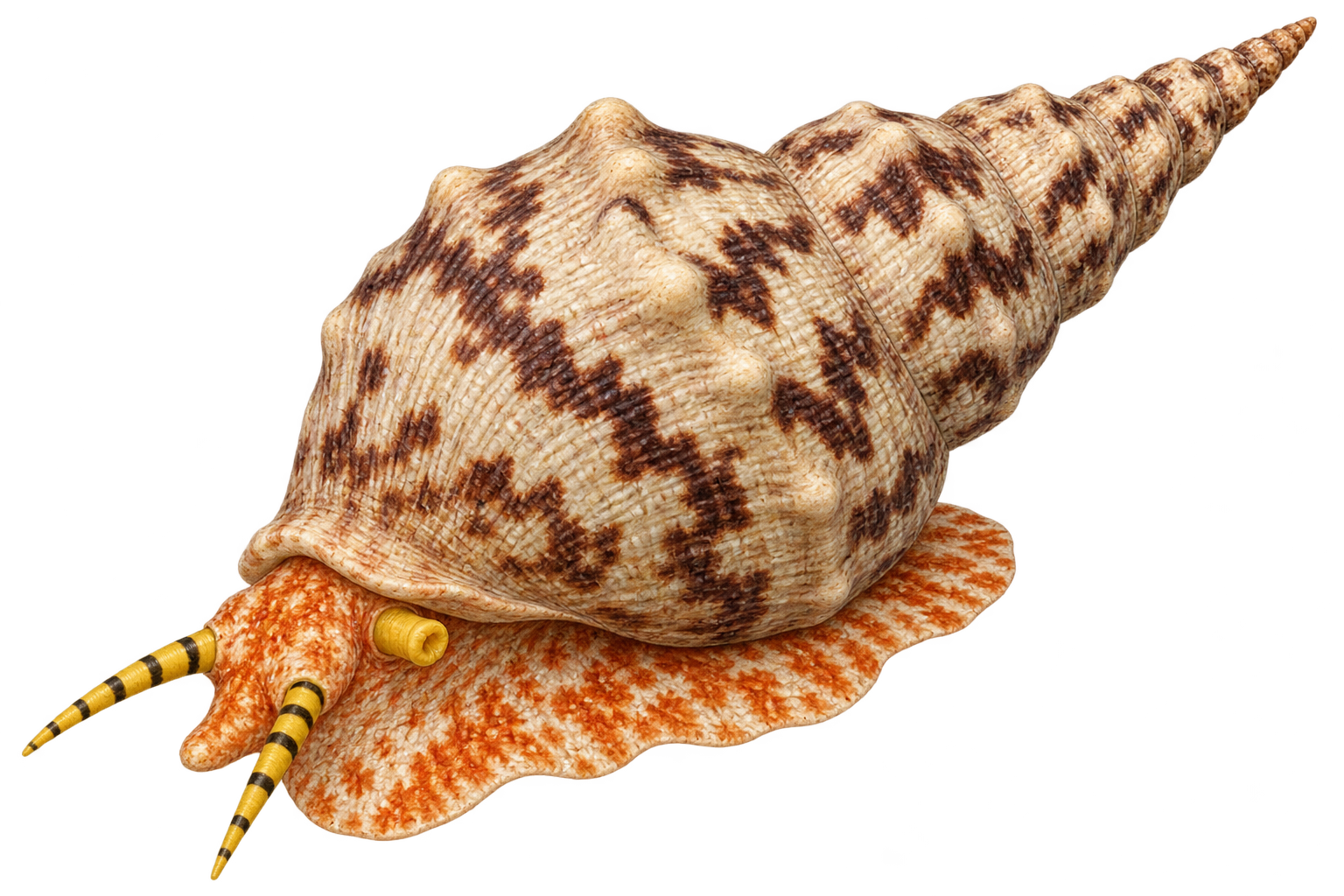
Fun facts for your next surface interval
- Trumpet by name, snail by trade: it is a predatory gastropod, not a musical animal.
- A long planktonic chapter: studied larvae remained pelagic for more than three months.
- Check the doorway: white inner-lip folds and paired outer-lip teeth are identification clues.
Florida and local context
Florida, regional occurrence: Florida Museum specimen 539972-Mollusca from offshore Brevard County; broader Florida, regional rarity not quantified
Documented regional presence is not a guarantee of an encounter or a measure of how common this animal is at your dive site.
How to recognize this animal
Look for a large, heavy shell with an elongated pointed spire, cream-and-brown markings and a broad aperture. The front canal is short. Within the opening, white folds cross a dark inner lip, and paired pale teeth occur on the outer lip over dark patches. A living snail can show yellow-and-black banded tentacles and a mottled orange foot beneath the shell.
Size and life stages
The FAO identification guide gives shell length to thirty-three centimeters, about thirteen inches. Some field accounts describe animals in the twenty-five to thirty-five centimeter range. These are shell measurements, not the total length of a stretched crawling snail. Large size can attract attention, but a small individual should be checked by the aperture, spire and canal rather than rejected automatically.
Habitat and where to look
This is a shallow-subtidal snail associated with reefs and adjacent rocky or mixed bottom. Search exposed margins and naturally visible shelter entrances without reaching into a crevice. Shell surfaces can become encrusted, hiding the cream-and-brown pattern. The aperture and emerging tentacles may then be more useful than the dirty upper shell, provided they can be seen without moving it.
Range and local context
FAO explicitly includes southeastern Florida, the Caribbean, Brazil and Bermuda in its range. A Florida Museum specimen from offshore Brevard County independently confirms Florida collection history. The profile makes no claim of a routine Stuart or Palm Beach encounter. Older literature sometimes combined related Mediterranean or Indo-Pacific tritons, so those records should not automatically expand this Atlantic species’ Florida story.
What is on the menu?
Tritons are predatory gastropods, and Atlantic accounts describe echinoderms, including sea stars and sea cucumbers, among their prey. The animal does not filter food through the trumpet-shaped shell. A snail adjacent to a sea star is not proof that it is feeding, and a diver should never create a staged predator-prey encounter to demonstrate the diet.
Daily habits and behavior
The muscular foot moves the heavy shell over the bottom while the tentacles sample its surroundings. The apparent shell trumpet is simply part of a living snail’s structure, not a sound-producing behavior to test. Encrusting growth can disguise its outline. Patient observation of a naturally emerging animal reveals more than lifting and rotating the shell ever should.
Mating and the next generation
Published larval research identified a prolonged pelagic stage, exceeding three months for the studied Charonia variegata larvae. Those drifting young can disperse far from adult habitat before settlement. That does not establish a precise Florida spawning season or a predictable travel route for an individual. Distinguish the documented larval observation from assumptions about every population’s development time.
Look-alikes and identification traps
True tulips have a comparatively smooth spindle-shaped shell and longer front canal, without the same heavy triton aperture. The Indo-Pacific giant triton, Charonia tritonis, is a different species and should not be added as a second Florida identity from an imported shell or mislabeled photo. Compare aperture folds and teeth, shell sculpture, living animal and verified locality together.
Observe without disturbing
Do not pick up, blow through, tap or clean a living shell. Keep enough room for the foot and tentacles to remain extended naturally, and record whether the observation was a living snail, an empty shell or a shell occupied by another animal. Collection and seafood safety require separate legal and health checks; an identification page is not permission to harvest.
Harvest, protection and eating safety
Shell collection conditional; food caution
Florida state waters: licensed live-shell collection may be lawful, with no species-specific annual closed months identified. Lee prohibits harvest and coastal-water possession; Manatee limits harvest and coastal-water possession to two per species. Parks, refuges, sanctuary zones and federal waters need separate checks. Do not treat the statewide allowance as food-safety clearance. No food recommendation for this species is established here.
This color is a qualified summary, not permission to collect or a guarantee that a particular catch is safe to eat. Read the current rules and health guidance below.
Conditional shell collection; local closures apply
Can it be hunted or harvested?
Atlantic Triton’s Trumpet is not among the gastropod groups listed in Florida’s marine-life rule. FWC’s unregulated-species recreational default applies where collection is otherwise lawful: up to 100 pounds or two organisms of this species per person per day, whichever is greater. That is a legal quantity threshold, not a recommendation to collect it. A Florida saltwater fishing license is required for a live sea shell, including shore collection, unless a statutory exemption applies. No species-specific size limit or separate multi-day possession allowance was identified; do not assume a bag can be multiplied by trip length.
Florida seasons and areas
No species-specific annual recreational closed season is listed in the reviewed Florida shell rules. Lee County prohibits harvest of these living mollusks or echinoderms and prohibits possession in or on county Florida waters seaward of mean high water. Manatee County allows no more than two of this species harvested per day and no more than two in possession in or on county Florida waters seaward of mean high water. State and federal parks, wildlife refuges and Florida Keys sanctuary zones may prohibit collection regardless of the statewide default. Western Dry Rocks is closed to all fishing April 1–July 31. These Florida state-water limits are not a blanket authorization for Atlantic or Gulf federal waters; check the exact federal area and landing rules before collection.
Can it be speared?
Neither this snail nor its family appears as a named prohibited species on FWC’s general spearing list. That omission is not a blanket permission: location-specific restrictions, closed areas and lawful collection rules still apply. For example, spearfishing is prohibited within 100 yards of public bathing beaches, commercial or public fishing piers, or a bridge portion where public fishing is allowed, and in numerous park waters. This guide recommends observation rather than spearing a snail.
Is it safe to eat?
This guide does not establish a Florida food-safety assessment for Atlantic Triton’s Trumpet and does not recommend collecting it for a meal. The fact that some other sea snails are eaten does not establish safety for this species. Check current Florida Department of Health advice and local closures; an unregulated harvest category is not an edibility or toxin-free guarantee.
Before you act: This recreational overview is not permission to collect or spear at your dive site. Confirm the species, date, management area, state or federal waters, gear, licenses and current local closures. Identification artwork cannot establish an identification or guarantee seafood safety.
Official rules and health guidance
- FWC: Recreational Marine Life requirements and regulated groups
- FWC: Recreational Sea Shell Collecting
- FAC 68B-26.002: Living mollusk and echinoderm definition
- FWC: Western Dry Rocks April–July fishing closure
- FWC: Spearing gear and prohibited areas
- Florida Department of Health: Seafood poisoning
- FAC 68B-26.004: Exact Lee and Manatee harvest and in-water possession restrictions
Reviewed 2026-11-10. Rules and advisories can change; check the linked authorities before harvesting or eating.
Sources and review
Reviewed 2026-11-10.
- https://biogator.org/collections/list.php?comingFrom=newsearch&country=United+States%3B+USA%3B+U.S.A.%3B+United+States+of+America&db=16&page=1277&state=Florida
- FAO: Western Central Atlantic gastropod identification guide
- DORIS: Charonia variegata anatomy and biology
- Biological Bulletin: Charonia variegata pelagic larvae study
- FWC: Recreational Sea Shell Collecting
- ITIS: Charonia variegata taxonomy and supporting references
Make your next dive happen
Dive With Us
Explore local charters and plan a dive suited to your experience.
View dive calendarTrain With Us
Build your fish identification, buoyancy and diving skills.
Explore trainingTravel With Us
Discover upcoming dive adventures and trip details.
Explore dive travelShop With Us
Browse equipment for your diving and ask our team for help choosing.
Explore dive gearReview current dates, availability, prices, inclusions and requirements on each listing before booking or buying.
Call us now
Ask about marine life identification
Marine Life Identification
Ask about dates, prerequisites or your next step. An inquiry does not reserve a place. Please provide your own contact details; do not include medical, payment or a child's personal information.
We use these details to respond to your inquiry. This form does not sign you up for marketing.
Explore more with Stuart Scuba
Open Water course options · Advanced Adventure training · Technical training · Professional training · All courses · Local dives · Dive trips · Facebook · Instagram · YouTube
Your surface-interval essentials
Questions for Stuart Scuba? info@stuartscuba.com
Check the Stuart Scuba Weather Center · Play scuba trivia
Weather and wildlife vary. Confirm current conditions, trip requirements and departure details with the operator.
Plan Your Next Dive with Stuart Scuba
Dive With Us
Explore upcoming local charters and choose a dive that fits your experience.
Before you book
Check the individual listing for departure time, requirements and availability.
Travel With Us
Find upcoming dive adventures and start planning your next trip.
Plan your trip
Review dates, inclusions and trip details on the travel calendar.
Stay Connected with Stuart Scuba
 Follow pageShare
YouTube
SubscribeWatch & shareFollow on InstagramView & share post
Follow company news, training updates, and dive stories.
Follow on LinkedInGoogle Reviews
See Stuart Scuba’s current Google rating and review count below. Open the listing in Google Maps to browse customer reviews.



