

Fish identification archive / Atlantic Spadefish
Atlantic Spadefish
Chaetodipterus faber
I saw this
Spotted this fish? Share the guide with your dive buddies. Review your caption before posting.
For Instagram, copy the caption and link into your own post or message. Nothing is posted automatically and this does not record a verified sighting.
Fun facts for your next surface interval
- Leaf costume, no audition required: youngsters can resemble drifting leaves.
- A stingy snack? Jellyfish tentacles can be on the menu.
- The stripes have a retirement plan: adult markings may fade with age.
Palm Beach connection
Lake Worth Lagoon / Blue Heron Bridge: Verified species row in Florida Museum local checklist.
Documented regional presence is not a guarantee of an encounter or a measure of how common this fish is at your dive site.
How to recognize this fish
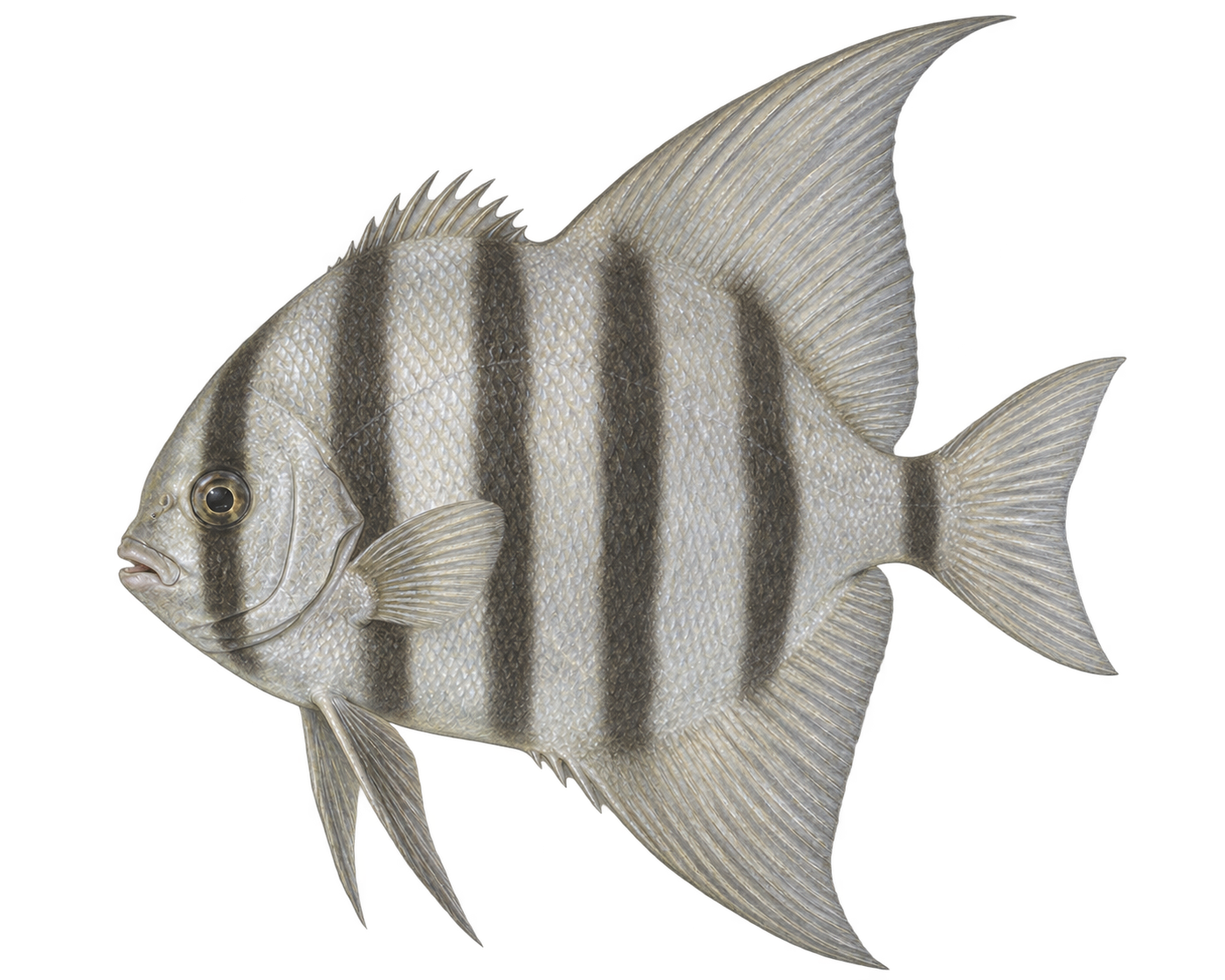
Atlantic Spadefish has a very deep, compressed body, a short blunt snout and a small mouth. Adults are silver-gray with several dark vertical bars, although those markings may fade. Tall pointed soft dorsal and anal fins give the fish its distinctive outline. The low spiny front of the dorsal is separated from the soft portion by a deep notch, rather than being a second unrelated appendage.
Size and life stages
Published maximum sizes are around 91 cm to 1 m, depending on the source. A fish seen on a dive may be considerably smaller. Juveniles are brownish and leaf-like, with different proportions and less obvious adult striping. Do not identify a small dark juvenile solely by comparing it with a large silver adult illustration.
Habitat and where to look
The species uses reefs, bays, inlets and other coastal structure, with sand or rubble nearby. Schools may occur around wrecks or above the reef rather than tucked into a small crevice. Look at the shape of individuals along the school edge, where the long fins and short snout can be seen without the visual confusion of overlapping bodies.
Range and local context
This western Atlantic fish occurs from the U.S. coast through Florida and south into tropical waters. Palm Beach County Diving Association describes local schools of spadefish, and Florida Museum's Lake Worth Lagoon inventory verifies Atlantic Spadefish. These records establish regional occurrence; they do not promise a large school on a specific charter or bridge dive.
What is on the menu?
Food includes bottom-associated invertebrates such as worms, crustaceans, mollusks and attached animals. Plankton and jellyfish tentacles can also be eaten. The small mouth is therefore not evidence of a strictly plant-based diet. Watch what an individual is actually contacting before describing a school as grazing algae or feeding on coral simply because those surfaces are nearby.
Daily habits and behavior
Atlantic Spadefish can form large schools and feed during daylight. A group may look almost like a moving wall when viewed from the side, then become much less conspicuous when individuals turn edge-on. That visual effect follows from the compressed body form. Allow the school to move naturally rather than approaching from several directions to hold it in place.
Mating and the next generation
Spawning produces buoyant eggs that develop in open water, with larvae initially supported by their yolk before active feeding. Published accounts describe seasonal reproduction, but this guide does not use a broad regional calendar as a guaranteed local schedule. The presence of a large school is not, by itself, evidence that spawning is underway.
Look-alikes and identification traps
Angelfishes also have tall, flattened bodies, but their dorsal profile and diagnostic markings differ. Sheepshead share dark bars yet have a longer snout and a different overall fin outline. Juvenile spadefish can resemble drifting plant material. Start with body shape and fin structure, then use bars and color as supporting evidence rather than the only test.
Observe without disturbing
Keep clear of the school's route and avoid swimming into its center for a photograph. Maintain buoyancy above structure and do not feed fish to draw them closer. For identification, try to include the snout, dorsal profile and tail in one natural side view. If the school moves away, let it go rather than turning an ordinary encounter into repeated pursuit.
Harvest, protection and eating safety
Harvest allowed under recreational limits
Can it be hunted or harvested?
Florida state waters: spadefish falls under the default recreational limit of two fish or 100 pounds per person daily, whichever is more. South Atlantic federal waters have a different rule: ten spadefish per person daily within the 20-fish snapper-grouper combined aggregate. There is no listed minimum size.
Florida seasons and areas
No regular species-specific closed season is listed. Offshore Atlantic protected areas and any emergency closure can still restrict fishing. The Florida state default is not the federal Atlantic bag limit; verify the water you will fish.
Can it be speared?
Spearfishing is allowed where the area and gear are lawful. South Atlantic federal rules prohibit using rebreathers for this fishery. Florida exclusions around swimming beaches, fishing piers, bridges and protected areas still apply.
Is it safe to eat?
Atlantic spadefish has Florida DOH mercury consumption guidance. Check the current advisory for the catch location and the person eating it rather than assuming unlimited meals are safe. Keep the catch chilled and cook fish to 145°F; proper cooking does not remove mercury.
Before you act: This recreational overview is not permission to collect or spear at your dive site. Confirm the species, date, management area, state or federal waters, gear, licenses and current local closures. A fish illustration cannot establish an identification or guarantee seafood safety.
Official rules and health guidance
- FWC default recreational limits
- SAFMC Atlantic spadefish rules
- SAFMC recreational aggregate limits
- FWC spearfishing restrictions
- Florida DOH linked fish-advisory booklet
- Florida DOH eating healthy seafood
- Florida DOH local fish advisory search
- FDA safe seafood handling
- FDA/EPA questions about mercury and preparation
Reviewed 2026-11-10. Rules and advisories can change; check the linked authorities before harvesting or eating.
Sources and review
Reviewed 2026-11-10.
Make your next dive happen
Dive With Us
Explore local charters and plan a dive suited to your experience.
View dive calendarTrain With Us
Build your fish identification, buoyancy and diving skills.
Explore trainingTravel With Us
Discover upcoming dive adventures and trip details.
Explore dive travelShop With Us
Browse equipment for your diving and ask our team for help choosing.
Explore dive gearReview current dates, availability, prices, inclusions and requirements on each listing before booking or buying.
Call us now
Ask about fish identification training
Reef Fish Identification
Ask about dates, prerequisites or your next step. An inquiry does not reserve a place. Please provide your own contact details; do not include medical, payment or a child's personal information.
We use these details to respond to your inquiry. This form does not sign you up for marketing.
Explore more with Stuart Scuba
Open Water course options · Advanced Adventure training · Technical training · Professional training · All courses · Local dives · Dive trips · Facebook · Instagram · YouTube
Your surface-interval essentials
Questions for Stuart Scuba? info@stuartscuba.com
Check the Stuart Scuba Weather Center · Play scuba trivia
Weather and wildlife vary. Confirm current conditions, trip requirements and departure details with the operator.
Plan Your Next Dive with Stuart Scuba
Dive With Us
Explore upcoming local charters and choose a dive that fits your experience.
Before you book
Check the individual listing for departure time, requirements and availability.
Travel With Us
Find upcoming dive adventures and start planning your next trip.
Plan your trip
Review dates, inclusions and trip details on the travel calendar.
Stay Connected with Stuart Scuba
 Follow pageShare
YouTube
SubscribeWatch & shareFollow on InstagramView & share post
Follow company news, training updates, and dive stories.
Follow on LinkedInGoogle Reviews
See Stuart Scuba’s current Google rating and review count below. Open the listing in Google Maps to browse customer reviews.



