

Fish identification archive / Atlantic Longfin Squid
Atlantic Longfin Squid
Doryteuthis pealeii
I saw this
Spotted this marine animal? Share the guide with your dive buddies. Review your caption before posting.
For Instagram, copy the caption and link into your own post or message. Nothing is posted automatically and this does not record a verified sighting.
Fun facts for your next surface interval
- Its scientific career includes helping researchers understand how nerve impulses work.
- Eight arms plus two feeding tentacles make ten appendages, even when two are tucked away.
- Its eggs come bundled in elongated capsules attached to the bottom, rather than as tiny free-floating squid.
Florida and local context
Off Florida, western Atlantic: Smithsonian specimen record explicitly identifies a Florida collection; not a Palm Beach-specific observation.
Documented regional presence is not a guarantee of an encounter or a measure of how common this animal is at your dive site.
How to recognize this animal
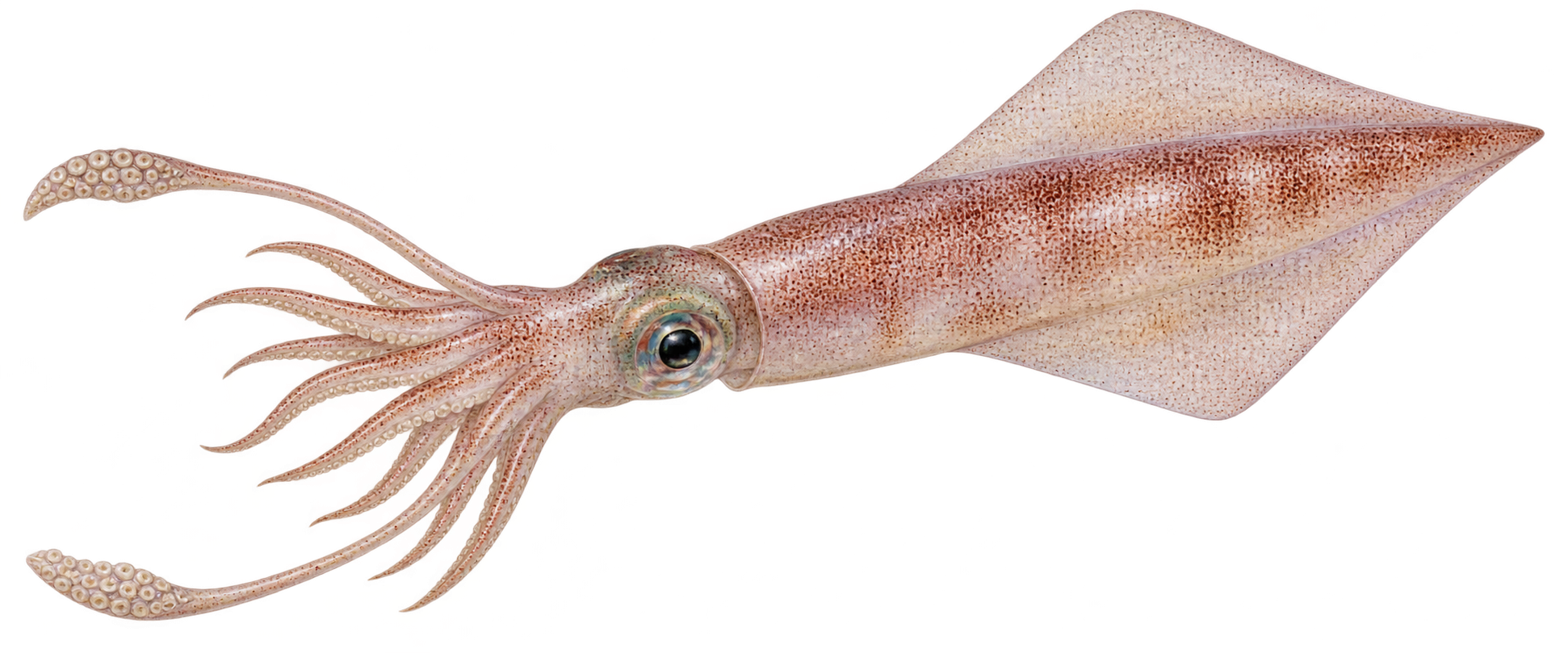
A slender, pointed mantle and paired fins extending along much of its rear half give this squid a streamlined outline. Eight shorter arms surround the mouth, accompanied by two longer feeding tentacles. Skin spots can expand or contract, altering its apparent color in moments.
Size and life stages
The mantle is usually less than 30 centimeters long, with large males reaching about 50 centimeters. That measurement excludes the head, arms and tentacles. Comparing a mantle measurement with another guide’s total length can make the same species appear confusingly different in size.
Habitat and where to look
Longfin squid use coastal and continental-shelf waters over the bottom as well as open water. They are swimming mollusks rather than reef fish. Their occurrence and depth can change with environmental conditions, so a guide entry should not be treated as a year-round shallow-dive forecast.
Range and local context
The species occupies western Atlantic and Gulf waters, including Florida, where a Smithsonian specimen record documents its presence. Much familiar fishery and laboratory research concerns populations farther north. Those northern observations should not be presented as proof of the timing or density of squid schools at Palm Beach.
What is on the menu?
Fish and crustaceans are important prey, with food choices changing as squid grow. The longer tentacles capture prey and bring it toward the arms and beak.
Daily habits and behavior
Jet propulsion provides quick movement, while the fins help with controlled swimming. Squid can change the appearance of their skin and release ink during escape. A sudden ink cloud is a reason to give space, not a photographic effect to provoke deliberately. The muscular mantle works with the funnel to move water for jet propulsion. Fins provide another form of movement, so the animal can alternate between controlled positioning and a fast escape. Its large nerve fibers made this squid especially useful in research on electrical signaling, linking a familiar coastal mollusk with foundational work in neuroscience.
Mating and the next generation
Females attach elongated egg capsules in clusters on the bottom. Hatchlings enter the water column and grow rapidly during a short life. An egg mass is living developing material, not discarded fishing line, so do not touch or remove unidentified gelatinous capsules.
Look-alikes and identification traps
Caribbean reef squid has broader fins running nearly the length of its mantle and a wider, more flattened appearance. The closely related Doryteuthis plei overlaps in southern waters and cannot reliably be separated from this species by a general silhouette.
Observe without disturbing
Watch a natural hunting sequence without using a light or bait to herd prey into the squid’s reach. Keep a diver photograph tentative rather than forcing an identification. Keep a steady position and let the squid choose its distance. Do not chase a school toward the surface or interfere with nearby fishing gear. An attractive transparent animal still needs unobstructed water around it, and maintaining buddy awareness comes before framing the photograph. Dive with Stuart Scuba to explore Florida marine life with an emphasis on careful observation. Ask about current conditions and an appropriate dive plan; wildlife sightings remain unpredictable.
Harvest, protection and eating safety
General Florida harvest rules; no species-specific statewide closed season identified
Can it be hunted or harvested?
Atlantic longfin squid is a squid, not an octopus. It is not included in the octopod live-collection category. In Florida state waters, the reviewed rules indicate the default recreational limit for otherwise unregulated species: 100 pounds or two individuals per person per day, whichever is greater. Lawful hook-and-line squid jigs or appropriate legal nets may be used where permitted. A recreational saltwater fishing license is required unless exempt; a shoreline-only license does not cover collecting while diving.
Florida seasons and areas
No Florida species-specific statewide recreational season or minimum size is listed in the rules reviewed. Federal fishing grounds and protected areas can have different requirements; check the applicable NOAA regulations rather than importing a Northeast commercial squid quota into a Florida recreational trip. Park, refuge and Florida Keys sanctuary zones can prohibit collection even where general state rules allow it. Check the exact site and current boundaries before any take. Under FAC 68B-26, “live shellfish” includes living mollusks, including this species even without a visible external shell. Lee County prohibits harvest and possession in county waters seaward of mean high water. Manatee County limits harvest to two of a species per day and possession to two of that species in those waters. Do not use a general statewide limit to bypass these county rules.
Can it be speared?
No species-specific statewide spearing ban was identified in the reviewed rules. Spearing is still prohibited in restricted areas, including within 100 yards of public swimming beaches, public fishing piers and bridge sections where public fishing is allowed. Hand collection or an appropriate lawful net is the practical choice for this animal; do not damage coral or live rock.
Is it safe to eat?
A legal catch is not automatically safe food. Use only a correctly identified, lawfully sourced animal from waters without relevant health warnings, keep seafood cold, prevent cross-contamination and cook thoroughly. FDA recommends 145°F for most seafood. People who are pregnant, older, immunocompromised or serving young children should avoid raw or undercooked seafood. Cooking does not remove every marine toxin.
Before you act: This recreational overview is not permission to collect or spear at your dive site. Confirm the species, date, management area, state or federal waters, gear, licenses and current local closures. Identification artwork cannot establish an identification or guarantee seafood safety.
Official rules and health guidance
- FWC: Unregulated Species and Default Limits
- FWC: Recreational Marine Life
- FAC 68B-42.001: restricted-species definitions (LII reproduction; current effective date checked against official FAC index)
- FWC: Saltwater Recreational Licenses and Permits
- NOAA: Current South Atlantic Fishing Regulations
- NOAA: Florida Keys Sanctuary Marine Zones
- FWC: Spearing and Restricted Areas
- FDA: Selecting and Serving Seafood Safely
- Florida Department of Health: Seafood Poisoning
- Florida Administrative Code: Southwest Florida Shells, Chapter 68B-26
- FAC 68B-26.002: live shellfish definition (LII reproduction)
- FAC 68B-26.004: Lee and Manatee restrictions (LII reproduction)
Reviewed 2026-11-10. Rules and advisories can change; check the linked authorities before harvesting or eating.
Sources and review
Reviewed 2026-11-10.
Make your next dive happen
Dive With Us
Explore local charters and plan a dive suited to your experience.
View dive calendarTrain With Us
Build your fish identification, buoyancy and diving skills.
Explore trainingTravel With Us
Discover upcoming dive adventures and trip details.
Explore dive travelShop With Us
Browse equipment for your diving and ask our team for help choosing.
Explore dive gearReview current dates, availability, prices, inclusions and requirements on each listing before booking or buying.
Call us now
Ask about marine life identification
Marine Life Identification
Ask about dates, prerequisites or your next step. An inquiry does not reserve a place. Please provide your own contact details; do not include medical, payment or a child's personal information.
We use these details to respond to your inquiry. This form does not sign you up for marketing.
Explore more with Stuart Scuba
Open Water course options · Advanced Adventure training · Technical training · Professional training · All courses · Local dives · Dive trips · Facebook · Instagram · YouTube
Your surface-interval essentials
Questions for Stuart Scuba? info@stuartscuba.com
Check the Stuart Scuba Weather Center · Play scuba trivia
Weather and wildlife vary. Confirm current conditions, trip requirements and departure details with the operator.
Plan Your Next Dive with Stuart Scuba
Dive With Us
Explore upcoming local charters and choose a dive that fits your experience.
Before you book
Check the individual listing for departure time, requirements and availability.
Travel With Us
Find upcoming dive adventures and start planning your next trip.
Plan your trip
Review dates, inclusions and trip details on the travel calendar.
Stay Connected with Stuart Scuba
 Follow pageShare
YouTube
SubscribeWatch & shareFollow on InstagramView & share post
Follow company news, training updates, and dive stories.
Follow on LinkedInGoogle Reviews
See Stuart Scuba’s current Google rating and review count below. Open the listing in Google Maps to browse customer reviews.



