

Fish identification archive / Atlantic horseshoe crab
Atlantic horseshoe crab
Limulus polyphemus
Fun facts for your next surface interval
Florida and local context
Florent Charpin’s species gallery identifies the photographed animal as Limulus polyphemus and explicitly captions the photograph Blue Heron Bridge, Florida. This is a source-labeled photograph, not an independently reidentified voucher or a current sighting guarantee.
A documented past record does not establish present abundance or guarantee an encounter.
Sources: Named-site photograph: source identification, not independently reidentified
How to recognize this animal
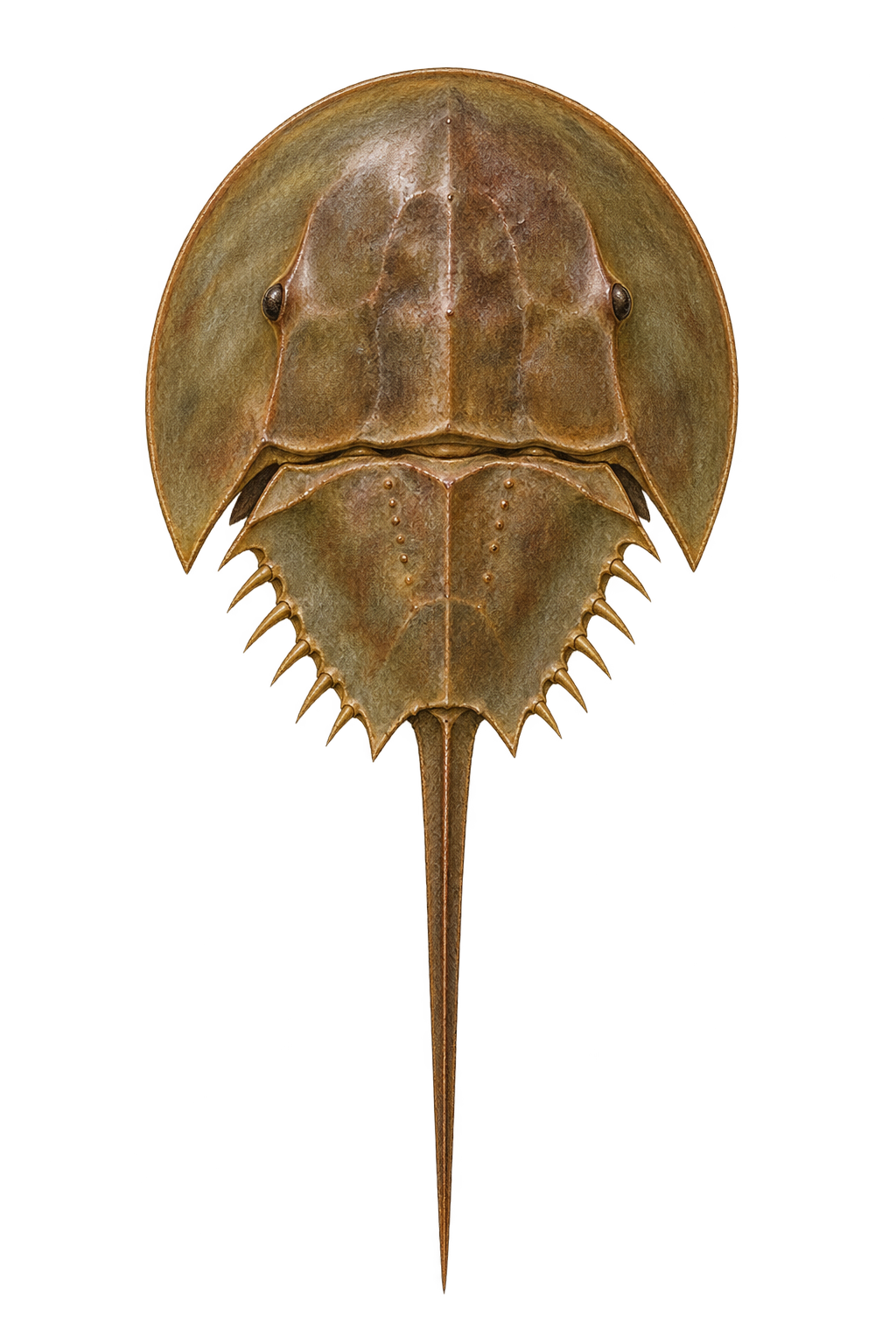
A broad, rounded front shield, smaller spiny rear shield and long pointed tail make a distinctive outline. The legs and mouth lie underneath, so a top view conceals much of the animal.
Sources: FWC: American horseshoe crab
Size and life stages
Adult females are larger than males. This profile does not supply a maximum because shell width, body length and length including the tail are different measurements; do not compare them as if interchangeable.
Sources: FWC: American horseshoe crab
Habitat and where to look
Look on shallow coastal bottoms, including sandy and muddy areas. Nesting animals use shorelines. The Blue Heron Bridge record is an underwater photograph, not evidence of a breeding beach.
Sources: FWC: American horseshoe crab
Range and local context
The Atlantic species occurs along the eastern North American coast and in the Gulf region. A source-labeled Blue Heron Bridge photograph provides the specific local evidence used here.
Sources: FWC: American horseshoe crab
What is on the menu?
Bottom-dwelling worms, mollusks and other small animals form its diet. Food is worked by structures at the bases of the legs rather than by a conspicuous external jaw.
Sources: FWC: Horseshoe crab facts
Daily habits and behavior
The tail helps the animal right itself. It is not a venom-injecting stinger. Leave an underwater animal free to move without turning it over for a photograph.
Sources: FWC: Horseshoe crab facts
Mating and the next generation
Florida nesting can occur throughout the year, with spring and fall peaks. Eggs buried along the shore become food for birds and fishes as well as the next generation of horseshoe crabs.
Sources: FWC: American horseshoe crab
Look-alikes and identification traps
This animal is not a true crab: it belongs to the chelicerate lineage. Do not identify every empty shield on shore as a recently dead animal; a shed shell can retain a remarkably complete outline.
Sources: FWC: Horseshoe crab facts
Observe without disturbing
Observe without lifting or dragging the animal. Never use the tail as a handle. Give paired or spawning animals room and avoid trampling shoreline nesting habitat.
Sources: FWC: Horseshoe crab facts
Harvest, protection and eating safety
Recreational harvest prohibited
Red identifies a verified Florida recreational prohibition, not an assertion that all permitted scientific or commercial collection is banned.
This color is a qualified summary, not permission to collect or a guarantee that a particular animal is safe to eat.
Can it be hunted or harvested?
Limulus polyphemus is explicitly identified by the FWC prohibition. Commercial or biomedical authorizations are separate and are not recreational allowances.
Florida seasons and areas
No recreational open season is established: FWC explicitly prohibits recreational harvest. Check the mapped site before any take. Blue Heron Bridge closes listed marine-life collection, not all county fishing. Biscayne prohibits ornamental collection without a superintendent permit and has a mapped March 1–May 31 fishing/possession closure effective in 2026, with a stowed continuous-transit exception. Pennekamp disallows tropical-fish collection and spearfishing. Key Largo Management Area prohibits tropical-fish take, marine-invertebrate take except specified lobster/stone-crab activities, and spearfishing. Sanctuary Preservation Areas prohibit fishing/collection except expressly stated exceptions. These are site rules, not whole-corridor bans.
Can it be speared?
Do not spear or otherwise take recreationally. FWC restricts spearfishing near public swimming beaches, fishing piers/bridges, jetties and in state parks. The Long Key-north Monroe restriction concerns state waters; Key Largo Management Area has a separate prohibition. Federal location alone is not clearance.
Is it safe to eat?
No food-safety clearance, recipe or meal frequency is established. Consult current Florida Health guidance for the animal, capture site and consumer. A legal allowance does not establish that a catch is safe to eat. No dated species-matched local menu evidence was verified.
Limulus polyphemus is explicitly identified by the FWC prohibition. Commercial or biomedical authorizations are separate and are not recreational allowances.
This review covers the Vero Beach–Key Largo Atlantic corridor: Indian River, St. Lucie, Martin, Palm Beach, Broward, Miami-Dade and Monroe counties. Florida Atlantic state waters and South Atlantic federal waters are distinct jurisdictions. Do not extend a state-water season tag to federal waters or transfer Atlantic rules to Gulf-side Keys waters. Park and sanctuary boundaries can override a species allowance.
Before you act: Confirm the species, date, exact management area, state or federal waters, gear, licenses and current local closures. A local occurrence record never grants permission to take an animal.
Official rules and health guidance
- FWC current recreational marine-life table
- FAC current marine-life definition landing page; full text not exposed
- FAC current closed-area rule landing page
- FWC current spearing methods and location restrictions
- NOAA-hosted historical explanatory spearing boundary brochure; not standalone current law
- NOAA current management-area tropical fish, invertebrate and spear restrictions
- NOAA current sanctuary preservation area restrictions
- Florida State Parks Pennekamp brochure; official indexed text
- NPS current Biscayne fishing and collection rules
- FWC current Biscayne mapped closure, effective March 2026
- Florida Health seafood toxin advice
- Florida Health consumption advice
- FWC species profile: recreational harvest prohibited
Reviewed 2026-11-11. Rules and advisories can change; check the linked authorities before acting.
Identification and source cautions
- A chelicerate, not a crustacean. The broad benthic-invertebrate scope includes it.
- The local identification is the cited photographer or publisher’s identification; it has not been independently reidentified from a specimen.
- Broad range or non-Florida research does not establish abundance, spawning dates or encounter probability at this Florida site.
- Unverified species-specific details are identified in the relevant section rather than inferred from related animals.
Sources and review
Biology and taxonomy reviewed 2026-11-11. Photographs on cited sites are reference material and are not reproduced here.
Make your next dive happen
Dive With Us
Explore local charters and plan a dive suited to your experience.
View dive calendarTrain With Us
Build your fish identification, buoyancy and diving skills.
Explore trainingTravel With Us
Discover upcoming dive adventures and trip details.
Explore dive travelShop With Us
Browse equipment for your diving and ask our team for help choosing.
Explore dive gearReview current dates, availability, prices, inclusions and requirements on each listing before booking or buying.
Call us now
Ask about marine life identification
Marine Life Identification
Ask about dates, prerequisites or your next step. An inquiry does not reserve a place. Please provide your own contact details; do not include medical, payment or a child's personal information.
We use these details to respond to your inquiry. This form does not sign you up for marketing.
Explore more with Stuart Scuba
Open Water course options · Advanced Adventure training · Technical training · Professional training · All courses · Local dives · Dive trips · Facebook · Instagram · YouTube
Your surface-interval essentials
Questions for Stuart Scuba? info@stuartscuba.com
Check the Stuart Scuba Weather Center · Play scuba trivia
Weather and wildlife vary. Confirm current conditions, trip requirements and departure details with the operator.
Plan Your Next Dive with Stuart Scuba
Dive With Us
Explore upcoming local charters and choose a dive that fits your experience.
Before you book
Check the individual listing for departure time, requirements and availability.
Travel With Us
Find upcoming dive adventures and start planning your next trip.
Plan your trip
Review dates, inclusions and trip details on the travel calendar.
Stay Connected with Stuart Scuba
 Follow pageShare
YouTube
SubscribeWatch & shareFollow on InstagramView & share post
Follow company news, training updates, and dive stories.
Follow on LinkedInGoogle Reviews
See Stuart Scuba’s current Google rating and review count below. Open the listing in Google Maps to browse customer reviews.



