

Fish identification archive / Atlantic Guitarfish
Atlantic Guitarfish
Pseudobatos lentiginosus
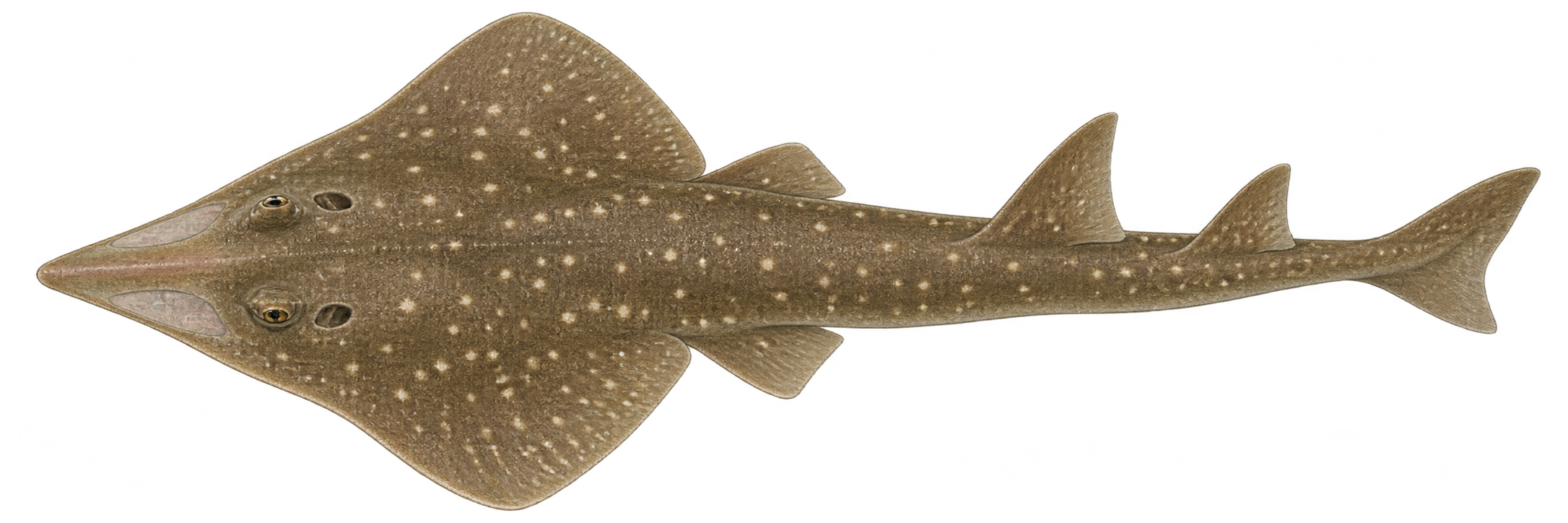
Fun facts for your next surface interval
- An underwater instrument shape: its body outline resembles a guitar, with a flattened front and a long muscular tail.
- Read the tail: two obvious dorsal fins on the tail help distinguish it from a typical stingray.
- Same fish, newer name: older records may call the same Florida species Rhinobatos lentiginosus rather than Pseudobatos lentiginosus.
Florida and local context
Documented New Smyrna Beach museum specimen; broader Florida coastal species: FWC supports Florida occurrence, and Harvard MCZ specimen MCZ:Ich:36408 documents New Smyrna Beach. The historical specimen is not a claim of present-day local abundance.
Documented regional presence is not a guarantee of an encounter or a measure of how common this animal is at your dive site.
How to recognize this animal
An Atlantic guitarfish looks like a ray joined to a shark-shaped tail. Its flattened, pointed head and pectoral disc lead into a thick rear body with two distinct dorsal fins. The tan to brown upper surface carries pale freckles, and translucent patches can show beside the snout. It lacks the long barbed whip characteristic of many stingrays.
Size and life stages
The species reaches roughly 30 inches (75 centimeters) in total length, measured from the snout through the tail rather than across the disc. Newborns are about 8 inches (20 centimeters). Its long tail makes total length a different measurement from the disc width used for most rays in this guide. Do not compare those numbers as though they measure the same shape.
Habitat and where to look
Atlantic guitarfish favor sandy or muddy coastal bottom, often in shallow water but also down to around 100 feet (30 meters). They can lie partly buried with the eyes and spiracles exposed. A quiet patch of sand may therefore hold more than it first appears to. Look carefully without brushing sediment away or probing for a hidden animal.
Range and local context
Florida occurrence is supported by FWC’s species account and a Harvard Museum of Comparative Zoology specimen from New Smyrna Beach. That is concrete regional evidence, not a current Palm Beach abundance estimate. The species also occurs elsewhere in the western Atlantic and Gulf. A museum locality establishes a past record, not the availability of an animal on today’s dive.
What is on the menu?
Small bottom animals, including mollusks, shrimp and fishes, form the diet. The flattened front end helps the guitarfish work close to the seabed, and prey may be pinned or manipulated near the snout. A feeding observation is best made without disturbing the sediment. Do not uncover buried invertebrates or offer food to make the animal move.
Daily habits and behavior
Unlike a broad-winged stingray that propels itself mainly with its disc, a guitarfish swims with substantial help from its muscular tail. It can alternate between resting on the bottom and moving over it. The sharklike rear half is a useful clue even when the head is partly hidden, but a buried animal should be left undisturbed.
Mating and the next generation
Atlantic guitarfish give birth to live young, with small litters reported up to about six pups. Males have claspers beside the pelvic fins; external color is not a dependable way to separate the sexes. Pups already share the basic guitar-shaped outline. Detailed reproductive timing is not well established enough here to assign a Florida-wide breeding calendar.
Look-alikes and identification traps
Stingrays usually have a thinner whip-like tail, often with a defensive spine, rather than this thick tail with two obvious dorsal fins. Skates have a different disc and tail arrangement. Other guitarfishes require attention to snout proportions and pattern. The current name is Pseudobatos lentiginosus; older Florida records under Rhinobatos lentiginosus refer to the same species.
Observe without disturbing
Keep fins and hands off the bottom around a resting guitarfish. A photograph from a natural oblique angle can show the pointed snout, pale freckles and both tail dorsals without uncovering it. Record total length only as an estimate unless measured through a permitted research method. Do not pick up the animal to confirm that it lacks a stingray barb.
Harvest, protection and eating safety
Harvest conditional; food safety unverified
Florida state waters: default harvest, license and lawful-location/gear rules apply; no species-specific annual state closed months were identified. Federal and local restrictions require separate checks. This review does not establish species-specific eating safety, and FDA advice for skate must not be substituted.
This color is a qualified summary, not permission to collect or a guarantee that a particular catch is safe to eat. Read the current rules and health guidance below.
Harvest may be allowed; default limits and site rules apply
Can it be hunted or harvested?
In Florida state waters, the reviewed default recreational limit is two fish or 100 pounds per person per day, whichever is greater, unless a special rule applies. No species-specific statewide minimum size was identified. Use lawful gear and the required saltwater fishing license unless exempt. This does not authorize collection at a dive site.
Florida seasons and areas
No species-specific annual Florida state-water closed months were identified in the reviewed rules. That is not an all-waters opening: park, sanctuary, refuge and local restrictions can apply. Verify the actual location, current notices and any federal rules for the trip before harvest.
Can it be speared?
Potentially allowed where otherwise lawful, because this species is not on FWC’s no-spearing list. Bag and site rules still apply. Spearing is prohibited within 100 yards of public swimming beaches, public or commercial fishing piers, and bridge portions open to public fishing, with additional area restrictions. No powerheads, bangsticks or rebreathers. This is not permission to spear at Blue Heron Bridge.
Is it safe to eat?
No blanket safe-to-eat claim is made. Check current Florida DOH species, catch-area and population-specific advice before eating a lawfully retained ray. Do not substitute FDA’s skate category for this species or assume that a lack of a prominent advisory establishes safety.
Before you act: This recreational overview is not permission to collect or spear at your dive site. Confirm the species, date, management area, state or federal waters, gear, licenses and current local closures. Identification artwork cannot establish an identification or guarantee seafood safety.
Official rules and health guidance
- FWC default recreational limits and lawful gear
- FWC saltwater recreational licensing
- FWC prohibited species, gear and spearing locations
- Florida DOH current fish-consumption advisory portal
- FDA advice about eating fish
Reviewed 2026-11-10. Rules and advisories can change; check the linked authorities before harvesting or eating.
Sources and review
Reviewed 2026-11-10.
- Harvard MCZ specimen record: documented New Smyrna Beach locality
- Smithsonian Shorefishes: diagnostic anatomy, habitat and range
- FWC species account: Florida occurrence and biology
- Florida Museum species account: anatomy and life history
- UF/IFAS Florida Sea Grant: claspers and shark/ray reproductive anatomy
- Eschmeyer’s Catalog of Fishes: current taxonomy and synonymy
Make your next dive happen
Dive With Us
Explore local charters and plan a dive suited to your experience.
View dive calendarTrain With Us
Build your fish identification, buoyancy and diving skills.
Explore trainingTravel With Us
Discover upcoming dive adventures and trip details.
Explore dive travelShop With Us
Browse equipment for your diving and ask our team for help choosing.
Explore dive gearReview current dates, availability, prices, inclusions and requirements on each listing before booking or buying.
Call us now
Ask about marine life identification
Marine Life Identification
Ask about dates, prerequisites or your next step. An inquiry does not reserve a place. Please provide your own contact details; do not include medical, payment or a child's personal information.
We use these details to respond to your inquiry. This form does not sign you up for marketing.
Explore more with Stuart Scuba
Open Water course options · Advanced Adventure training · Technical training · Professional training · All courses · Local dives · Dive trips · Facebook · Instagram · YouTube
Your surface-interval essentials
Questions for Stuart Scuba? info@stuartscuba.com
Check the Stuart Scuba Weather Center · Play scuba trivia
Weather and wildlife vary. Confirm current conditions, trip requirements and departure details with the operator.
Plan Your Next Dive with Stuart Scuba
Dive With Us
Explore upcoming local charters and choose a dive that fits your experience.
Before you book
Check the individual listing for departure time, requirements and availability.
Travel With Us
Find upcoming dive adventures and start planning your next trip.
Plan your trip
Review dates, inclusions and trip details on the travel calendar.
Stay Connected with Stuart Scuba
 Follow pageShare
YouTube
SubscribeWatch & shareFollow on InstagramView & share post
Follow company news, training updates, and dive stories.
Follow on LinkedInGoogle Reviews
See Stuart Scuba’s current Google rating and review count below. Open the listing in Google Maps to browse customer reviews.



