

Fish identification archive / Atlantic glasseye
Atlantic glasseye
Heteropriacanthus cruentatus
Fun facts for your next surface interval
- A snapper in name only: Despite the common name glasseye snapper, it is a bigeye-family fish rather than a true snapper.
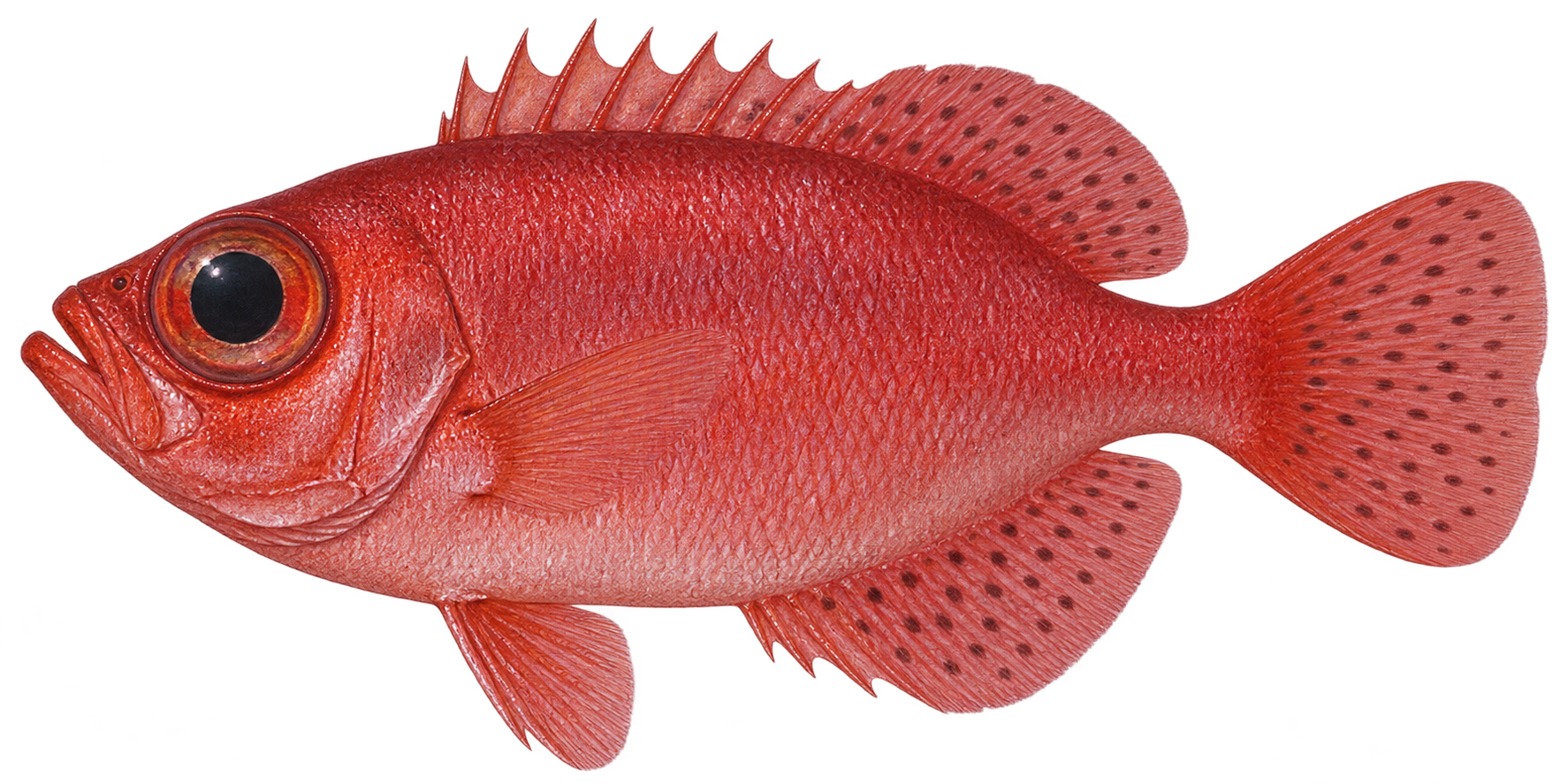
- Polka-dot fins: Oval dark marks on three rear fins help separate it from Atlantic bigeye.
- Same nickname, different ocean: The Atlantic and Indo-Pacific glasseyes are different species in the reviewed taxonomy.
Florida and local context
Reported in REEF diver surveys at Blue Heron Bridge (WPB), Phil Foster Park. Cumulative survey records document occurrence, not a guaranteed encounter or present-day abundance.
Documented regional presence is not a guarantee of an encounter or a measure of how common this animal is at your dive site.
How to recognize this animal
Atlantic glasseye have a deep oval body, very large eyes and an oblique upturned mouth. They are often pink to red, including the fins and iris, but can also be silvery with reddish blotches. Oval dark specks on the soft dorsal, anal and tail fins are a key clue. The tail is slightly rounded, and the lower jaw tip sits approximately at the body's midline.
Size and life stages
Smithsonian reports a maximum of 51 cm, about 20 inches. That figure is a species maximum, not a size prediction for a South Florida dive. A full-grown reference should not be reduced and labeled a juvenile without a separate check of juvenile anatomy. Small fin markings can disappear in a distant photograph, so their apparent absence may reflect image quality rather than identity.
Habitat and where to look
The species inhabits reefs, including shallow reef habitat, and occupies water near structure as well as the adjacent water column. The compiled range starts at 5 m and reaches 432 m. These records describe biological occurrence, not safe dive limits or equal use of every depth. Regional inclusion should not be interpreted as a promise that the fish is easy to find in a particular shallow refuge.
Range and local context
This is an Atlantic species occurring on both sides of the ocean; the reviewed western range extends from New Jersey to Argentina. Smithsonian has South Florida occurrence points, supporting regional eligibility. Indo-Pacific records are excluded from this Atlantic identity. Reported in REEF diver surveys at Blue Heron Bridge (WPB), Phil Foster Park. Cumulative survey records document occurrence, not a guaranteed encounter or present-day abundance.
What is on the menu?
Smithsonian lists small fishes, cephalopods, bottom-living crustaceans and pelagic crustaceans among its foods. The account identifies both carnivory and plankton feeding. These categories describe a broader diet than a claim that it eats only fish. A close mouth portrait cannot establish the actual prey of an individual, and feeding should never be staged for a photograph.
Daily habits and behavior
Color can range from rich red to silver-pink, sometimes with irregular red bars or blotches and yellowish fins. For identification, prioritize the rear-fin specks and rounded tail over the overall color. The reviewed sources do not establish a detailed South Florida activity schedule or local group size. Record whether a fish was alone, near shelter or in open water rather than supplying those details by assumption.
Mating and the next generation
The species data identify pelagic eggs and larvae, placing early development in the water column. The reviewed Atlantic sources do not establish a local breeding calendar or a guarded nest. Avoid importing reproductive details from an Indo-Pacific fish under the same common name: Atlantic glasseye is Heteropriacanthus cruentatus, while the Indo-Pacific sister species is H. carolinus.
Look-alikes and identification traps
Atlantic bigeye, Priacanthus arenatus, lacks the oval dark specks on the rear fins and has a slightly concave tail. Its lower jaw projects higher relative to the body midline. Those combined differences are more informative than their shared red color and large eyes. The name glasseye snapper is misleading for family identification: this fish belongs to Priacanthidae, not the true snapper family Lutjanidae.
Observe without disturbing
Observe from outside reef shelter and keep illumination brief enough to avoid repeatedly disturbing the fish. Do not reach into a crevice or move other animals to expose the tail. Save a broadside frame if the fish offers one naturally. An uncertain large-eyed red fish should remain uncertain when the fin pattern cannot be resolved.
Harvest, protection and eating safety
Default recreational regime outside closed areas; Pennekamp harvest and possession prohibited
Yellow means collection or harvest is conditional on current rules and location. It is not permission to harvest or an assurance that the fish is safe to eat.
This color is a qualified summary, not permission to collect or a guarantee that a particular catch is safe to eat. Read the current rules and health guidance below.
Can it be hunted or harvested?
This species belongs to Priacanthidae, not the true snapper family Lutjanidae. Florida’s default recreational limit applies: two fish or 100 pounds per person per day, whichever is more, subject to licensing, lawful gear and area restrictions. This is neither unlimited harvest nor a food-safety clearance. John Pennekamp Coral Reef State Park is an important exception: taking, killing or possessing Priacanthidae is prohibited there.
Florida seasons and areas
No species-specific statewide seasonal closure is established in the designation and default rules. At Pennekamp, Priacanthidae take, kill and possession prohibition applies year-round. Check sanctuary zones, Biscayne rules, Blue Heron collection restrictions and all local mapped boundaries for the intended activity. Western Dry Rocks closes to fishing April 1–July 31; Biscayne’s designated bonefish area closes March 1–May 31 with its stated transit exception.
Can it be speared?
Not permitted at Pennekamp. Elsewhere, default lawful-gear rules may allow spearing only where harvest and the location are lawful; do not treat this as a dive-site permission. Monroe County from Long Key north to Miami-Dade, relevant parks, beach/pier/bridge and jetty buffers impose additional restrictions. No powerheads, bangsticks or rebreathers.
Is it safe to eat?
No reliable species-specific meal allowance or safety clearance established. Do not borrow snapper guidance solely from the glasseye snapper common name or confuse Atlantic and Indo-Pacific glasseye species. No blanket safe-to-eat assurance. Consult current Florida DOH advice for the exact fish, capture water and consumer, particularly pregnancy, nursing and children; this guide does not establish a species-specific meal allowance. Legal harvest and normal appearance do not establish food safety.
Blue Heron Bridge is an observation site: marine-life harvest is prohibited within the designated dive-site boundary. A local occurrence record is not permission to collect or spear.
Before you act: This recreational overview is not permission to collect or spear at your dive site. Confirm the species, date, management area, state or federal waters, gear, licenses and current local closures. Identification artwork cannot establish an identification or guarantee seafood safety.
Official rules and health guidance
- FWC marine-life taxon and Pennekamp applicability; commercial quotas NOT adopted
- Codified marine-life designation list
- Official marine-life designation registry
- Codified Florida reef-fish list
- Current federal species tables
- Codified Pennekamp prohibition
- Official Pennekamp rule registry
- FWC default recreational limits
- FWC recreational marine life
- NOAA Keys sanctuary zones
- FWC Western Dry Rocks closure
- FWC Biscayne National Park regulations
- FWC spearing restrictions
- Florida DOH fish consumption guidance
- Florida DOH seafood poisoning
Reviewed 2026-11-11. Rules and advisories can change; check the linked authorities before harvesting or eating.
Sources and review
Reviewed 2026-11-11.
Make your next dive happen
Dive With Us
Explore local charters and plan a dive suited to your experience.
View dive calendarTrain With Us
Build your fish identification, buoyancy and diving skills.
Explore trainingTravel With Us
Discover upcoming dive adventures and trip details.
Explore dive travelShop With Us
Browse equipment for your diving and ask our team for help choosing.
Explore dive gearReview current dates, availability, prices, inclusions and requirements on each listing before booking or buying.
Call us now
Ask about marine life identification
Marine Life Identification
Ask about dates, prerequisites or your next step. An inquiry does not reserve a place. Please provide your own contact details; do not include medical, payment or a child's personal information.
We use these details to respond to your inquiry. This form does not sign you up for marketing.
Explore more with Stuart Scuba
Open Water course options · Advanced Adventure training · Technical training · Professional training · All courses · Local dives · Dive trips · Facebook · Instagram · YouTube
Your surface-interval essentials
Questions for Stuart Scuba? info@stuartscuba.com
Check the Stuart Scuba Weather Center · Play scuba trivia
Weather and wildlife vary. Confirm current conditions, trip requirements and departure details with the operator.
Plan Your Next Dive with Stuart Scuba
Dive With Us
Explore upcoming local charters and choose a dive that fits your experience.
Before you book
Check the individual listing for departure time, requirements and availability.
Travel With Us
Find upcoming dive adventures and start planning your next trip.
Plan your trip
Review dates, inclusions and trip details on the travel calendar.
Stay Connected with Stuart Scuba
 Follow pageShare
YouTube
SubscribeWatch & shareFollow on InstagramView & share post
Follow company news, training updates, and dive stories.
Follow on LinkedInGoogle Reviews
See Stuart Scuba’s current Google rating and review count below. Open the listing in Google Maps to browse customer reviews.



