

Fish identification archive / Atlantic Calico Scallop
Atlantic Calico Scallop
Argopecten gibbus · Pectinidae
I saw this
Spotted this marine life? Share the guide with your dive buddies. Review your caption before posting.
For Instagram, copy the caption and link into your own post or message. Nothing is posted automatically and this does not record a verified sighting.
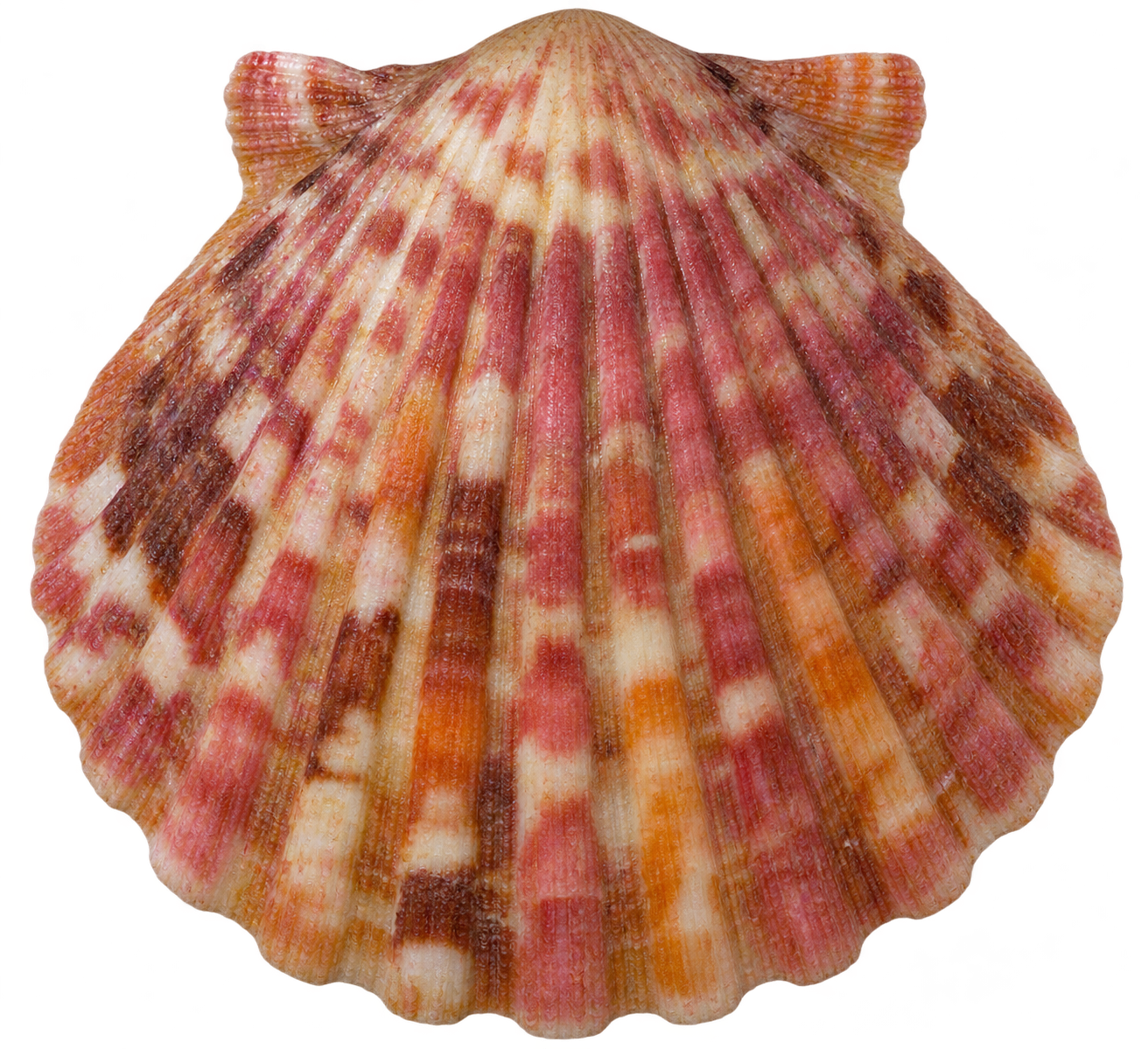
The Atlantic calico scallop, Argopecten gibbus, has a rounded, ribbed shell with small hinge projections. Its upper valve often carries a patchwork of pink, red, orange or brown markings. That variable pattern helps explain the name, but shell shape, ribbing and habitat should be considered together rather than relying on one attractive color combination.
Offshore Florida context
FWC documents calico scallops in deeper waters along both Florida coasts. The well-studied Cape Canaveral bed provides direct east-coast evidence, while the wider distribution includes Florida’s Atlantic coastal waters. This is an offshore sandy- or shelly-bottom species, not the shallow seagrass scallop familiar from recreational bay-scalloping trips.
For a Vero Beach–Key Largo directory, identify the habitat honestly and do not translate a broad range into a promised sighting at a named reef. Deep-water records are ecological information, not encouragement to exceed training, equipment or dive-plan limits. A beach-worn valve also does not establish a living scallop bed at that beach.
Feeding and movement
Calico scallops filter food particles from water passing across their gills. Unlike an attached adult oyster, a scallop can move by rapidly closing its valves and expelling water. Small blue eyes around the mantle edge detect changes such as shadows and movement. Do not provoke repeated swimming for a video.
Reproduction and early life
Adults possess both male and female reproductive organs and release reproductive cells into the water. After a planktonic larval period, young scallops settle and attach to hard material, which can include older scallop shells. FWC describes rapid growth and early reproductive maturity, allowing different size groups to occur in the same bed.
Lookalikes
Calico and bay scallops are related but differ importantly in their usual habitat and shell pattern. A small patterned scallop is not automatically a bay scallop, and a recreational bay-scallop season is not a general season for every scallop species. Photograph the full valve shape and hinge area when possible, using an undisturbed animal or an already empty shell.
Observe and record
Note the bottom type, depth and whether the specimen was alive in place. These details improve the usefulness of a record more than a close-up without context. Keep the animal on its natural bottom and avoid disturbing neighboring shells or sediment.
Before collecting, check current rules for the actual species, waterbody and protected area. General shellfish guidance and bay-scallop regulations cannot be treated as interchangeable. This page is an identification resource and provides no independent harvest authorization.
References
Collection and shellfish safety
Calico scallops are not bay scallops: do not apply a bay-scalloping season or bag limit by analogy. Before any collection, verify species-specific FWC guidance, licenses and local access restrictions. This offshore species profile is not harvest permission or seafood-safety clearance. FWC live-shell collection guidance and FWC hard-clam and oyster rules. Official guidance reviewed November 12, 2026; no location-specific harvest or sanitation clearance is given.
Make your next dive happen
Dive With Us
Explore local charters and plan a dive suited to your experience.
View dive calendarTrain With Us
Build your fish identification, buoyancy and diving skills.
Explore trainingTravel With Us
Discover upcoming dive adventures and trip details.
Explore dive travelShop With Us
Browse equipment for your diving and ask our team for help choosing.
Explore dive gearReview current dates, availability, prices, inclusions and requirements on each listing before booking or buying.
Call us now
Ask about fish identification training
Reef Fish Identification
Ask about dates, prerequisites or your next step. An inquiry does not reserve a place. Please provide your own contact details; do not include medical, payment or a child's personal information.
We use these details to respond to your inquiry. This form does not sign you up for marketing.
Explore more with Stuart Scuba
Open Water course options · Advanced Adventure training · Technical training · Professional training · All courses · Local dives · Dive trips · Facebook · Instagram · YouTube
Your surface-interval essentials
Questions for Stuart Scuba? info@stuartscuba.com
Check the Stuart Scuba Weather Center · Play scuba trivia
Weather and wildlife vary. Confirm current conditions, trip requirements and departure details with the operator.
Plan Your Next Dive with Stuart Scuba
Dive With Us
Explore upcoming local charters and choose a dive that fits your experience.
Before you book
Check the individual listing for departure time, requirements and availability.
Travel With Us
Find upcoming dive adventures and start planning your next trip.
Plan your trip
Review dates, inclusions and trip details on the travel calendar.
Stay Connected with Stuart Scuba
 Follow pageShare
YouTube
SubscribeWatch & shareFollow on InstagramView & share post
Follow company news, training updates, and dive stories.
Follow on LinkedInGoogle Reviews
See Stuart Scuba’s current Google rating and review count below. Open the listing in Google Maps to browse customer reviews.



