

Fish identification archive / Almaco Jack
Almaco Jack
Seriola rivoliana
I saw this
Spotted this marine animal? Share the guide with your dive buddies. Review your caption before posting.
For Instagram, copy the caption and link into your own post or message. Nothing is posted automatically and this does not record a verified sighting.
Fun facts for your next surface interval
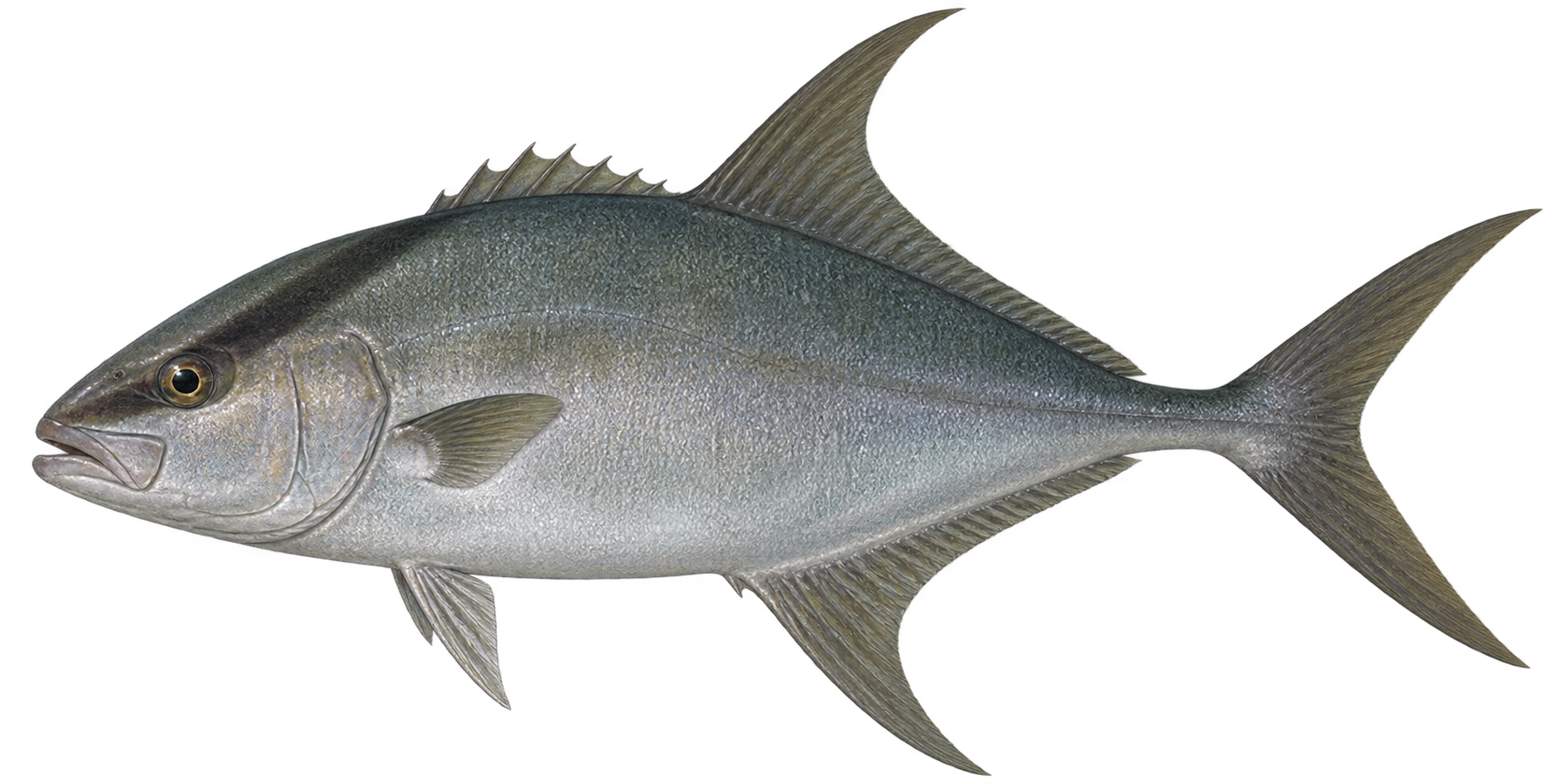
- Its tall second dorsal fin is a useful contrast with the lower profile of a greater amberjack.
- Young almaco jacks can associate with floating objects before using offshore reef habitats.
- Unlike many Caranx jacks, it has no hard scutes along the lateral line.
Florida and local context
Florida regional range; potential Lake Worth Lagoon occurrence: Florida occurrence is documented by the linked species references. The Lake Worth Lagoon checklist includes this species but leaves the Verified cell blank; its lagoon occurrence is treated here as potential, not confirmed.
Documented regional presence is not a guarantee of an encounter or a measure of how common this animal is at your dive site.
How to recognize this animal
The almaco jack is a deep-bodied, high-backed member of Seriola. Its most useful distant feature is the tall, curved leading lobe of the second dorsal fin, accompanied by a pronounced anal-fin lobe. The back is blue-green to olive and the underside silver. An oblique dark band may run through the eye toward the first dorsal.
Size and life stages
Smithsonian records adults reaching at least 63 inches, or 160 centimeters, while noting that much smaller fish are common. Juveniles have a head band and several dark body bars with irregular pale centers. Those bars do not continue onto the dorsal and anal fins. The tall dorsal lobe and body depth become important adult identification features.
Habitat and where to look
Outer reef slopes, offshore banks and the water above them are characteristic habitat. Adults can move between a near-bottom position and the surrounding water column. Young fish often associate with floating objects. Published records extend far deeper than recreational diving limits, so this profile describes biological habitat rather than recommending a depth at which to pursue the species.
Range and local context
Almaco jacks have a broad tropical distribution, with western Atlantic records from Cape Cod to Argentina including Florida. The Lake Worth Lagoon checklist includes the species but leaves it unverified. This regional guide therefore supports Florida occurrence, not a confirmed lagoon sighting. Offshore reef suitability alone cannot establish that one will visit a particular Palm Beach wreck.
What is on the menu?
Fishes dominate the diet, with squid and other invertebrates also recorded. The strong streamlined body allows movement through open water, while the association with reefs and banks offers access to concentrated prey. Watching its position relative to a bait school can be informative, but do not infer a feeding event solely because a jack circles structure.
Daily habits and behavior
Adults often form small groups rather than the dense swarms associated with some smaller jacks. A turning fish offers a useful comparison between its deep body and tall dorsal lobe. The pectoral is relatively short, unlike the long sickle-shaped pectorals of Caranx jacks. Its lateral line also lacks the hard scutes typical of several of those relatives.
Mating and the next generation
The eggs are pelagic, and species references also describe a drifting larval stage. Early fish using floating objects occupy a different setting from adults above outer reefs. No locally verified reproductive calendar is supplied here. A small group of large almaco jacks may be cruising or feeding; group size alone does not identify spawning behavior.
Look-alikes and identification traps
Greater amberjacks are generally more elongated and have a lower second-dorsal lobe. Lesser amberjacks and banded rudderfish introduce further juvenile identification problems. Compare body depth, fin-lobe height and the arrangement of juvenile bars together. A large 'amberjack' silhouette is not a sufficient species identification, especially when different regulations may apply to neighboring species.
Observe without disturbing
Let circling fish approach on their own and keep your attention on depth, current and your buddy. Do not leave a wreck or reef route to follow a departing group into blue water. Capture the entire dorsal outline if possible. Keep any uncertain Seriola identification provisional rather than turning a partial photograph into a harvest decision.
Harvest, protection and eating safety
Harvest may be allowed; limits and site restrictions apply
Can it be hunted or harvested?
In Florida state waters this species is subject to the default recreational limit of two fish or 100 pounds per person per day, whichever is greater, unless a special area rule applies. No statewide species-specific minimum size is listed in the reviewed rules. Use lawful gear and hold the required saltwater fishing license unless exempt. “Unregulated” does not mean unrestricted or permission to harvest at a dive site. South Atlantic federal waters differ: the recreational limit is ten of this species within the 20-fish snapper-grouper aggregate, with no recreational minimum size listed. The state default is not the federal bag limit. Do not apply the commercial 20-inch almaco minimum or the greater-amberjack season to this recreational species. Private-boat anglers and divers age 16 or older targeting this species also need the annual State Reef Fish Angler designation unless a listed vessel or activity exemption applies; ordinary fishing-license exemptions do not necessarily exempt this designation.
Florida seasons and areas
No regular species-specific state-water closed months were identified. The South Atlantic federal recreational season was listed open on 2026-11-10; check current closure notices before a trip. Park, sanctuary and site restrictions still apply. Gulf federal trips require a separate current-rule check rather than applying the South Atlantic aggregate.
Can it be speared?
Potentially yes where otherwise lawful: this species is not on FWC’s no-spearing list. Size, bag, area and gear rules still apply. Spearfishing is prohibited within 100 yards of a public swimming beach, a commercial or public fishing pier, or a bridge portion where public fishing is allowed, and in additional listed areas. No powerheads, bangsticks or rebreathers. This is not permission to spear at Blue Heron Bridge or another dive site.
Is it safe to eat?
Ciguatera has been reported for almaco jack, and mercury guidance also matters. Do not call it universally safe to eat. Consult the current Florida DOH advisory portal for the catch area and consumer group, rather than assuming a meal frequency from an older guide. Cooking or freezing cannot be relied on to remove ciguatera toxin.
Before you act: This recreational overview is not permission to collect or spear at your dive site. Confirm the species, date, management area, state or federal waters, gear, licenses and current local closures. Identification artwork cannot establish an identification or guarantee seafood safety.
Official rules and health guidance
- FWC default recreational bag and legal gear
- SAFMC almaco jack recreational rules
- FWC spearing species and location restrictions
- Florida DOH current fish-consumption advisory portal
- Florida DOH seafood-poisoning guidance
- FDA advice about eating fish
- FishBase almaco jack biology
- FWC saltwater recreational licensing
- FWC State Reef Fish Angler designation
Reviewed 2026-11-10. Rules and advisories can change; check the linked authorities before harvesting or eating.
Sources and review
Reviewed 2026-11-10.
Make your next dive happen
Dive With Us
Explore local charters and plan a dive suited to your experience.
View dive calendarTrain With Us
Build your fish identification, buoyancy and diving skills.
Explore trainingTravel With Us
Discover upcoming dive adventures and trip details.
Explore dive travelShop With Us
Browse equipment for your diving and ask our team for help choosing.
Explore dive gearReview current dates, availability, prices, inclusions and requirements on each listing before booking or buying.
Call us now
Ask about marine life identification
Marine Life Identification
Ask about dates, prerequisites or your next step. An inquiry does not reserve a place. Please provide your own contact details; do not include medical, payment or a child's personal information.
We use these details to respond to your inquiry. This form does not sign you up for marketing.
Explore more with Stuart Scuba
Open Water course options · Advanced Adventure training · Technical training · Professional training · All courses · Local dives · Dive trips · Facebook · Instagram · YouTube
Your surface-interval essentials
Questions for Stuart Scuba? info@stuartscuba.com
Check the Stuart Scuba Weather Center · Play scuba trivia
Weather and wildlife vary. Confirm current conditions, trip requirements and departure details with the operator.
Plan Your Next Dive with Stuart Scuba
Dive With Us
Explore upcoming local charters and choose a dive that fits your experience.
Before you book
Check the individual listing for departure time, requirements and availability.
Travel With Us
Find upcoming dive adventures and start planning your next trip.
Plan your trip
Review dates, inclusions and trip details on the travel calendar.
Stay Connected with Stuart Scuba
 Follow pageShare
YouTube
SubscribeWatch & shareFollow on InstagramView & share post
Follow company news, training updates, and dive stories.
Follow on LinkedInGoogle Reviews
See Stuart Scuba’s current Google rating and review count below. Open the listing in Google Maps to browse customer reviews.



