The Pursuit of Better Trim and Buoyancy
Benjamin Hadfield Apr 27, 2026
The Pursuit of Better Trim and Buoyancy
For me, diving has always been my opportunity for applied progress.
Not perfection. Perfection sounds exhausting, suspiciously religious, and frankly unavailable in my current life package. Progress, though? That I can work with.
Diving gives me a place to practice growth, awareness, discipline, humility, and that rare quiet moment when learning stops being an idea and becomes something you can actually feel in your body. A better breath. A cleaner kick. A calmer stop. One less unnecessary hand flap. Small things, but underwater, small things matter.
That is what trim and buoyancy are to me.
Not a certification card. Not a specialty class. Not a box to check. Not something you master once and keep forever, like a toaster oven or the ability to quote Jaws at exactly the wrong moment.
Trim and buoyancy are living skills. They need maintenance. They need honesty. They need regular check-ins. Left alone too long, they drift. And like most things that drift in diving, eventually someone has to chase them.
I take pride in being able to stay flat, glide cleanly, hold position, and remain still in the water without panic-kicking, hand-sculling, or looking like I am being attacked by an invisible raccoon. But that did not happen by accident. It came from practice, feedback, and a willingness to keep fixing tiny problems before they became big, embarrassing, air-sucking ones.
The agencies may call it “peak performance buoyancy,” “perfect buoyancy,” “neutral buoyancy,” or whatever marketing department had coffee that morning. I do not care much about the name. I care about the pursuit.
Because without constant self-checks, it is easy to drift off course. One extra pound of lead. One lazy descent. One hand movement that becomes a habit. One instructor demonstrating poor form and calling it “good enough.” At first, it does not seem like much. But small mistakes compound.
Diving is very honest that way.
And let me be clear: the water is undefeated.
You can argue with it. You can scull, bicycle-kick, over-inflate, under-vent, twist, grunt, and make very serious diver faces. The water does not care. It will calmly expose every bad habit you brought with you while fish swim past looking deeply unimpressed.
So before we talk about the secrets to great trim and buoyancy, let’s talk about what happens when divers are given bad advice, too much lead, and just enough confidence to become a cautionary tale.
Dive Form Is Everything
Great buoyancy does not start with the inflator button.
It starts with form.
If your body is out of balance, your gear has to compensate. If your gear is compensating, your breathing changes. If your breathing changes, your buoyancy changes. Then your hands come out, your fins start bicycling, and suddenly you are conducting an underwater orchestra nobody bought tickets for.
Instructors often say, “Be flat.” That is not wrong, but it is incomplete. “Be flat” is like telling someone doing yoga to “just balance.” Thank you, Guru Obvious. Now what?
Here is the better visual:
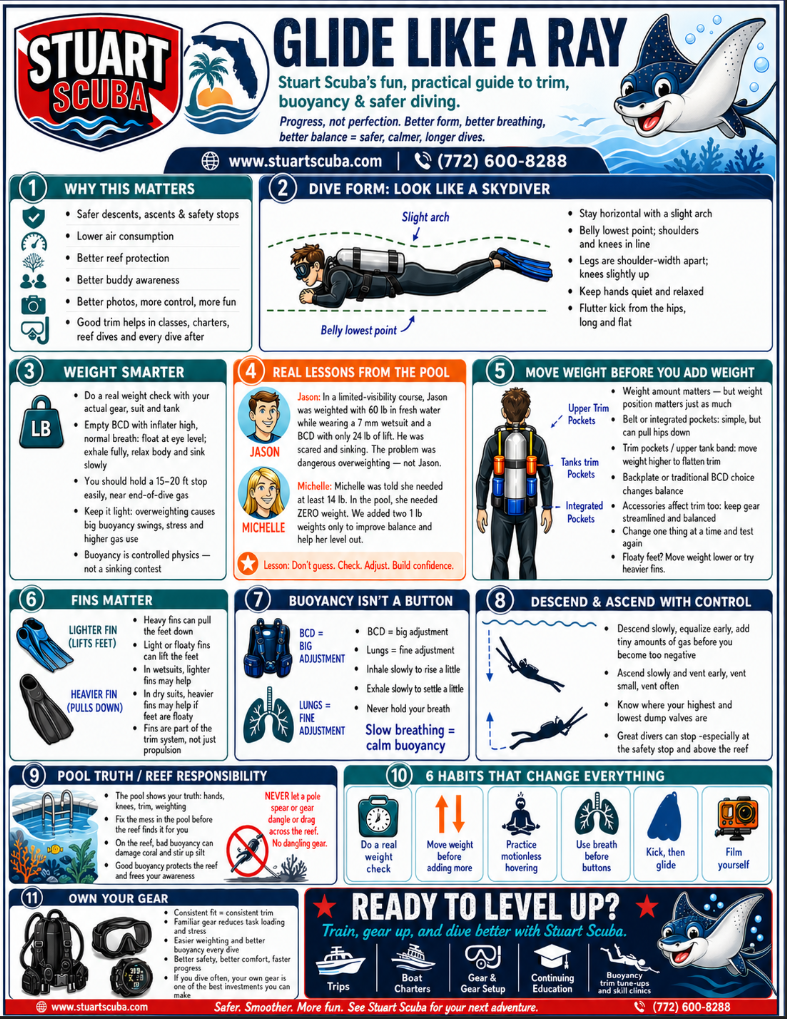
Look like a skydiver.
Your body should be horizontal but relaxed. Your back has a slight arch. Your belly is the lowest point. Your shoulders and knees are roughly in line. Your legs are about shoulder-width apart. Your knees can bend slightly upward behind you. Your head is neutral, not cranked up like someone yelled “free tacos on the boat.”
That shape matters because it creates a stable platform. A stable platform makes buoyancy easier. Easier buoyancy means less effort. Less effort means better gas consumption, better awareness, and fewer moments where your buddy wonders if you are okay or just aggressively interpretive dancing.
When you move, move cleanly. Do not use your hands. Your hands are for communication, gauges, lights, cameras, reels, SMBs, and solving actual problems. They are not emergency fins.
If you flutter kick, kick long, flat, and from the hips. The fins should move behind you, not below you. If you frog kick, open, press, close, and glide. Hold the glide. Let the glide tell you the truth. If you can only stay horizontal while actively kicking, you are not balanced yet. You are just outrunning the problem.
Good divers can move.
Better divers can stop.
Weighting: Stop Wearing the Problem
Weighting may be the most misunderstood part of diving.
Too many divers are taught that weight fixes everything. Trouble descending? Add weight. Nervous student? Add weight. Floaty feet? Add ankle weights. Bad form? Add weight. Strange noise in the compressor room? Probably add weight.
At some point, the diver is no longer wearing ballast. They are wearing a bad decision.
Proper weighting should allow a calm, controlled descent and the ability to hold a shallow stop at the end of the dive with a nearly empty cylinder. It should not make you feel like an anchor with a mask.
The best way to know your proper weight is to check it, not guess it.
Use the same gear, exposure protection, and cylinder type you plan to dive. Ideally, do the check with a nearly empty cylinder or account for the gas you will use during the dive. At the surface, with an empty BCD and a normal breath, you should float around eye level. When you exhale, you should begin to sink slowly. At the end of the dive, you should be able to hold 10–15 feet without fighting to stay down or rocketing to the surface.
Then write it down.
Different suit? Different tank? Salt instead of fresh? Different fins? New check.
The old “percentage of body weight” logic is how divers end up somewhere between “properly weighted” and “small municipal anchor.” That math would personally put me into the category of mooring equipment. No thank you.
In an aluminum 80 with a soft plate or carbon fiber setup, I am often in the 4–6 pound range. With a steel tank, I may be at zero. That is not magic. That is controlled physics, calm breathing, and not trying to solve every issue with lead.
Overweighting is not just inefficient. It can be dangerous.
An overweighted diver has to add more gas to the BCD to become neutral. More gas means bigger buoyancy swings as depth changes. Bigger swings require more corrections. More corrections create more stress. More stress burns more gas.
That is how overweighted divers become gas-sucking pigs.
Not because they are bad divers. Because their system is bad.
Jason and the Sixty-Pound Problem
One story has stayed with me because it is the perfect example of how bad weighting can scare a diver right out of the sport.
Jason came to me after taking a night and limited visibility course. He had been diving in fresh water, wearing a 7 mm wetsuit, and someone had weighted him with 60 pounds.
Sixty.
Pounds.
In fresh water.
With a BCD that had about 24 pounds of lift.
For anyone not enjoying the math, that is like asking a Chihuahua to tow your pickup truck. It is not conservative. It is a cartoon with liability paperwork.
Jason became scared because he was sinking. Of course he was. He was not diving anymore. He was being repossessed by gravity. He could only keep his head above water once he got close enough to shore to touch bottom.
That is not training. That is not “making sure he can get down.” That is creating a dangerous situation and letting the diver believe the fear was his fault.
It was not his fault.
The system was wrong. The weighting was wrong. The thinking was wrong.
And after an experience like that, you do not just remove lead. You rebuild trust. You show the diver that water is not the enemy. You show them that calm, balanced diving is possible. You give them back control.
That is what proper weighting does.
Michelle and the Myth of “At Least Ten Pounds”
Michelle came to me after another instructor had convinced her she needed at least 10 pounds.
“At least” is the part that makes my eye twitch.
“At least 10 pounds” is not instruction. It is a lead subscription plan.
So we took Michelle to the pool and did the radical thing that should have happened in the first place: we checked.
No guessing. No body-weight chart. No ancient scrolls of Somebody Told Me Once.
We checked.
And Michelle needed no weight.
Zero.
None.
She did not need 10 pounds. She needed calm instruction, a proper check, and a chance to let her body and gear tell the truth.
We did eventually add two one-pound weights, but not because she needed them to sink. We added them to balance her trim and bring her head down slightly. That is the point too many divers miss.
Weighting is not just about getting down.
It is about balance.
There is a huge difference between adding weight because a diver cannot descend and placing weight because a diver needs better trim. One is ballast. The other is distribution.
Michelle did not need a pile of lead. She needed two thoughtful pounds in the right place.
That is good diving.
That is good instruction.
And it is much better than throwing lead at the problem like we are seasoning a steak.
Weight Position: Move Weight Before You Add Weight
Once you stop asking only “How much weight?” you can ask the better question:
Where should the weight go?
Two divers can carry the same total weight and behave completely differently because the weight is placed differently. One is flat and calm. The other is feet-down, head-up, kicking constantly, and wondering why the ocean has betrayed them.
The ocean has not betrayed them.
Their weight placement has.
Think of your body and gear as a seesaw. Weight too low or too far back can pull the hips or feet down. Weight too high or too far forward can pull the head and shoulders down. Heavy fins can drag the feet down. Floaty fins can send the feet up. A tank mounted too low or too high can change everything.
So before adding lead, move the lead you already have.
Use weight pockets or a belt for ditchable ballast, but understand that weight around the waist may pull the hips down. Use trim pockets on the tank band when you need weight higher on the body. Moving just two pounds from the waist to an upper cam band can make a diver dramatically flatter.
A steel backplate adds weight high and close to the body. A soft plate or carbon fiber setup may require a little weight elsewhere. Neither is automatically better. The water decides. Your job is to listen.
Accessories matter too. Lights, reels, SMBs, cameras, backup masks, and tools all affect balance. If everything heavy is clipped to one side, do not be shocked when you roll that way. If everything dangles below you, congratulations, you have created drag and possibly a small underwater wind chime collection.
How to diagnose trim problems
Get neutral in a safe place. Get into your skydiver position. Fold your hands. Stop kicking. Breathe normally. Then see what happens.
If your feet drop, check for heavy fins, a low tank, too much weight on the hips, poor posture, or weight that needs to move higher.
If your feet rise, check for floaty fins, dry suit gas in the legs, a tank that is too high, or a need for small lower-body trim adjustment.
If your head drops, check for too much weight high on the system or a tank positioned too high.
If you roll, check for uneven weight or heavy accessories on one side.
Change one thing at a time. Test. Adjust. Test again.
No one is making a dramatic action movie called Two Pounds on the Upper Cam Band, but that is where good diving is built.
Fins Are Part of Trim
Fins are not just engines. They are part of your balance system.
Some fins are heavy and negative. Some are light. Some are neutral. Some are so floaty your feet appear to be seeking political asylum at the surface.
In a wetsuit, heavy fins may pull the feet down. If you are already foot-heavy, lighter fins may help. In a dry suit, floaty feet can be a real issue because gas can migrate into the legs and boots. In that case, heavier fins may help bring the feet down and stabilize the diver.
That does not mean every dry suit diver needs heavy fins or every wetsuit diver needs light ones. It means fins must match the whole system: suit, tank, BCD or wing, backplate, body position, and dive environment.
I have seen divers spend hours changing weight while ignoring fins that were fighting them the whole time. That is like trying to fix your car’s alignment by changing the radio station.
Look at the fins.
They matter.
Buoyancy Is Not a Button
The BCD is a tool. It is not the whole skill.
Good buoyancy is the relationship between weighting, breathing, body position, gear configuration, depth awareness, exposure suit compression, cylinder characteristics, and calm decision-making.
Newer divers often use the inflator like a panic switch. They feel low, so they add air. Then they rise, so they dump. Then they sink, so they add. Then they rise again. Up, down, up, down. Congratulations, you are now an elevator with fins.
Good buoyancy is smaller, slower, and calmer.
Use the BCD for larger changes and your lungs for fine-tuning. Add small amounts of gas before you become a lawn dart. Vent before expanding gas turns your ascent into a surprise space program.
The best buoyancy corrections are often the ones nobody sees.
Breathing: The Fine-Tuning Tool
Your lungs are your most precise buoyancy control device.
That does not mean holding your breath. Never hold your breath while scuba diving. But your breathing pattern can help you rise slightly, settle slightly, and stay still.
Think of the BCD as the coarse adjustment and your lungs as the fine adjustment.
If you are properly weighted and trimmed, a slow inhale should make you rise gently. A slow exhale should let you settle gently. Not launch. Not crash. Just move.
There is a delay, and that delay matters. You inhale, then a moment later you rise. You exhale, then a moment later you settle. New divers often miss the delay. They inhale, nothing happens instantly, so they kick or add air. Then everything catches up and suddenly they are headed upward with the facial expression of someone who has made administrative errors.
Slow down.
Breathe. Wait. Feel what happens.
To rise slightly, inhale slowly and fully, stay still, and wait for the lift. To settle slightly, exhale slowly and completely without forcing it, stay relaxed, and wait for the drop. For a safety stop, keep the breath steady and use tiny BCD adjustments only when breathing is not enough.
This is where buoyancy starts to feel like meditation.
Not because it is mystical, but because it demands presence.
Also because when you do it well, you are calm while everyone else appears to be performing an underwater tax audit.
Descents and Ascents: Do Them Before They Do You
A good descent is not a race to the bottom.
Start calm. Vent the BCD. Exhale to begin descending. Equalize early. Stay with your buddy. Add small amounts of gas as you descend, before you get too negative and start dropping like your warranty expired.
Do not wait until you are falling fast and then blast gas into the BCD. That creates the classic beginner elevator cycle: sink, inflate, rise, dump, sink, repeat until morale declines.
Descend like an elevator with brakes.
Ascents require even more anticipation. As you rise, gas expands in your BCD and exposure suit. If you wait until you feel yourself accelerating, you are already late.
Vent early. Vent small. Vent often.
Know which dump valve is highest based on your body position. Stay horizontal when you can, but position yourself so gas can actually leave the BCD. Use your breathing to help: a longer exhale can slow a slight rise while you vent; a slow inhale can help correct a slight drop at a stop.
Safety stops are where buoyancy should shine. A diver who can hold a stop calmly without bicycling, sculling, or depth yo-yoing has built a real skill.
Pool Work: Where the Truth Has Lane Lines
The pool is one of my favorite places to work on trim and buoyancy because the pool does not lie.
There is no current to blame. No surge. No reef profile. No dramatic ocean soundtrack. Just a diver, some gear, a hard bottom, and the truth.
Ask a diver to hover. Ask them to stop kicking. Ask them to keep their hands still. Ask them to descend slowly and stop at a specific depth. In about three minutes, the little habits show up.
The hands come out.
The knees drop.
The fins bicycle.
The inflator gets squeezed like it owes them money.
That is not failure. That is information.
The pool gives us a safe place to find the mess before the reef does. I would much rather discover in the pool that a diver is overweighted, foot-heavy, head-down, or terrified of sinking than discover it over coral, in current, or on a night dive when everyone’s comfort level is already busy filing a complaint.
A pool session can turn “I am bad at buoyancy” into “Oh, my system was wrong.” Sometimes confidence comes from removing eight pounds of unnecessary lead and moving two pounds to a smarter place.
Reef Work: Where Buoyancy Becomes Responsibility
On the reef, buoyancy is not just personal performance. It is responsibility.
In the pool, bad buoyancy is embarrassing. On the reef, bad buoyancy can be destructive.
A diver who cannot control depth may kick coral, land in sand, stir up silt, grab living structure, or crash into the exact thing they came to admire. Usually they are not trying to do harm. They are just so busy surviving the dive that they have no awareness left for the environment.
That is one of the biggest costs of poor trim and buoyancy: it steals awareness.
When a diver is properly weighted, balanced, and breathing calmly, their world opens up. They see the reef. They see their buddy. They see their depth. They see their gas. They see the turtle before it leaves a strongly worded review.
When a diver is fighting buoyancy, their world shrinks to three questions:
Am I going up?
Am I going down?
Why are my hands doing jazz?
Good buoyancy makes better divers, better buddies, better photographers, and better reef guests.
Six Practical Habits for Better Trim and Buoyancy
1. Do a real weight check
Use your actual gear, suit, and cylinder. Check with a nearly empty cylinder or account for gas weight. You should be able to descend calmly and hold a shallow stop at the end of the dive. Write down the result.
2. Move weight before adding weight
If your trim is off, adjust placement first. Move weight higher, lower, forward, or backward. Try trim pockets. Adjust tank height. Look at fins. Do not use extra lead as a personality trait.
3. Practice motionless hovering
In a safe place, get neutral and horizontal. Fold your hands. Stop kicking. Breathe normally. Start with ten seconds. Then thirty. Then a minute. The goal is smaller corrections, not statue cosplay.
4. Use breath before buttons
For small changes, inhale slowly to rise and exhale slowly to settle. Wait for the delayed response. Do not stack inflator use on top of breath changes unless you actually need both.
5. Kick, then glide
Whether you frog kick or flutter kick, stop thrashing. Kick with purpose, then glide. If the glide falls apart, your trim is telling you something.
6. Film yourself
Nothing removes illusion like video. Have someone film you from the side, front, and back while you hover, kick, turn, descend, and stop. What you think you look like underwater and what you actually look like underwater are often two very different documentaries.
Common Mistakes I See Again and Again
I see divers add weight instead of solving problems.
I see divers use their hands constantly and not realize it.
I see divers bicycle-kick vertically while believing they are horizontal.
I see divers crash into the bottom because they were never taught a controlled descent.
I see divers rocket up from safety stops because they waited too long to vent.
I see divers with dangling gear hanging below them like a garage sale.
I see divers who can swim, but cannot stop.
And, most concerning, I sometimes see instructors demonstrate these habits to students.
That matters.
Students copy what they see. If an instructor kneels on the bottom, students learn the bottom is a platform. If an instructor uses their hands constantly, students learn hands are part of propulsion. If an instructor is overweighted, vertical, and unstable, students learn that is normal.
We have to do better.
Good trim and buoyancy should not be advanced skills. They should be foundational skills taught from the beginning.
The Goal Is Not Perfection
The goal is not perfection.
The goal is awareness. Refinement. Honest self-checks. Noticing the one-percent drift before it becomes a completely different course.
Am I balanced?
Am I horizontal?
Am I carrying too much weight?
Is my weight in the right place?
Are my fins helping or fighting me?
Am I using my hands?
Am I breathing calmly?
Am I moving through the water or fighting it?
Am I protecting the environment beneath me?
Am I setting the example I would want a new diver to copy?
That is the work.
And when it all comes together, there is nothing quite like it.
You hover motionless in the water. Your breath slows. Your fins are still. Your hands are quiet. The reef, wreck, spring, wall, or open blue surrounds you, and for a moment, you are not wrestling with the dive.
You are part of it.
That is the magic.
That is the reward.
Not perfection.
Just forward motion toward something better.